
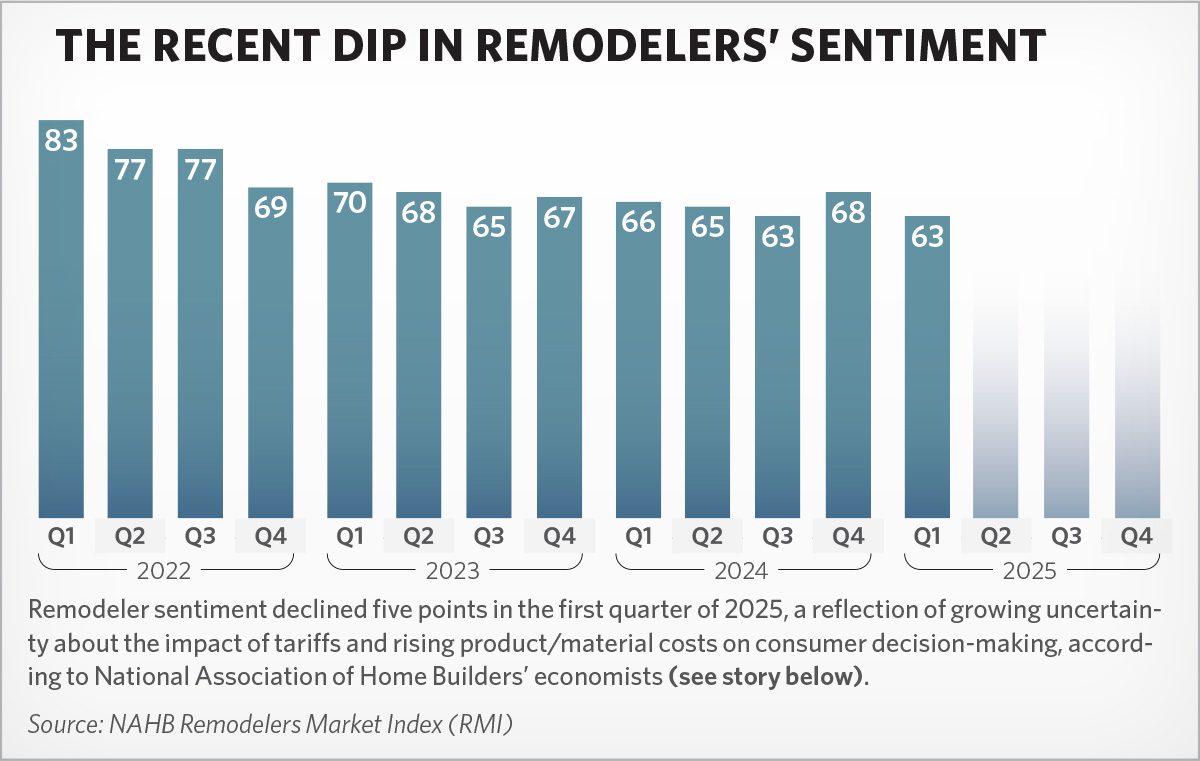
Elevated mortgage rates, rising construction costs, labor shortages and newly imposed tariffs are combining to dampen the 2025 prospects for both new construction and residential remodeling, according to a consensus of housing market analysts. Among the key statistics and forecasts released in recent weeks by government agencies, research firms and industry-related trade associations were the following:
Housing Starts & New Home Sales
The recent decline in housing starts “is a clear signal” that affordability pressures due to elevated interest rates, rising construction costs and labor shortages are intensifying, housing analysts said last month. “Elevated mortgage rates and rising construction costs are making it increasingly difficult to deliver homes at price points accessible to entry-level buyers,” said Buddy Hughes, chairman of the National Association of Home Builders. “Without policy support, addressing the affordability crisis remains an uphill battle.” When asked about the impact of tariffs on their business, 60% of builders reported in April that their suppliers have already increased or announced increases of material prices. On average, suppliers have increased their prices by 6.3% in response to announced, enacted or expected tariffs, according to the NAHB. Builders estimate a typical cost effect from recent tariff actions at $10,900 per home, the trade association added.
Existing-Home Sales
Existing-home sales remain sluggish due to affordability challenges tied to elevated high mortgage rates, the chief economist for the National Association of Realtors reported last month. According to Lawrence Yun of the Washington, DC-based NAR, current market conditions signal “the troublesome possibility of less economic mobility for society.” According to the latest NAR forecast, mortgage rates will average 6.4% in 2025, declining slightly to 6.1% in 2026. The trade association said it expects existing-home sales to rise 6% this year, and accelerate another 11% in 2026. “Home-price growth will moderate due to more supply coming onto the market,” Yun predicted. “A meaningful decline in mortgage rates would help both demand and supply – demand by boosting affordability, and supply by lessening the power of the mortgage rate lock-in effect,” he added. “We expect mortgage rates to slide moderately lower, but the high national debt will prevent rates from falling drastically.”
Residential Remodeling
Annual expenditures for improvements and maintenance to owner-occupied homes are expected to grow modestly through 2026, according to the Leading Indicator of Remodeling Activity, released in April by the Remodeling Futures Program at the Joint Center for Housing Studies of Harvard University. The LIRA projects that year-over-year spending for home renovation and repair will increase 2.5% this year, reaching a record $526 billion by the first quarter of 2026. “Recent increases in the sales of existing homes are expected to drive slow but steady growth in home remodeling and repair,” said Carlos Martín, director of the Remodeling Futures Program at the Cambridge, MA-based Joint Center. “High home values and other strong economic indicators have supported an uptick in homeowner improvement spending. However, economic volatility due to the uncertainty surrounding tariffs and falling consumer confidence could well dampen expected growth.”
Cabinet & Vanity Sales
Sales of kitchen cabinets and bathroom vanities declined in March compared to the same month in 2024, the Kitchen Cabinet Manufacturers Association reported. According to the KCMA’s latest monthly “Trend of Business Survey,” participating manufacturers reported that overall cabinet and vanity sales in March were down 4.0% from the same month a year earlier. Sales declines were reported for stock cabinets (-20.9%), as well as for semi-
custom (-0.5%) and custom units (-0.5%), the KCMA reported. Year-to-date sales through March were down 4.9% compared to the same three-month period a year earlier, the Reston, VA-based KCMA added.
Market Analysis | Report Reflects Consumer Uncertainty, Fueled by Rising Costs
WASHINGTON, DC — Rising homeowner equity and limited opportunities to move into other homes continues to bolster the home-improvement market and keep remodelers’ sentiments positive, although sentiment “is not quite as positive” as it was the previous quarter, “as some remodelers are reporting that uncertainty about tariffs and the direction of the economy are making customers hesitant to spend on larger projects,” according to a new report from the National Association of Homebuilders. KEEP READING