
Smooth food preparation and kitchen clean-up relies heavily on a highly functional sink area. When it comes to design, this space must include operational and aesthetic options tailored to the homeowner’s lifestyle and personality.
In the kitchen, as with the rest of the house, there’s a strong desire for a personalized, customizable experience. “The trend towards individualization reflects the central principle of our time,” stresses Tim Bohmann, director category management, Dornbracht, based in Germany. “Self-determination and self-realization, uniqueness and personal freedom of choice are becoming more of a driving force than ever before. This can also be transferred to the interior sector. Whether with a high-quality mix of materials, colorful elements or different application scenarios, consumers expect a wide range of options to design their kitchen according to their own ideas – including kitchen sinks, faucets and water accessories.”
The sink area needs to be designed for quick, efficient work, whether during prep or clean up. “Enhanced functionality is a trend that’s present and one that will keep growing for years to come. Through our annual consumer research, we’re able to see that consumers crave convenience at all possible angles,” offers Kiran Singh, senior brand manager, Peerless Faucet, a brand of Delta Faucet Company, in Indianapolis, IN.
Aesthetically, styles vary widely as designers work to create spaces unique to the homeowners who will use them. While classic finishes and materials continue to enjoy popularity, consumers are increasingly willing to play with colors and textures.
Workstation sinks, water accessories that increase access and health, and technology that has a real impact are additional trends in the sink space. That’s according to manufacturers recently surveyed by Kitchen & Bath Design News.
Individual Style
Consumers are eager to express their own personality and design style in the kitchen, creating a need for myriad finish and material options, as well as the option to customize accessories and features in the sink area.
“Consumers are looking for faucet designs and colors that reflect their own personal style. In many instances, this combines modern materials with classic styles,” states Becky Wagner, channel manager, kitchen and bathroom faucets, at Kohler, WI-based Kohler Co.
“Customizable accessories for specific areas and usage themes seem to grab the interest of the designers and consumers,” reports Jonathon Chong, lead engineer, industrial design, R&D and analysis at Elkay in Downers Grove, IL.
Jeff Silverstein, CEO at California Faucets in Huntington Beach, CA, says that, rather than a specific style trend, the company has seen a willingness to experiment. “We see a lot more finishes and variety of styles. There’s not one dominant style. It’s been spread across the whole gamut. Traditional, contemporary, transitional and industrial – it all seems to be fair game,” he remarks.
Effective Enhancements
Technology in the kitchen sink and faucet space centers around advancements with a practical advantage.
“Technology is playing a transformative role in shaping trends in these areas, particularly by enhancing functionality, sustainability and convenience,” says Bohmann. “Built-in filtration systems ensure access to clean, safe drinking water.”
“Smart technology continues to be an important trend in kitchen design and function,” adds Wagner. “It has an impact on the environment – dispensing set amounts of water – and allows for efficiency and convenience in the kitchen space.”
Technology that is straightforward and simple allows for the desired personalization. It provides customization for everyday needs, but shouldn’t be an extra chore, offers Chong. These additions need to be low maintenance and hassle free, intuitive and easier to use, he adds.
Chris Lee, president, Lenova Group in Hillside, IL notes that smart chip technology including voice, temperature and volume controls are in demand.
Some manufacturers, however, say less is more. Silverstein says that though there’s a perception that younger generations want to operate everything from their cell phones and have high-tech hands-free faucets, they’ve seen the opposite. “We’ve had zero demand from our customers for technological advancements in the kitchen. There seems to be a want to return to the very tactile, easy to use, intuitive types of products in the kitchen that are very familiar and very comfortable,” he observes. Some of this may stem from hands-free products not being reliable, Silverstein adds. “In the most used appliance in the house, they want it to be trouble free and easy to maintain.”
David Emmons, v.p. at Newport Brass, in Santa Ana, CA, reports that touch and proximity faucets continue to be popular in kitchens, but voice-activated technology has seen limited adoption.
Dawn Robinson, national director of sales & marketing at BOCCHI, in Alpharetta, GA, states that advances in manufacturing are an important technology focus since more consumers understand the different processes used to make different materials. While BOCCHI has always used high-pressure casting to make products as uniform as possible, as well as thinner, stronger and quieter, more people are asking about it now, she remarks. Customers are more educated and want to know how things are created, not just what they look like, she adds.
This increased awareness also leads to demand for products that are eco-friendly. “With water scarcity continuing to be a growing issue, sustainability is extending to home products, with a focus on environmentally friendly manufacturing,” reports Singh. “Water-saving faucets with aerators and precise flow controls are further increasing in popularity.”
Enhanced Utility
As an area used for both prep and clean-up, the sink area must offer practical solutions that make these tasks easier. “In the kitchen, the functionality of materials is an indispensable basic requirement,” says Bohmann.
Demand for high functionality in the sink area has led to an increase in demand for both workstations and integrated faucets and accessories.
Lee notes that stainless steel sinks with integrated faucets for multiple functions are trending, including undermount triple-ledge designs with functional accessories and sinks integrated with a glass rinser, waterfall faucet, pull-down triple spray function faucet, soap dispenser, hot water and drinking water faucet.
A functional drain system is also important, Lee adds. A regular drain leaves water on the bottom of the sink, while a functional bottom water drain system makes water drain faster and completely, he reports.
Robinson notes that the workstation trend has been strong in 2024 and will continue into 2025. People have loved big farmhouse sinks with workstation accessories, she adds, but they are seeing a shift away from that style towards fully undermount fireclay kitchen sinks with built-in workstations. And while people want them in any size, she continues, the majority want them as big as you can make them.
Some trends that began with COVID – such as demand for sophisticated, beautiful, low-maintenance products that make life easier at a reasonable price – have never gone away, Robinson reports. “When [consumers] find something that hits all those areas, that’s what they are going for,” she points out.
Faucets with multiple functions integrated are popular, Lee maintains. These include triple-function spray heads, waterfall functions, a glass rinser, drinking water and hot water, soap dispenser and a touchless sensor.
“Pull-down and pull-out sprayers remain popular for their versatility,” reflects Singh. “With a significant majority of older adults in the U.S. expressing a strong desire to “age in place,” Peerless looks towards a more inclusive kitchen and bath industry.”
Water Access and Filtration
Accessories that make water access easy and healthier are in great demand, manufacturers say.
“Anything having to do with water and healthy water – water dispensers, filtration, instant hot water – all those types of devices have been a real growing market,” notes Silverstein.
“With consumers’ continued focus on health and wellness, kitchen faucet filtration experiences continue to be a key trend with simpler user interaction/interface,” Wagner agrees. “This includes boiling, chilled and sparkling water options.”
Chong states that health and wellness with regard to hydration has been on the rise, especially in the U.S. “The understanding of clean drinking water vs. eco waste is now a big concern for everyone, yet convenience is just as important,” he remarks. More companies are adding all-in-one solutions for safe drinking water to their standard kitchen faucets, he adds.
Alyson Angotti, group product manager, filtration at Elkay, says there are many potential health impacts to the chemicals in standard tap water. “We offer an assortment of products to help homeowners overcome the largest chemicals found within PFAS, PFOA and PFOS,” she emphasizes, including a filter that removes lead, microplastics and more. Their filtered kitchen faucet has a dedicated filter line, meaning only water intended for drinking is filtered.
Aesthetic Appeal
While function is a top concern, aesthetics are no less important. Consumers are playing with color a little more, with a range of style preferences creating demand for a wide array of materials and finishes.
“[Sinks and faucets] should integrate into the overall design concept,” Bohmann stresses. “Stainless steel modules, dark woods and translucent stones with LED lighting are being used more and more frequently, for example. Together with a mix of colors and styles – including gold, glass, leather and fabric – a sophisticated and dynamic atmosphere is created.”
“Industrial-style designs, with features like exposed springs and utilitarian looks are also standing out this year,” reports Singh. Sleek and minimalist designs continue to be in demand for kitchen faucets, she adds. “Aligning with modern and stylish kitchen styles, high-arc and gooseneck shapes, for example, are on the rise due to their striking look, yet functional capabilities.”
Silverstein reflects that traditional styles are now cleaner without a lot of fancy curlicues, and instead have light ornamentation that gives a nod to the traditional looks. He also says that bridge-style faucets, especially in traditional designs when paired with a farmhouse sink, have been strong over the past year.
Warm and Classic
Classic finishes continue to enjoy popularity, and warm, natural finishes are also on the rise. Matte black continues to be a strong preference as well, manufacturers say.
“Classic finishes like black and stainless steel remain timeless favorites due to their versatility and elegance,” offers Bohmann. “At the same time, bronze and gold are becoming increasingly popular, adding warmth and luxury to modern kitchens.”
Silverstein agrees that the classics – such as polished nickel, chrome and satin nickel – remain extremely popular, and matte black has been going strong for several years. He adds that two finishes have been emerging strongly recently: satin bronze, which has passed satin brass as one of the company’s top finishes, and a burnished brass finish that will patina over time.
“The use of unique and diverse metal conditioning techniques is enabling the creation of innovative faucet designs,” comments Emmons. Yellow brass and gold tones have also been on the rise, he adds.
“Matte black and mixed metal designs are on-trend,” says Singh. “These finishes pair well with both modern and transitional kitchens.”
Wagner adds that warm, earthy tones are gaining popularity again in home design. “Rich, warm neutrals create a sophisticated and comfortable space. Earthy hues such as deep bronze and Kohler’s Truffle finish offer a sophistication and richness to kitchen spaces,” she reports.
Playing With Color
The desire to create a look that is unique has led to demand for materials that can bring a touch of color into the space.
Chong believes fireclay and cast iron are more traditional kitchen looks due to their glossy colors, but quartz has been trending up due to its functionality, design uniqueness and color options.
In both stainless and fireclay, Lee adds, color finishes that match appliances, furniture or hardware are in demand. “This makes the kitchen unique and integrated with the home,” he states.
Robinson notes that BOCCHI is seeing more people have fun with color for their sink. Matte finishes in white and black are popular, but in 2024 she saw a rise in biscuit finishes, a tone popular in the 1980s. “People are bringing it back in a very chic way,” she reports. This is driven by countertop materials that lend themselves to natural colors, she believes.
Blues have always been strong for the company, Robinson continues, but BOCCHI is introducing a dark spruce option to coincide with the rise of green tones in the kitchen. The firm is also introducing a gray fireclay option that looks more like concrete.
“Concrete is a wonderful, all-natural material that people love, but it doesn’t make the best kitchen sink,” she explains. The new color is a nod to the firm’s eco-manufacturing processes while giving the customer a finish in a color they want, she adds.
People are looking for materials they can have fun colors in, to personalize the space to their lifestyle. “Fireclay is a material that allows you to do that,” Robinson continues.
Featured Products
Click on product image to request more information.
The Rivera Hammered Brass Bar/Prep Sink from Thompson features rounded edges, a functional square, flat bottom and Thompson’s signature hand-hammered texture. Shown here in Semi-Satin Brass, this design is also available in Copper, Antique Copper, Nickel and Stainless Steel.
Blending architectural details with industrial style, the Torak Commercial Style Pull Down Faucet from Kraus features a sleek modern silhouette with twisted lever handle. The faucet is available in a range of finishes, including a bold split finish featuring matte black and brushed gold accents.
California Faucets has added teak wood to the customization options available for its Descanso Series of kitchen faucets. The solid brass faucet, which features a modern industrial aesthetic, is available in the company’s 25-plus artisan finishes.
The Olympia K-5080 kitchen faucet from Pioneer Industries features magnetic docking for the faucet head and a 7-9⁄16” reach, ideal for smaller spaces, notes the firm. The ADA-compliant faucet is available in Polished Chrome, PVD Brushed Nickel and Black Matte.
Featuring a minimalist design, the Seager Pull-Down Kitchen Faucet from Newport Brass features a dual-functioning head that goes from stream to spray and a magnetic docking system. Made from solid brass, the ADA-compliant faucet is available in over 20 finishes.
The Lenova K224B kitchen faucet, made of T304 stainless steel, showcases a double-function spray head with Neoperl aerator. The faucet features a ceramic cartridge with diamond content for drip-free operation. Featured is Matte Black and Brushed Brass/Gold two-tone with an extra PVD layer.
Crafted in Italy, Dual Spray Faucets from Buster + Punch are constructed from rough-cast and precision-machined solid metal. Levers include cross or linear-knurled versions, both matching the knurled pull-out nozzle that transitions between an aerated flow and precise needle spray.
Premier Copper Products offers a variety of sizes, designs and configurations for its artisan-crafted copper kitchen sinks. Shown is a 33″ Hammered Copper Apron Front Single Basin Kitchen Sink, complete with scroll design and nickel background. Each piece is hand hammered, making them one of a kind.
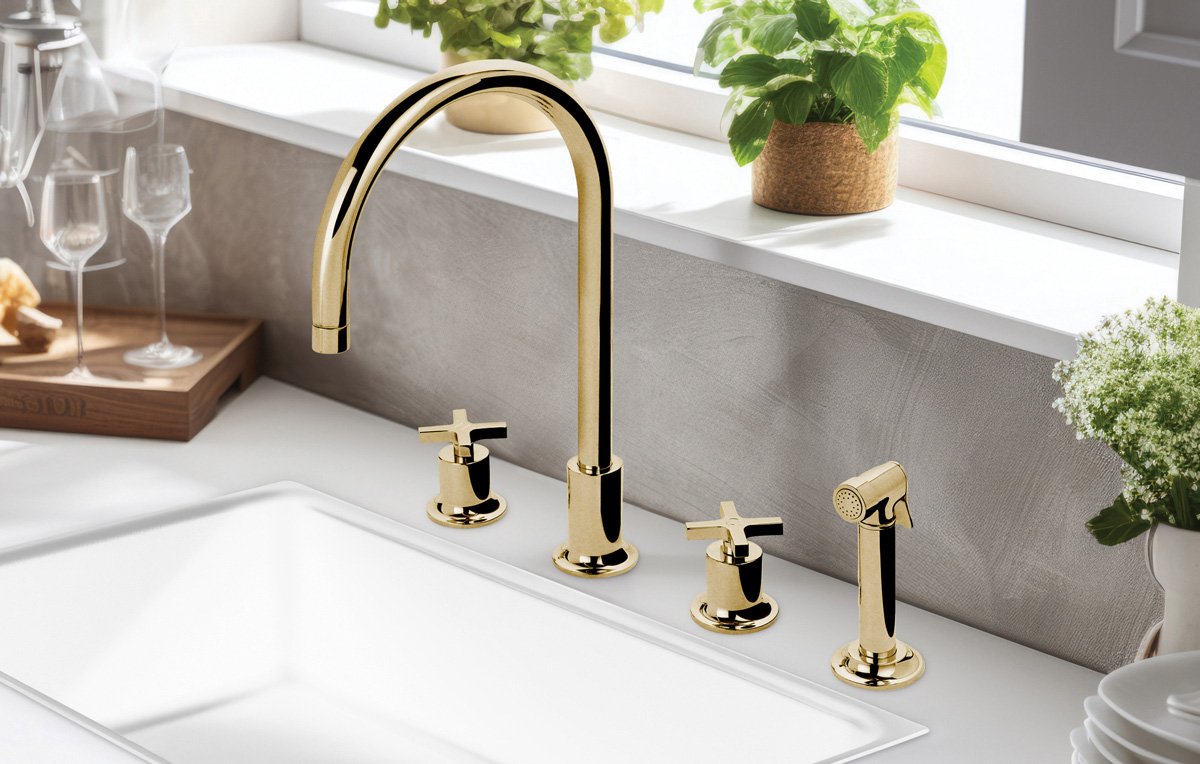
Barber Wilsons has added a kitchen faucet to its Milne Collection. Characterized by cross-top handles and clean line, the Milne Editions 1040 is distinguished by a tubular, high-profile spout and hand spray. Crafted of solid brass, it is available in a variety of living and established finishes.
Stone Forest’s Brass Prep Sink merges the natural warmth of hand-hammered brass with artisan craftsmanship. The sink basin is available in brushed or polished brass and accommodates a 3.5″ kitchen drain. The sink, which is also available in a stainless steel variation, measures 15″x15″ and is 7.5″ deep.
Zurn Elkay Water Solutions has launched Quartz Classic Workstation sinks, crafted from natural quartz and acrylic resins for an organic look and feel of stone. The sinks include an acacia wood cutting board, colander, drying rack, roll-up drying rack, bottom grid and color-matching drain.
Building on its Components line, Kohler has introduced the Components Kitchen Faucet Collection. The line features a Slim Sweep Spray with a forceful water blade, and a Two-Function aerator allows users to turn the tip of the faucet spout 90 degrees to activate Mist spray for glassware.
See more featured products in the January | February 2025 issue of KBDN.