

CHICAGO — Technology has become an increasingly integral component in the day-to-day operations of kitchen and bath design firms, with design and video-conferencing software, online-purchasing platforms, sophisticated communications tools, web-based marketing and artificial intelligence (AI) among the advances critical to success in an increasingly tech-savvy market.
That is the key finding of anationwide survey of kitchen/bath dealers and design firms conducted by Kitchen & Bath Design News in conjunction with KBDN’s exclusive research partner, Bryan Research. The online survey, which drew responses from nearly 300 industry professionals, was fielded in January and mirrors the findings of other surveys regarding the use of technology in the design, remodeling and construction trades (see related Editorial).
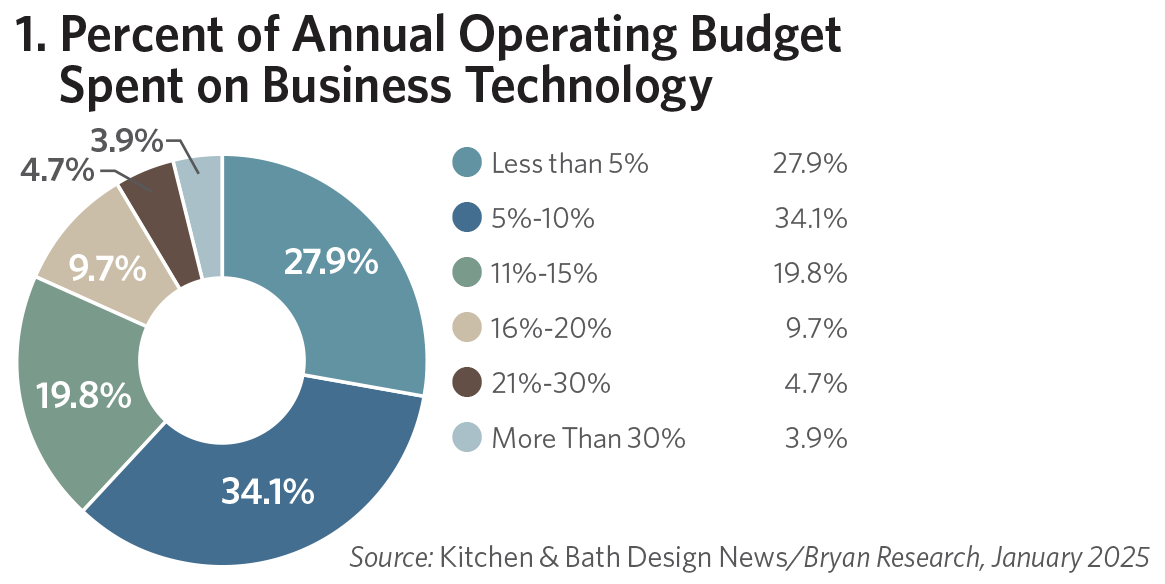
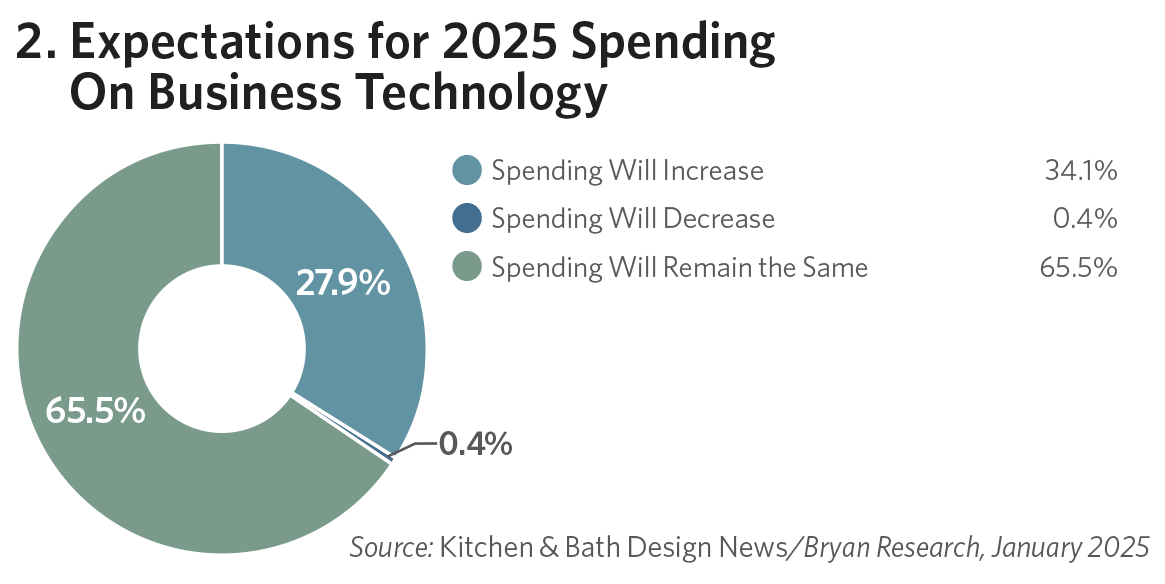
Surveyed business owners told KBDN that they are spending, on average, 8.4% of their annual operating budget on technology, although about one in three report they expect that percentage to increase in 2025. Interestingly, nearly 4% report that they spend more than 30% of their annual operating budget on technological advancements, a reflection of both technological advances and increasingly tech-savvy clients (see Figures 1 & 2).
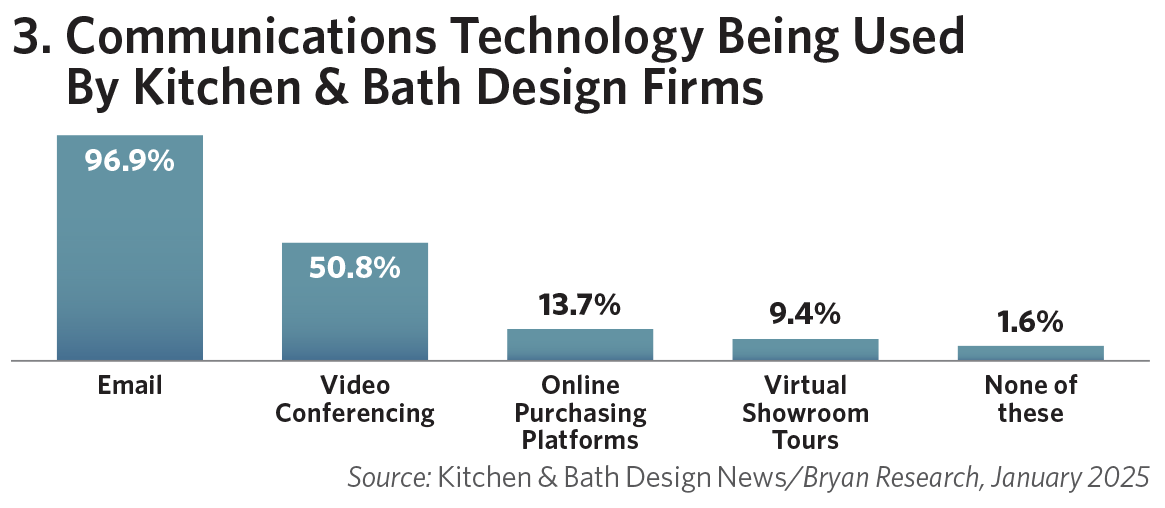
According to the survey’s findings, the vast majority of respondents (93.4%) report that they currently utilize some form of technology to communicate with clients and prospects. 97% of those polled said they regularly use email, while more than half use video-conferencing software such as Zoom and FaceTime. Moreover, nearly 14% use online platforms that allow clients to execute purchase decisions. In contrast, only about 9% currently offer virtual showroom tours, and less than 2% use none of those communications tools (see Figure 3).
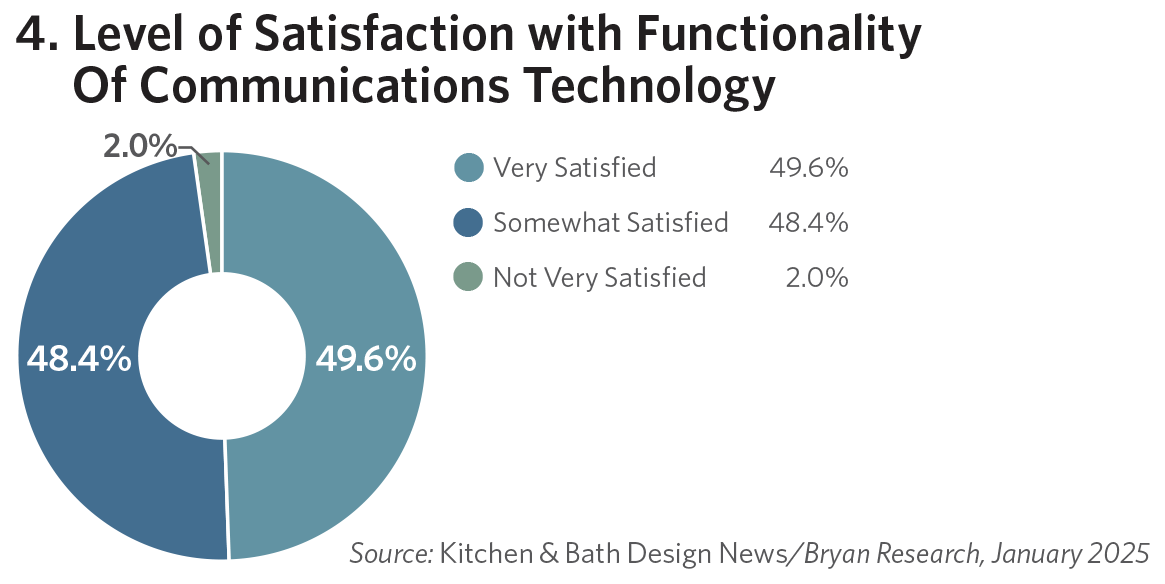
Most of those surveyed (98%) say they are either “very” or “somewhat” satisfied with the functionality of the communications technology they are currently using (see Figure 4). A similar percentage reports that they’re satisfied with the ease of use of that technology.
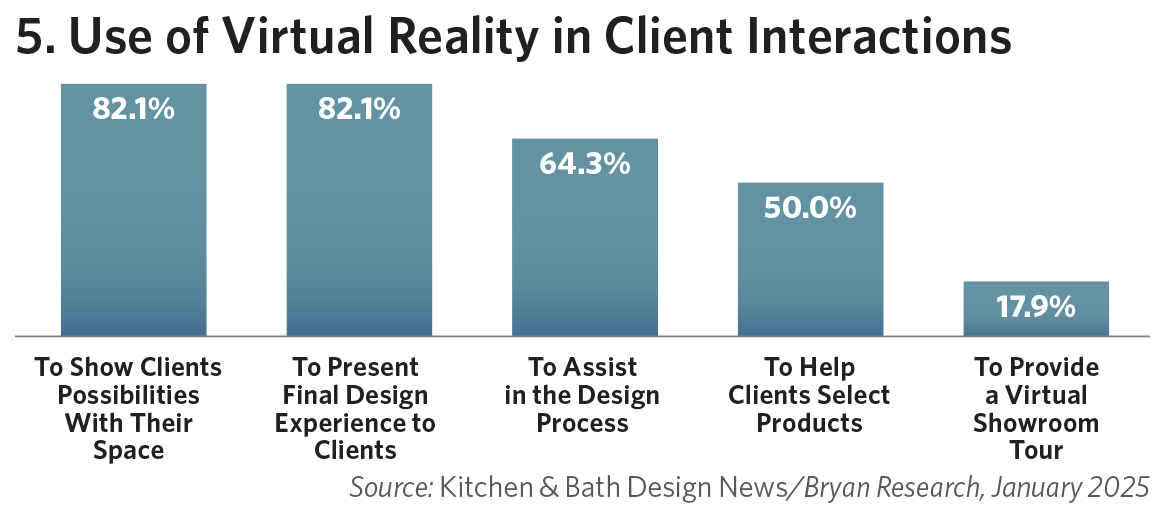
In additional survey findings, nearly 80% of those polled report that they currently utilize design software. In contrast, roughly 90% say they do not employ virtual reality to assist in their interactions with clients. Of those who utilize virtual reality, it is invariably used to show clients design possibilities for their kitchen, bath, or other-room space (see Figure 5).
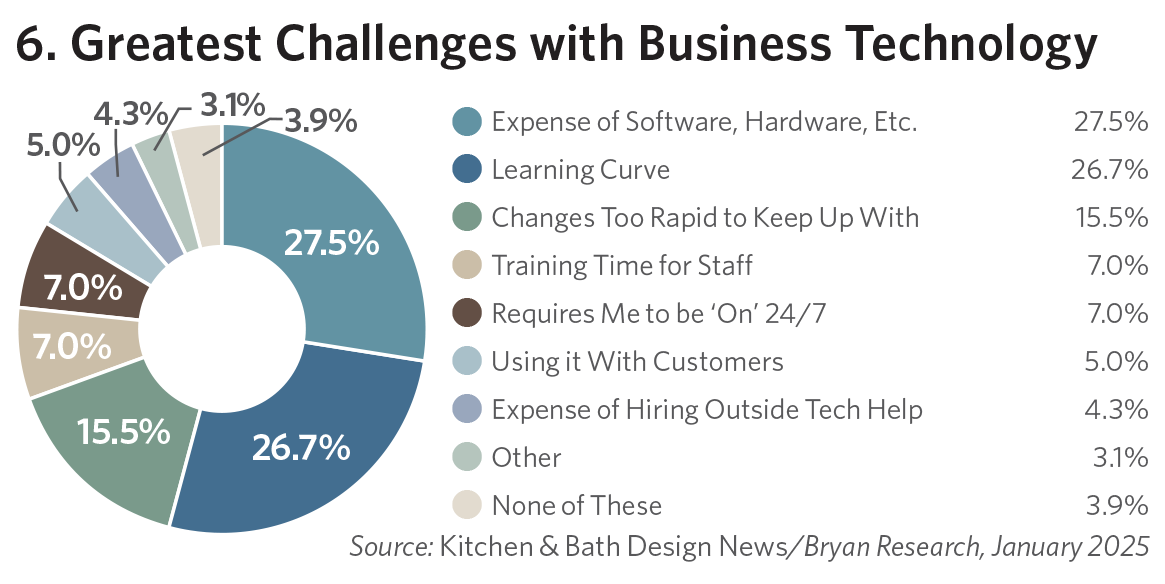
The greatest challenge they experience with business technology, survey respondents report, is with the expense for hardware and software (27.5%), and the learning curve involved in incorporating the technology into their business operations (27.7%). Other challenges include keeping up with changes to both the technology and the training time involved for staff, using it with customers, and the need to be “on” 24/7 (see Figure 6).
Growing Use of AI
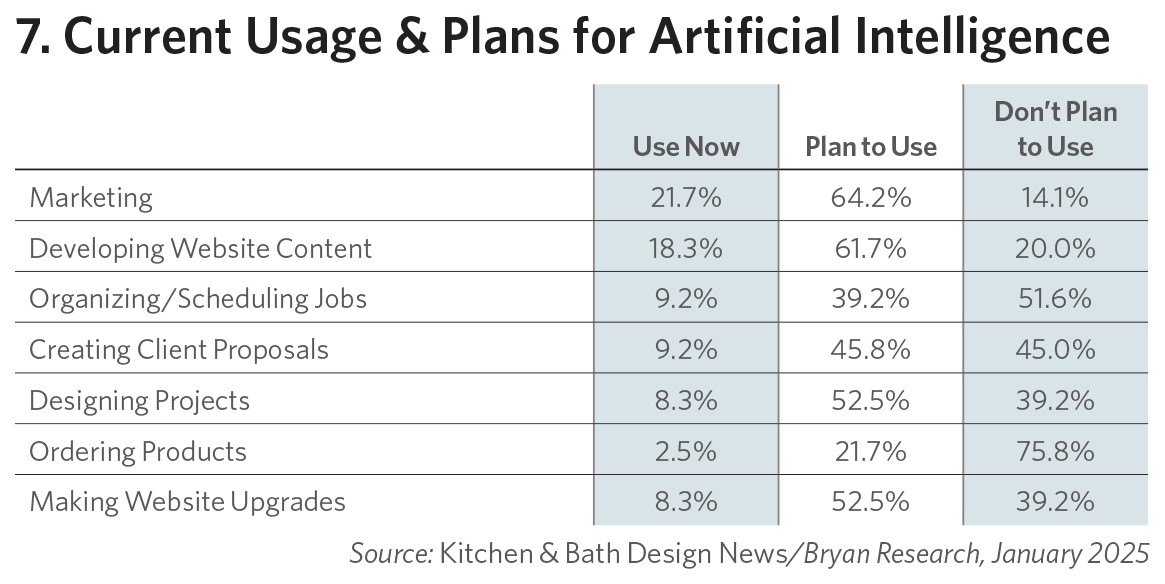
The majority of those surveyed (83.6%) do not currently use artificial intelligence (AI) to assist with their business operations. However, roughly 37% of those who don’t use AI report that they plan to use it for one or more business functions at some point in the next two years (see Figure 7).
Of those who currently utilize AI, about 22% use it for corporate marketing efforts, while 18% employ it to develop content for their company’s website. Other current uses for AI include organizing and scheduling jobs (9.2%), creating client proposals (9.2%), making improvements to a company’s website (8.3%), and designing projects (8.3%).
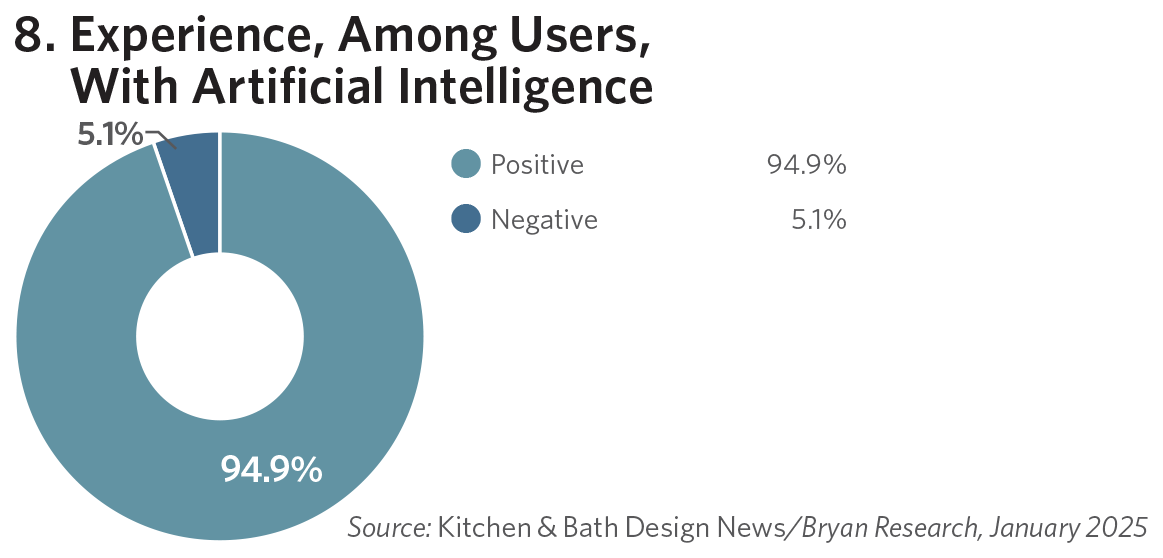
For the 16% of survey respondents who are currently utilizing AI, most rave about it (see Figure 8).
“AI is my tech ‘hot sauce,’” one business owner told KBDN. “I use it for everything: content on our website, blog writing, crafting emails and proposals, researching technologies and materials.”
“I’ve used AI to create a core story for my company, as I rebranded last year and wanted help to redefine our connection,” another survey respondent said. “I also use it for content ideas on social media.”
“I’m still in the ‘discovery phase’ with AI, but I find it totally amazing and worth the expense,” said yet another.
Others share an entirely different view.
Indeed, among those who are not currently using AI, roughly 66% say they are either “very” or “somewhat” interested in using or learning about it. The balance, about 34%, report they are “not very interested” in AI at all.
More in Market Research
Design Firms Report Leveraging Software in Key Areas
PALO ALTO, CA — Nearly all businesses across the nation’s residential construction and design industry leverage software to manage operations, engage clients, automate workflows, facilitate payments and enhance brand visibility, according to a nationwide survey across key design and construction industry sectors.
Beyond these specialized tools, businesses also depend on software for billing and invoicing, marketing, CRM, employee time tracking and website building, according to the survey, conducted by Houzz Inc., the Palo Alto, CA-based online platform for home remodeling and design.
“Industry pros report that they’ve implemented new processes for operational efficiency and client communication, and made strategic investments in technology to address the challenges they faced in 2024,” said Marine Sargsyan, staff economist for Houzz. “This will better position them for an anticipated increase in demand, enhance their resilience amidst potential tariffs, and leverage expected improvements in both local and national economic conditions.”
According to Houzz, drafting and rendering software is currently being used by 84% of surveyed architects, 57% of design-build firms, and 54% of interior designers. Within the construction sector, software for cost and bid estimation is routinely used by nearly 2 in 5 design-build firms (38%), specialty contractors (37%) and a third of general contractors (33%), added Houzz, whose findings were based on data reported by more than 1,500 professionals in the Houzz community.
In 2024, firms across the nation’s design and construction industry prioritized investments in several key areas to address ongoing challenges and enhance operational performance. Increasing efficiency was a top focus, with 40% of architects, 42% of specialty contractors, and 40% of design-build firms dedicating resources to streamline processes and improve productivity.
Similarly, improving communication with clients and teams was a significant priority, particularly among design-build firms (45%), general contractors (44%) and interior designers (39%), Houzz said. Finally, 20% of architects, 16% of interior designers and 16% of design-build firms focused on maximizing returns on existing technology investments, the company added.
Designers’ Concerns Aired Over Potential Impact of AI
CHICAGO — Artificial intelligence (AI) may well spearhead the next wave of technology aimed at kitchen and bath design firms, but its potential impact is sparking widespread uncertainty – and in some cases grave concern – among business owners.
Asked what technology they believe will have the greatest future impact on their business, an overwhelming majority of kitchen/bath design professionals surveyed by Kitchen & Bath Design News pointed to AI as a potential threat – and, nearly as often, to the blinding speed at which technological advances are impacting the design and remodeling trade.
Many business owners told KBDN they recognize the need to keep up with technological advances or risk putting their businesses at a competitive disadvantage. Many others say their businesses have reaped distinct benefits by implementing technology such as 3D design-modeling software, digital advertising programs, communications software and material-handling programs.
“If I don’t keep up with technology, I’ll lose customers,” one business owner told KBDN. “Today’s clients ‘live’ online, and if I’m not there, someone else is. I need to stay up with current technology or I’ll be left behind.”
“Technology is here to stay, and it will evolve, so if we don’t embrace it our businesses will get left behind,” another design pro said. “One must change with the times, and clients are becoming a lot savvier when it comes to technology. If we want to lead, we must adapt.”
But others draw the line when it comes to embracing AI.
“AI is going to bring a lot of bad design into our industry,” one business owner observed. “It’s also going to challenge designers to create renderings that are not only realistic but functional – something that AI is bad at. It lacks that human touch and experience.”
“AI will be a major challenge, only because it’s being forced into so many programs without a real explanation of how it’s used,” another business owner said. “I fear that it will change the expectations of clients in ways that may not be achievable. To understand the applications, and how to incorporate AI into everyday business, will take time and money.”
Other AI critics say that, while increasingly prevalent in the design trade, AI lacks the kind of personal interactivity that’s among the keys to many design firms’ success.
“I’m aware that AI is currently taking over the typical business, but I feel our customers deserve to work with a human being 100% on their project,” a dealer told KBDN. “There are some aspects of design (such as personal interaction) that cannot be handled by AI. Our company prides itself on the ‘personal touch.’”
“A lot of my clients are older, and AI frightens them,” another dealer commented. “Taking time to try to explain AI to clients is design and sales time that I lose.”
Among other comments pertaining to AI:
- “I’m sure AI will impact my business. I’m concerned about being replaced. We’re still planning to remain a ‘hands-on’ business, however, as I believe it’s important to continue to work closely with our clients both in our showroom and in clients’ homes.”
- “I believe that homeowners will begin to use AI to design their own kitchens. This will cause more people to realize that they can do this on their own, and your everyday kitchen and bath dealers will see a drop in design requests.”
- “I think AI is already changing everything, and I cannot fathom how good or bad this will be going forward. I think AI is Pandora’s Box.”
- “AI won’t replace designers, but those who can keep up with the technology will be more efficient and the technology will allow us to reach more clients that may not have been able to afford design services prior to now, due to efficiencies that are gained.”
- “Upgrades will be needed to our existing technology, but there’s a lack of interest in learning some of the newer tech options since technology changes so fast and we’re less inclined to invest the time and money into learning something new that may change or not be around in a few years,” adds another design pro.”