
High home prices, elevated interest rates and the possibility of tariff-driven cost increases for key building products and materials are among the headwinds putting a damper on housing and remodeling forecasts as 2025 reaches its midway point (see related story, NAHB Pushes Congress to Boost Production of Homes in U.S.; Editorial, The Fight for Home Affordability). Among the key statistics and forecasts released in recent weeks by government agencies, research firms and industry-related trade associations were the following:
Housing Starts & New Home Sales
High construction costs, elevated mortgage rates and challenging housing affordability conditions are causing home builders “to approach the market with caution,” the National Association of Home Builders said last month. “The single-family home-building market is facing competing concerns and opportunities,” commented Robert Dietz, chief economist for the Washington, DC-based NAHB. “Given persistent affordability concerns, reducing inefficient regulatory costs would offer the best policy path to improve attainable housing supply and bring down shelter inflation.” Constrained housing affordability conditions due largely to ongoing, elevated interest rates have led to a recent reduction in single-family production, the NAHB reported. “Upside and downside risks will become clearer as the new year progresses,” Dietz predicted. “An easing regulatory environment and tax cuts could act as tailwinds, but tariffs and potentially higher deficits could dampen market momentum.”
Existing-Home Sales
Elevated home prices and high mortgage rates continue to strain affordability and impact the sales of existing homes, the National Association of Realtors reported. Housing affordability “suffered” according to the latest available statistics, as mortgage rates remained in the 7% range, the Washington, DC-based NAR said. Compared to a year ago, the monthly mortgage payment on a $300,000 home increased to $1,590, the Washington, DC-based trade organization said. At the same time, pending home sales pulled back, while year-over-year contract signings lowered in all four U.S. regions, the NAR reported. “It’s unclear if the coldest January in 25 years contributed to fewer buyers, and if so, expect greater sales activity in upcoming months,” the trade association added.
Residential Remodeling
Home professionals are approaching 2025 “with renewed confidence” after a year marked by revenue and profitability declines, according to a forecast by Houzz Inc., the Palo Alto, CA-based online platform for home remodeling and design. Houzz’s annual forecast, released in February, noted that more than 3 in 5 firms in the nation’s residential construction and design sectors are projecting a positive business outlook this year. In 2024, businesses across all key industry groups reported the biggest year-over-year decline in average annual revenue growth since 2014, said Houzz, which attributed missed revenue targets to declines in both the number and the size of projects. Labor shortages will continue to be a “persistent challenge,” while expectations for rising labor costs are also widespread, Houzz noted. While the availability of products and materials is expected to remain largely unchanged, more companies surveyed anticipate costs to rise in 2025 than those that expect costs to decline, Houzz added.
Harvard Report: U.S. Remodeling Still Above Pre-COVID Levels
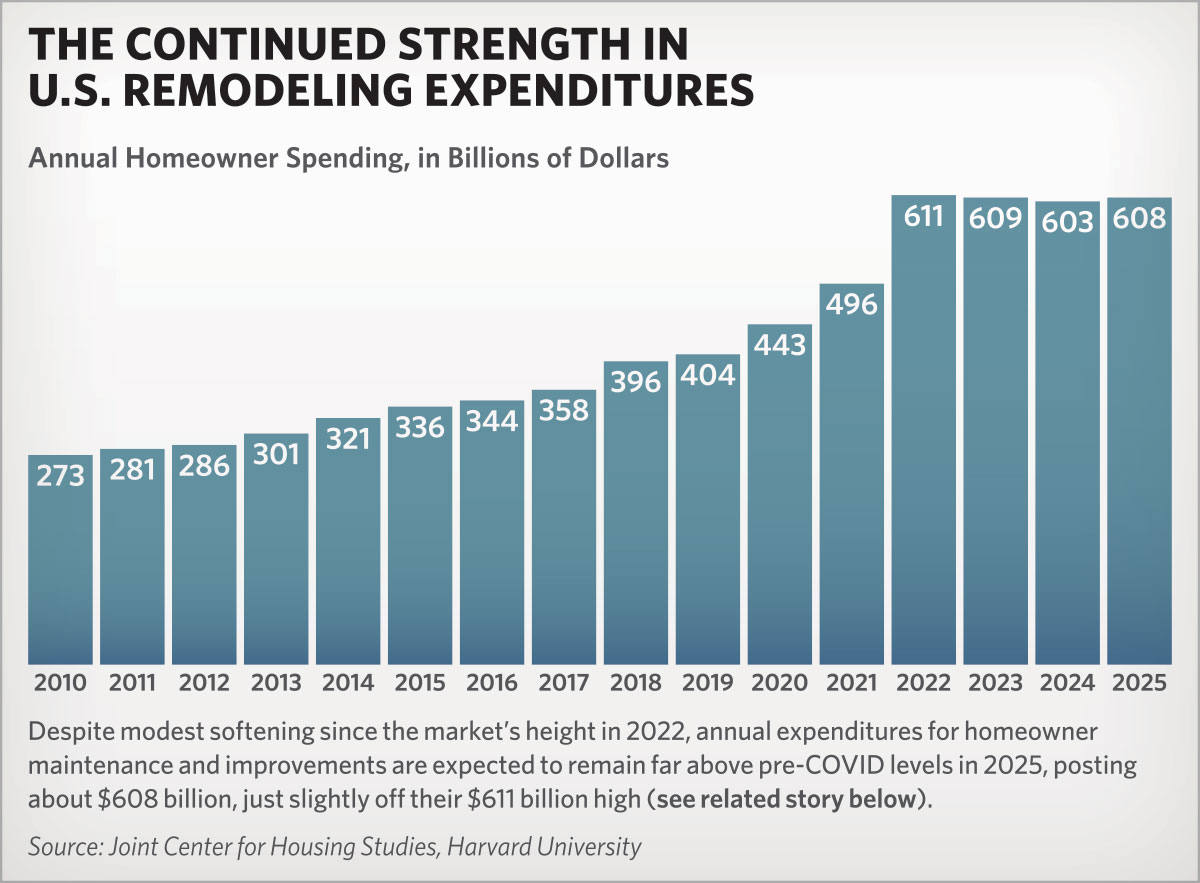
Spending in the U.S. residential remodeling market reached unprecedented heights in the wake of the COVID-19 pandemic, soaring above $600 billion for the first time in 2022. And despite modest declines the past two years, market expenditures for improvements and repairs to owner-occupied and rental properties is expected to remain “far above” pre-pandemic levels in 2025. KEEP READING