
Home builders, remodelers and kitchen/bath professionals are expressing optimism over their prospects in 2025, even as the market continues to face headwinds that blunted growth in 2024. Among the key statistics and forecasts released in recent weeks by government agencies, research firms and industry-related trade associations were the following:
Housing Starts & New Home Sales
Builder sentiment is holding steady as high home prices and elevated mortgage rates offset renewed hope about an improved regulatory business climate this year, the National Association of Home Builders reported. “While builders are expressing concerns that high interest rates, elevated construction costs and a lack of buildable lots continue to act as headwinds, they’re also anticipating future regulatory relief,” said NAHB Chairman Carl Harris. The NAHB is forecasting additional interest rate cuts from the Federal Reserve in 2025, but with inflation pressures still present, the association has reduced its forecast from 100 basis points to 75 basis points for the federal funds rate. “Concerns over inflation risks will keep long-term interest rates near current levels, with mortgage rates remaining above 6%,” noted NAHB Chief Economist Robert Dietz. The NAHB is forecasting single-family starts to post only a slight increase in 2025, Dietz added.
Residential Remodeling
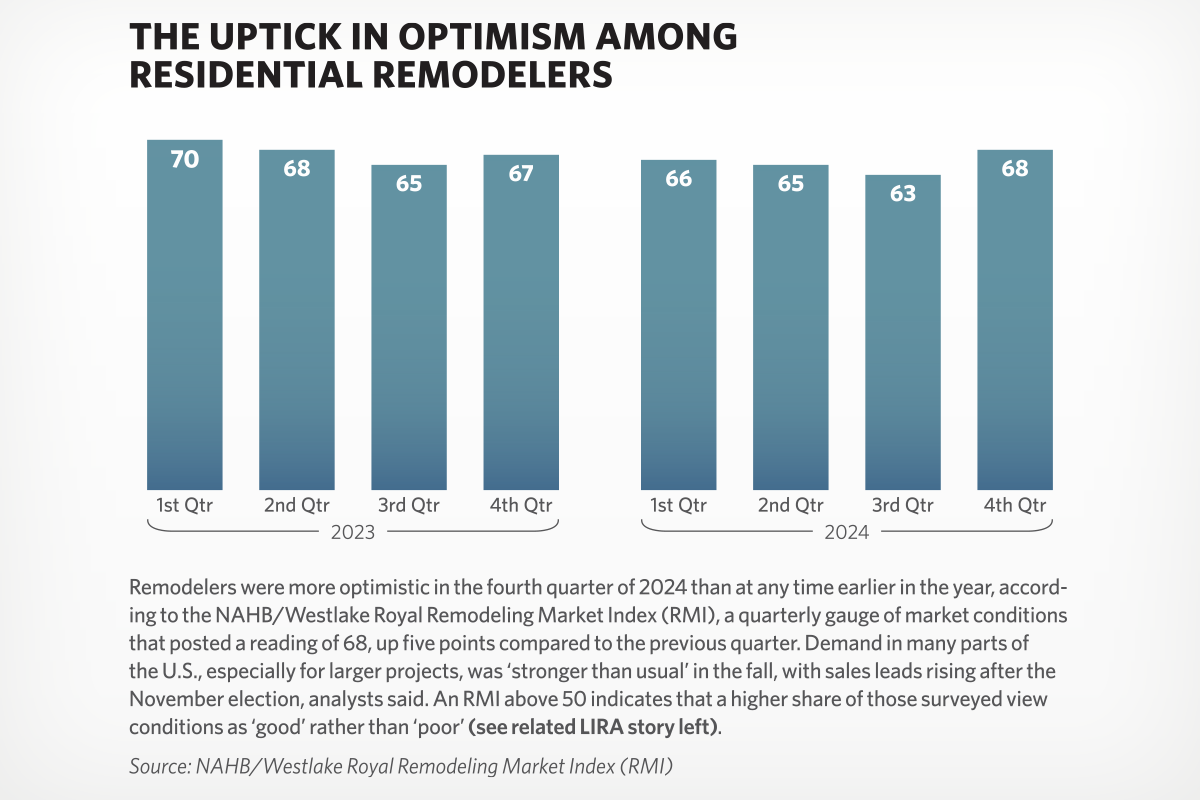
After two years of decline, annual expenditures for improvements and maintenance to owner-occupied homes are expected to grow at a mild pace throughout 2025, according to the Leading Indicator of Remodeling Activity (LIRA), released in January by the Remodeling Futures Program at the Joint Center for Housing Studies of Harvard University. The LIRA projects that year-over-year spending for home renovation and repair will increase by 1.2% in 2025. While remodeling expenditures are expected to grow only modestly in 2025, analysts have increased their projection for the market’s size by $30 billion, or 6.4%, to $509 billion. “A solid labor market, rising home values, and continued improvement in existing-home sales are supporting greater activity in home remodeling,” said Carlos Martín, director of the Remodeling Futures Program at the Joint Center.
Major Home Appliance Shipments
Domestic shipments of major home appliances gained ground in 2024 compared to the same 12-month period a year earlier, the Association of Home Appliance Manufacturers reported. According to the latest figures, released in January by the Washington, DC-based AHAM, major home appliance shipments totaled 76.2 million units from the time period of January through December of last year, up 2.6% from the 74.3 million units shipped in calendar year 2023. Shipment gains for 2024 were posted for refrigeration (+3.7%) and home laundry products (+2.2%). In contrast, shipments of kitchen cleanup (-2.1%) and cooking appliances (-2.1%) were both off from the previous year, AHAM said.
‘Worst’ of Housing Shortage Ending, Realtors Association Asserts
BOSTON — The worst of the housing inventory shortage is likely coming to an end, while mortgage rates have stabilized and job growth is continuing – all of which should result in steady increases in existing-home sales, according to a forecast by the chief economist for the National Association of Realtors.
After two years of sluggish home sales, existing-home sales are forecasted to rise to 4.47 million in 2025, and more than 5 million in 2026, said Lawrence Yun of the Washington, DC-based NAR, noting that household equity is also at record heights while job gains since the beginning of the COVID-19 pandemic have resulted in record-high payroll employment.
Yun said that he expects a slower growth rate in home prices during the next two years, because of additional housing supply reaching the market. He expects the Federal Reserve to maintain “a gradual approach” to easing monetary policy, offering relief to prospective buyers, and forecasts that mortgage rates will stabilize near 6% in 2025, “likely establishing a new normal.”
“Home buyers appear to have recalibrated expectations regarding mortgage rates and are taking advantage of more available inventory,” Yun said. “Buyers are no longer waiting for, or expecting, mortgage rates to fall substantially. Stable mortgage rates and continued income growth will pave the way for more Americans to achieve homeownership.” ▪