
The nation’s housing and remodeling sectors seem anxious to turn the page on 2024, with market forecasts generally optimistic even as affordability issues, labor shortages and other challenges persist (see related Forecast 2025 coverage). Among the key statistics and forecasts released in recent weeks by government agencies, research firms and industry-related trade associations were the following:
Housing Starts and New-Home Sales
Home builder sentiment has markedly improved in the wake of the presidential election, amid forecasts calling for a gradual, if uneven, decline in mortgage rates, significant regulatory relief for the housing industry, and an increase for single-family construction in the coming months. But while builder confidence is improving, the industry “still faces many headwinds, such as an ongoing shortage of labor and buildable lots, along with elevated building material prices,” National Association of Home Builders Chief Economist Robert Dietz said, adding that affordability conditions remain challenging. “Despite the beginning of the Fed’s easing cycle, many prospective home buyers remain on the sideline, waiting for lower interest rates,” Dietz observed. “We’re forecasting uneven declines for mortgage interest rates in the coming quarters, which will improve housing demand but place stress on building lot supplies due to tight lending conditions for development and construction loans.”
Existing-Home Sales
The worst of the housing inventory shortage is likely at an end, while mortgage rates are stabilizing and job growth is continuing – all of which should result in steady gains for existing-home sales, according to a 2025 forecast by the National Association of Realtors. “After two years of sluggish home sales, existing-home sales are forecasted to rise to 4.47 million in 2025, and more than 5 million in 2026,” said Lawrence Yun, chief economist for the NAR. Noting that household equity is also at record heights, while job gains since the beginning of the COVID-19 pandemic have led to record- high payroll employment, Yun projected a slower rate of growth in home prices during the next two years, due to additional housing supply reaching the market. He forecasted that the median existing-home price will rise to $410,700 in 2025, and to $420,000 in 2026, while the annual 30-year fixed mortgage rate will decline to 5.9% in 2025, but move higher in 2026. The housing market can expect six to eight more interest rate cuts, the economist said, predicting that “the new normal” for mortgage rates should be between 5.5% and 6%.
Residential Remodeling
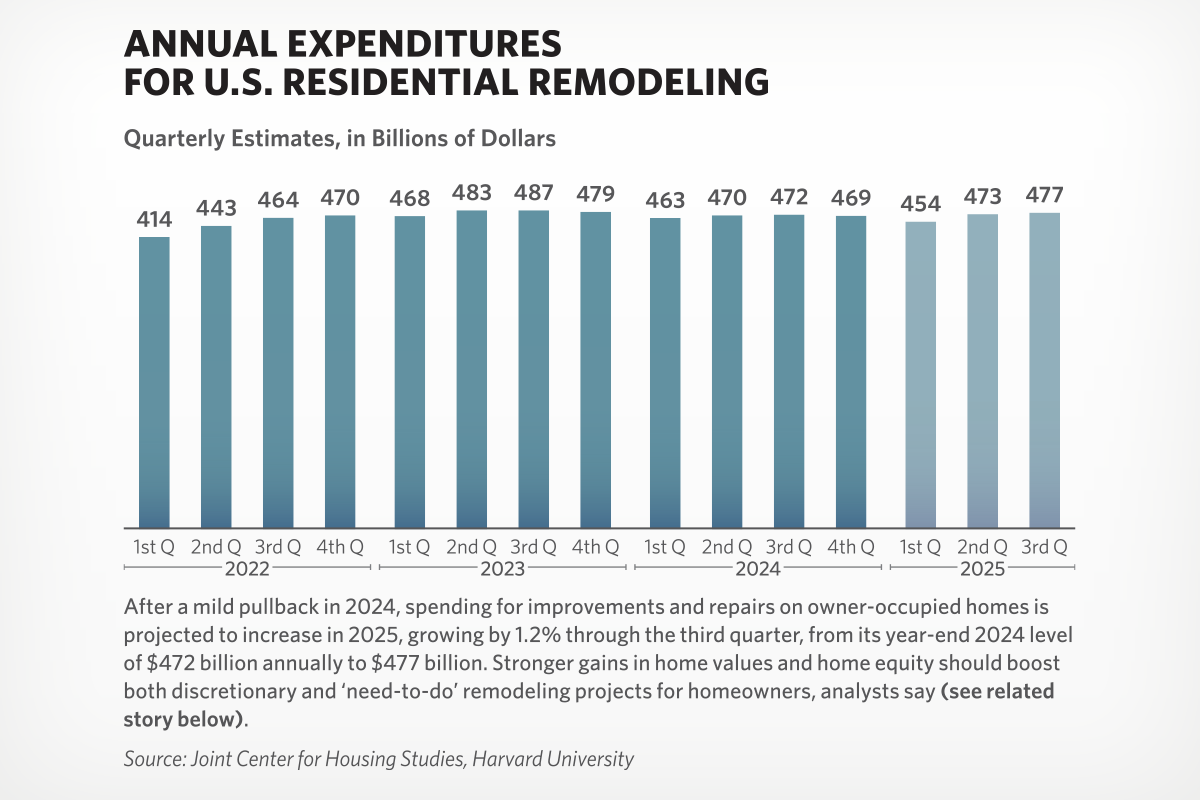
The “holding pattern” for large, discretionary remodeling projects continued as 2024 wound to a close, with many households responding to persistent affordability challenges by trading down to lower-cost options, according to the latest in a series of “US Remodeler Indexes,” a quarterly gauge of market conditions compiled by Kitchen & Bath Design News’ sister magazine, Qualified Remodeler, in conjunction with real-estate market analyst John Burns Research and Consulting.“High building materials prices and the cost of financing are key impediments to growth,” the USRI found, adding that the remodeling market has largely shifted to wealthier households, which tend to be less interest-rate and cost sensitive. Remodeling projects that accommodate multi-generational living are also becoming increasingly common in response to the escalating cost of homeownership, the report found, noting that despite high costs, remodelers remain bullish about 2025 prospects, with lower interest rates and a reduction in consumer uncertainty fueling their optimism.
Market Analysis
Return to Growth Projected for Residential Remodeling in 2025
After a mild pullback last year, spending for improvements and repairs on owner-occupied homes is set to expand once again by the latter part of 2025, according to the Leading Indicator of Remodeling Activity (LIRA), a quarterly market gauge released by the Remodeling Futures Program at the Joint Center for Housing Studies of Harvard University.