
Tile’s first priority is to offer wall, floor and even ceiling protection within the humid environment of a bathroom. Fortunately, there are beautiful ways in which designers can accomplish that goal. Even something as seemingly simple as subway tile in a stunning color or interesting pattern can elevate the space. Designers also use a vast array of showstopping selections beyond that, in a dizzying array of material compositions, shapes, sizes, colors and patterns, to create spaces that range from dramatic to dreamy or colorful to classic, and everything in between.
This month, KBDN asked designers to share projects that showcase showstopping tile as a way to elevate a bathroom.
Memorable…with a kick
When Emily van der Linde considered tile choices for this client’s beach home, she wanted them to reflect a modern and elevated coastal look…“something beautiful and memorable, with a kick!” says the principal designer for Lacquer Design in Pensacola, FL.
As such, the bathrooms showcase a collection of zellige and cement tiles. Each takes a turn being the showstopping moment in their respective room.
“We choose zellige tiles for their textured, handmade quality and the beautiful way the light reflects off of them,” she says. “They remind me of the inside of a seashell or of sea glass. Cement tiles are a great choice for wet areas such as bathrooms where function has to come first, especially for floor tiles where there is a potential for slipping.”
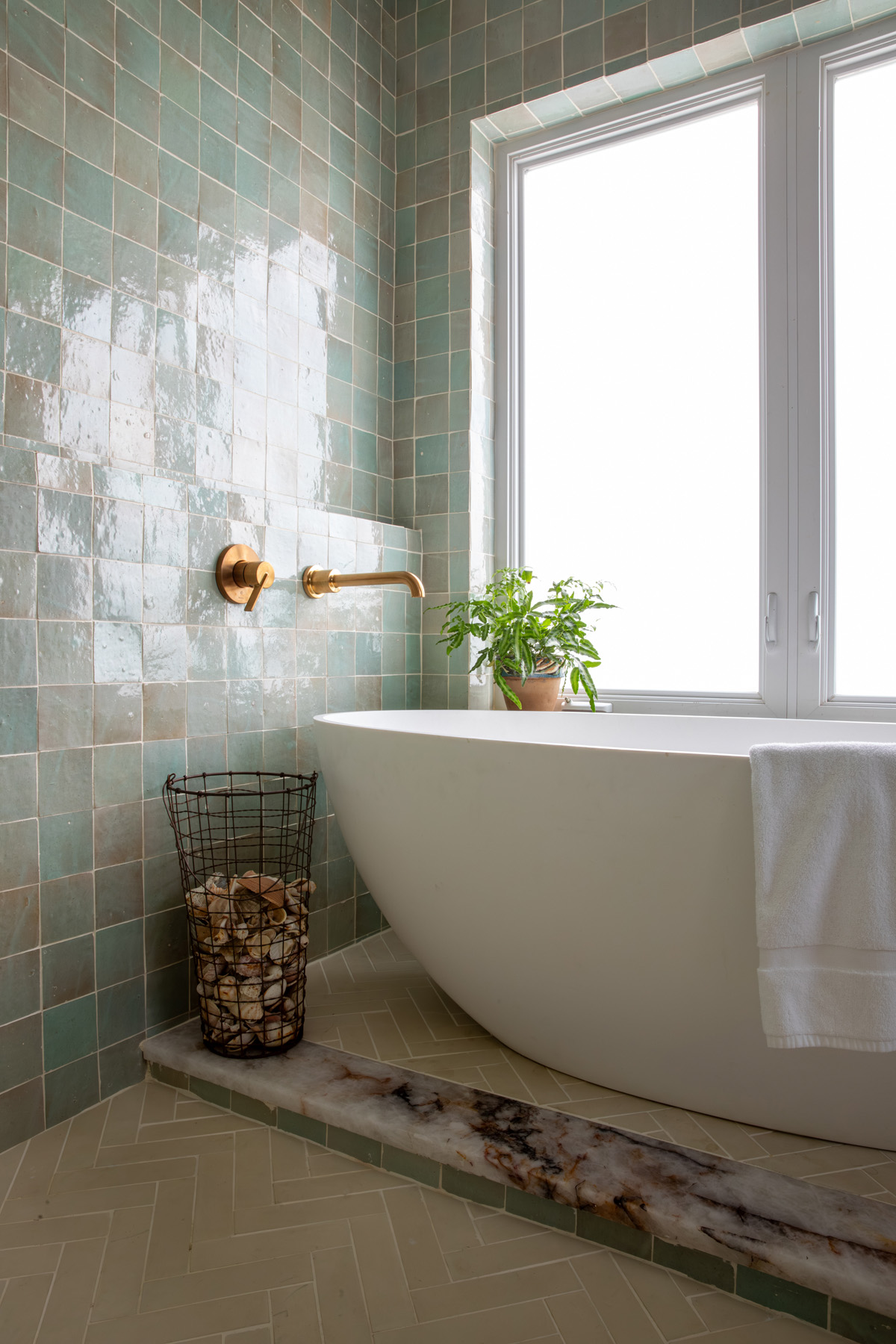
In the primary bathroom 4″x4″ Absinthe zellige tile from Zia Tile clads three walls, including those that surround the freestanding tub and line the shower, which blend into each other to create a wet room effect.
“We wanted to use tile to set the mood for each space,” the designer explains. “In this room, surrounding the bathtub in the zellige tile creates a calm and serene atmosphere in an adult area of the house. We really wanted to take the design up a notch, but not be too overt with beachy décor.”
In this guest bathroom, Emily…
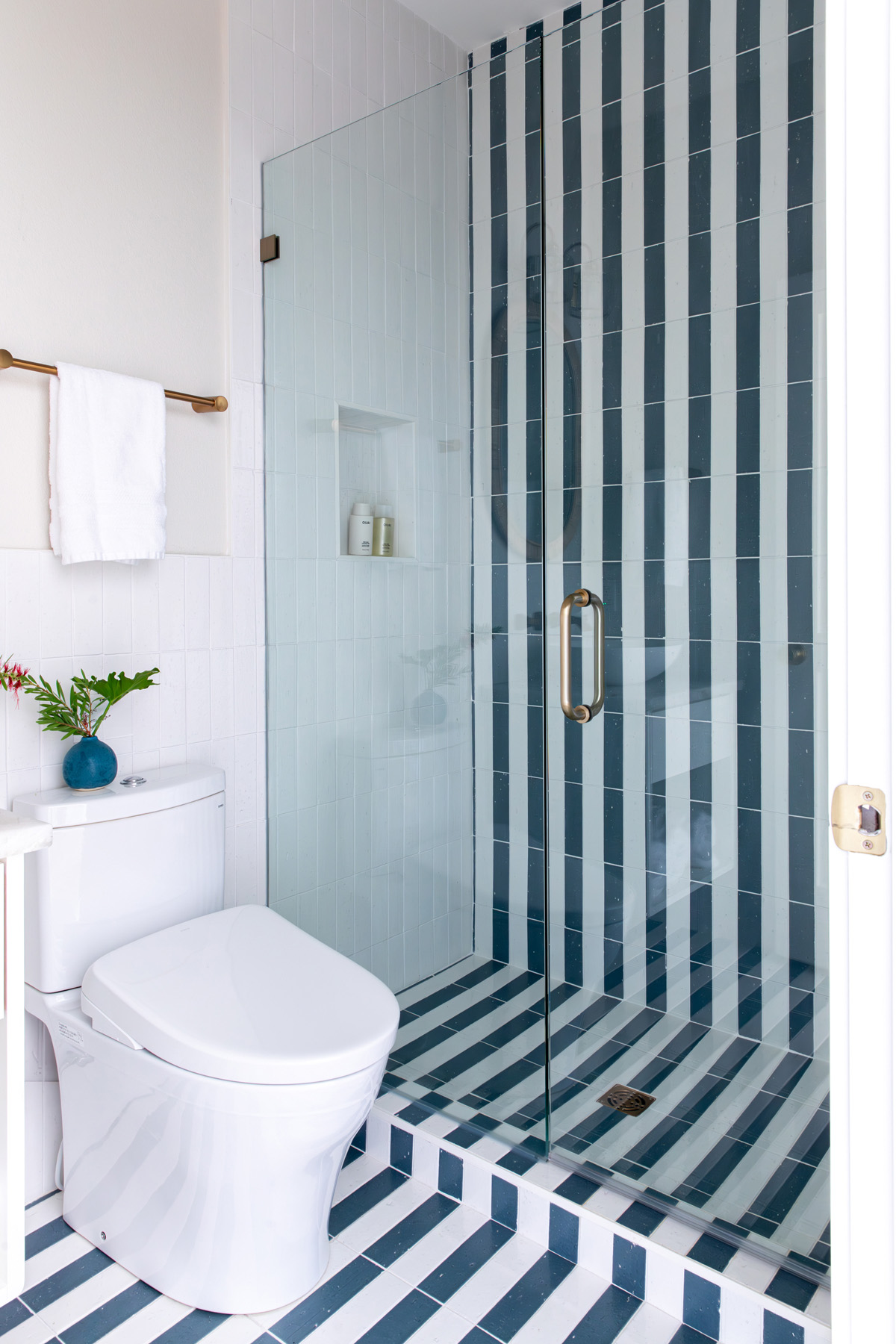
In this guest bathroom, Emily van der Linde juxtaposed dark blue tile with white in the shower to create a bit of drama.
Photos: Laura Rowe Photography
In this primary bathroom, Emily…
In this primary bathroom, Emily van der Linde used zellige tile to clad three walls, including those that surround the freestanding tub and line the shower, which blend into each other to create a wet room effect. Cement tiles are laid in a herringbone pattern on the floor and on the tub platform, the latter of which is accented with quartzite that matches the vanity top.
In this guest bath, printed…
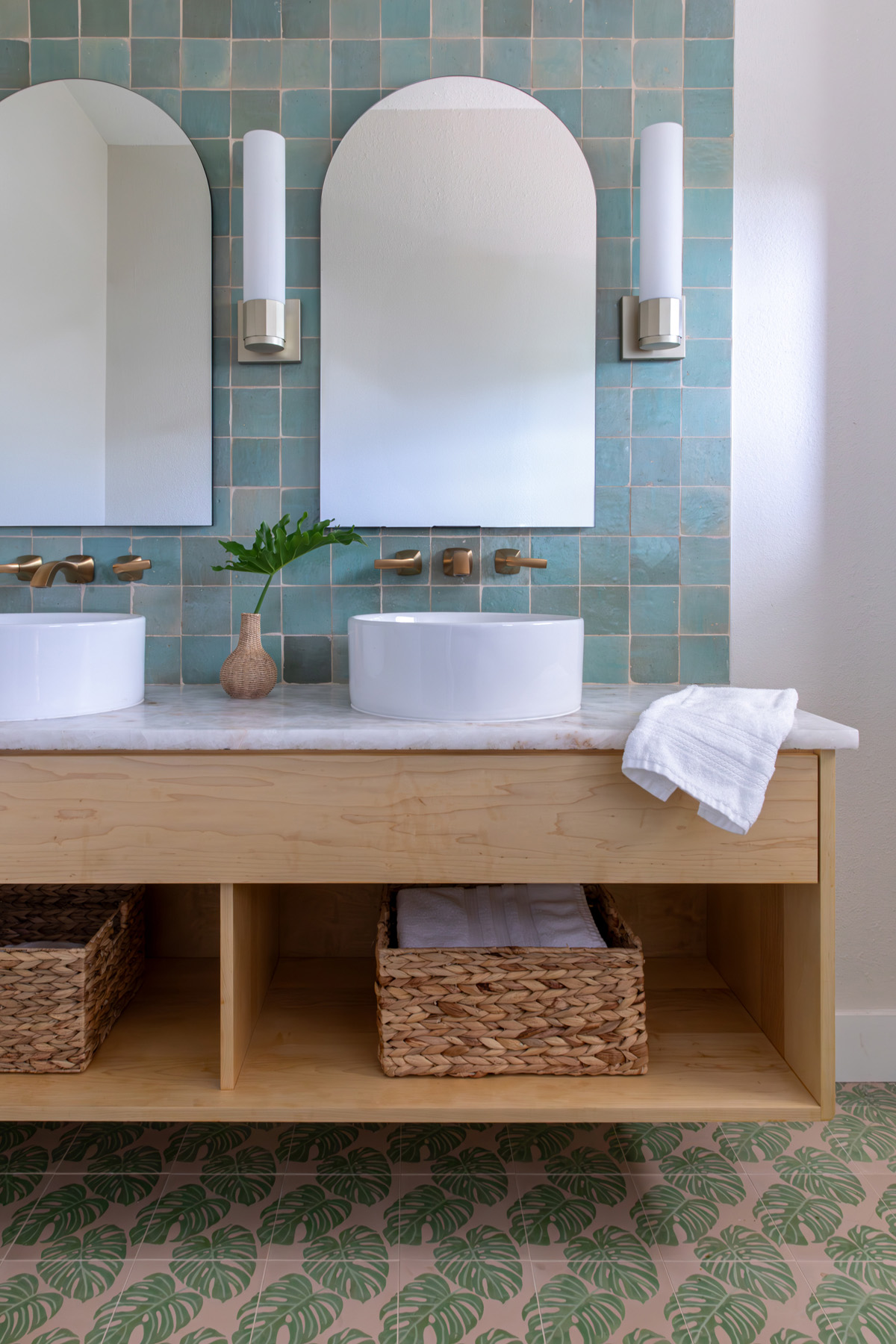
In this guest bath, printed cement floor tiles, which flow into the shower, serve as the showstopper in the room designed by Emily van der Linde. Their flora persona also reflects the tropical nature of the home’s front yard. For the walls, van der Linde chose zellige tiles behind the vanity mirrors and alternating nouveau-shaped zellige tile for the shower.
Long, rectangular 2″x8″ cement tiles from Zia Tile, in a Bone colorway, are laid in a herringbone pattern on the floor and on the tub platform, the latter of which is accented with quartzite that matches the vanity top.
In the guest bath, Zia Tile’s 8″x8″ Monstera printed cement floor tiles, which flow into the shower, serve as the showstopper in the room. Their flora persona also reflects the tropical nature of the home’s front yard.
“There are a lot of neutrals used throughout the house, but we wanted to have a little fun in the guest bath,” she reports. “The punchy pattern on the floor adds visual interest in an unexpected place, keeping things interesting.”
For the walls, van der Linde chose 4″x4″ Skylight zellige tile behind the vanity mirrors and alternating 4″x10″ nouveau- shaped zellige tile in Jaipur Pink for the shower.
“From a design perspective, tile allows for endless creativity through color, texture and pattern,” she indicates. “It can make a statement or retreat into the background for a subtle effect. This versatility helps tailor the design to each client’s taste and the overall look and feel of the home.
“I think designers and homeowners are embracing more creative applications of tile, and there is a growing trend of using tile as an artistic medium,” van der Linde continues. “Hand-painted and hand-printed tiles from boutique artisans are becoming more prevalent, and they are especially impactful when installed on shower walls as a focal point. These artisanal pieces add character and a sense of craftsmanship that transforms the entire space. It’s an exciting time for tile design, with so many opportunities to infuse artistry and personality into interiors.”
Abundant use of color
Rima Nasser rarely designs all-white bathrooms these days. Thanks to an abundance of tile representing every color of the rainbow and beyond, she finds plenty of opportunity to incorporate color. The designer also uses tile as a way to make a small bathroom feel larger, or one with a low ceiling feel taller. As well, tile with a reflective finish can make a space feel brighter, and textured tile can add dimension as well as slip resistance.
“There are a lot of different looks we can accomplish just by using a certain color or patterned tile, set in a certain direction or layout,” explains the owner/principal designer of TEW Design Studio in Raleigh, NC.
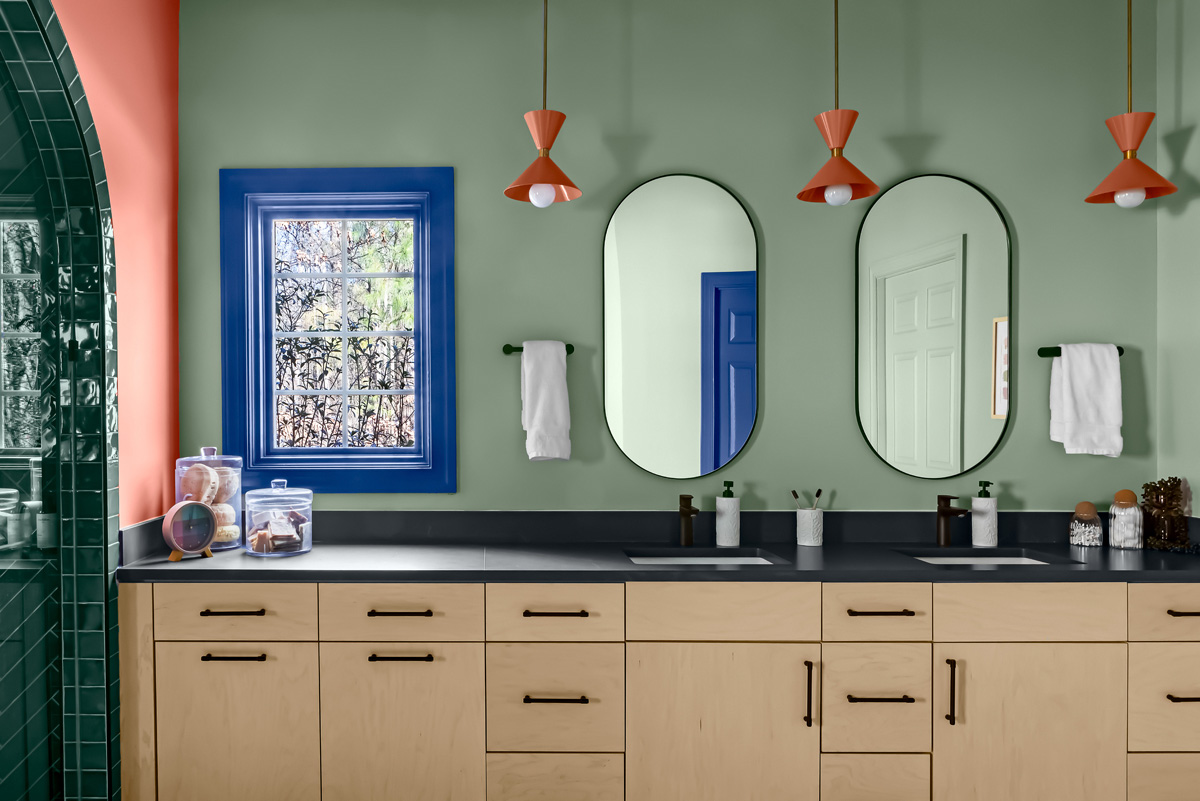
Rima Nasser rarely designs all-white bathrooms these days. In this space, she used an abundance of colors…
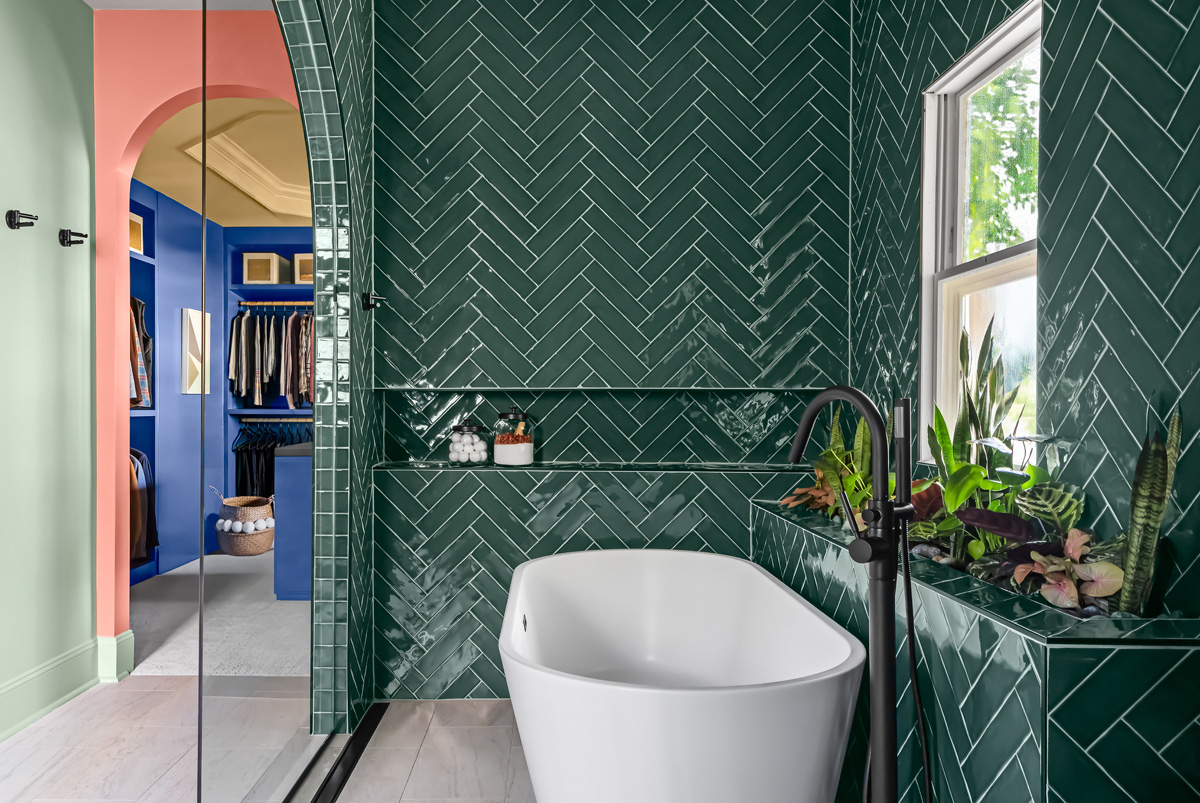
Rima Nasser rarely designs all-white bathrooms these days. In this space, she used an abundance of colors, including royal blue doors and window casings, green walls and a salmon-colored ‘frame’ that draws attention to the emerald green wet room. In the wet room, ceramic tile laid in a herringbone pattern clads the walls, toiletry niches and a built-in planter box.
Photos: Catherine Nguyen Photography
For example, in one bathroom, which was an award-winning design in KBDN’s Kitchen & Bath Design Awards last year, Nasser saturated the space with an abundance of colors, including royal blue doors and window casings, green walls and a salmon-colored ‘frame’ that draws attention to the emerald green wet room.
“These clients were very open to color, which is nice to play with when given the opportunity,” she says. “I usually do a shared interest board with clients to see what they like. When I shared some colorful options, they absolutely loved them so we focused on color blocking and having fun!”
STP Tile’s Drift 3″x12″ ceramic tile in Emerald takes center stage in the wet room, where it is laid in a classic herringbone pattern. To draw further attention, Nasser added an arched entrance clad in a matching colorway. Additional tiled features, including two toiletry niches, a bench topped with quartz and a built-in planter box, add to the grandeur. A white ceiling and STP Tile’s Granum in a light-colored Grigio Chiaro, along with the glossy finish on the wall tile, keep the shower/tub area from being too dark.
“These clients love to take showers, so we knew we had to create something grand for them,” she relates.
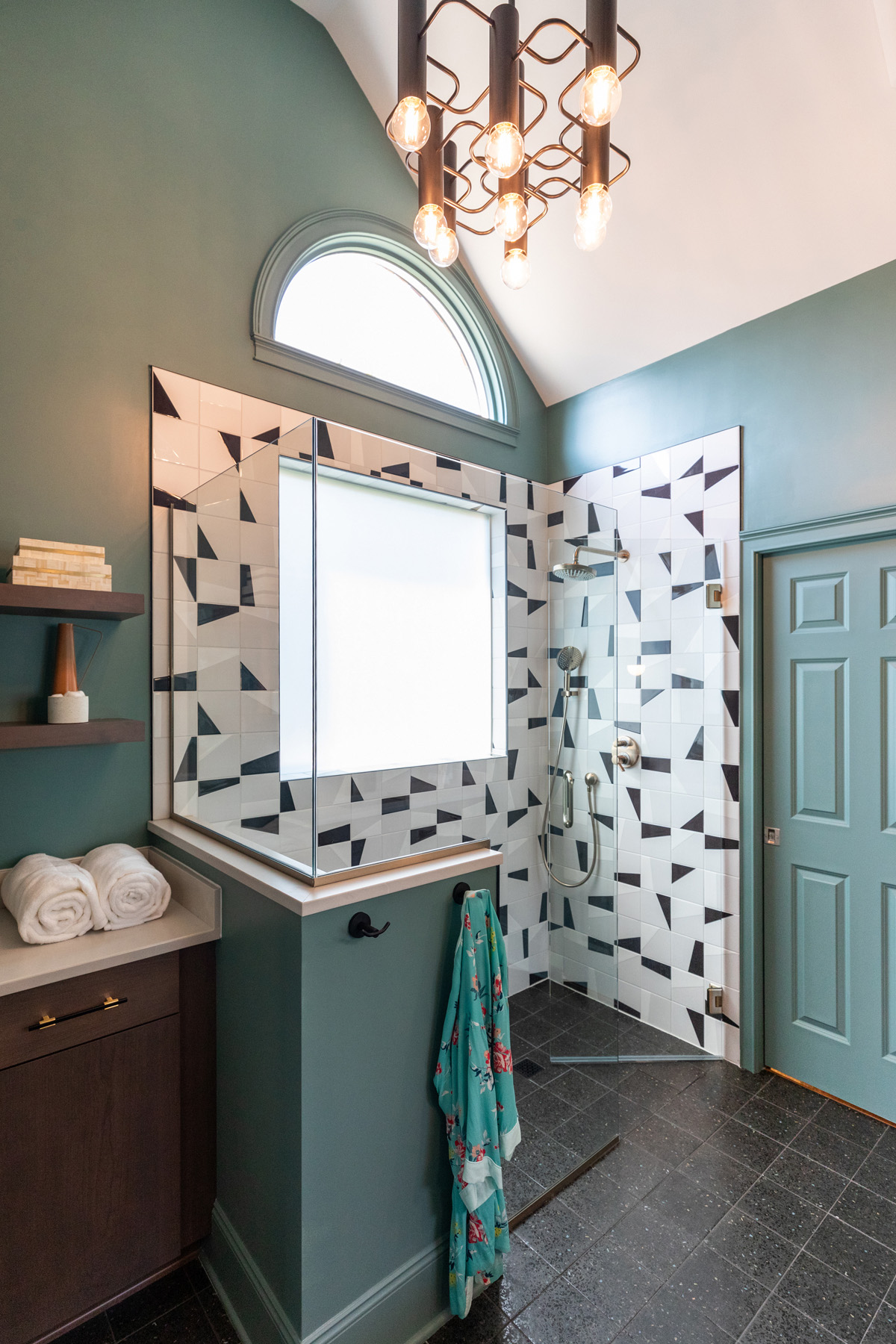
Nasser also used tile as a focal point in another primary bathroom where WOW’s Duo Collection porcelain tiles in a mix of black and white add interest to the shower.
Rima Nasser transformed this standard 1990’s all-white, outdated bathroom into a more functional space with a…
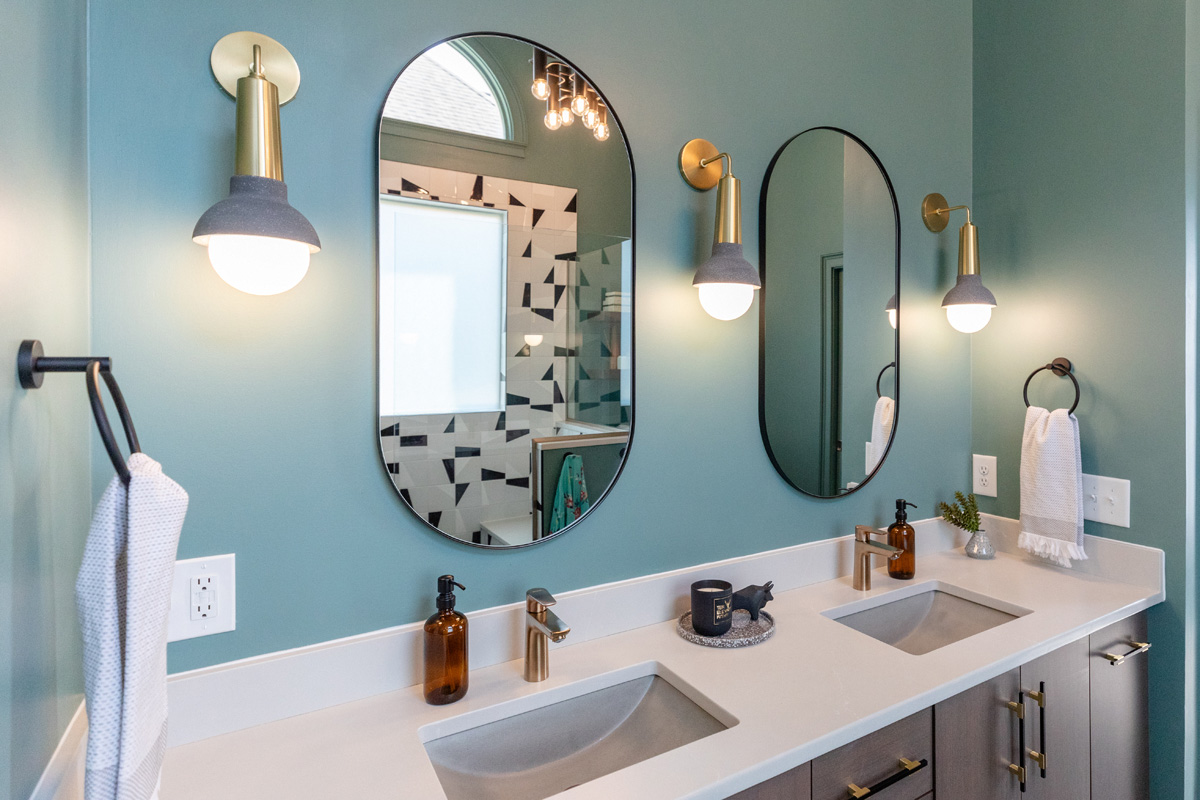
Rima Nasser transformed this standard 1990’s all-white, outdated bathroom into a more functional space with a larger shower that showcases graphic tile where each piece is unique and unrepeatable, which enhanced the random, lively nature of the design.
Photos: Allie Mullin Photography
“This bathroom was a standard 1990’s all-white, outdated bathroom without much storage, a small shower and large built-in tub,” she relates. “The room was a large space with really high ceilings, but it wasn’t serving them well.”
With an interest for a mid-century modern vibe and improved functionality, the designer removed the tub so she could super-size the shower where she showcased the graphic tile. Each piece is unique and unrepeatable, which enhanced the random, lively nature of the design.
“It’s a large space so it could handle the playful aspect of the tile,” she explains. “It was a nice way to bring pattern into the space and create interest. And, with the tile’s glossy finish, it reflects a lot of light. The room feels bright and is a great place to start a morning.”
Nasser complemented the shower wall tile with WOW’s Drops Collection porcelain tile in Natural Drops Graphite for the shower floor. Since the shower is curbless, she was able to extend the terrazzo-look tile into the rest of the room to create a seamless aesthetic.
Living big and bold
Whether she’s trying to achieve a minimalist or maximalist look, Lauren Brandwein uses tile as a way to set the overall tone for a space.
“Tile is essential for bringing layers of textures to a space and to set the tone for how someone wants to live in their space,” says the owner of Rock House Design in Sonoma County, CA.
In the case of one recent primary bathroom project, an addition to a house she renovated, her clients were looking to live big and bold, supported by modern Mediterranean and eclectic tile selections and design elements.
“Their home is a two-story Spanish bungalow and they wanted to carry that feeling throughout the home’s interiors,” she explains, noting that the kitchen and butler’s pantry have a varied selection of textured, colorful tile, too. “They also wanted a storied environment, thus the bold floor pattern blended with the dimensional wall tile and luxurious wallpaper. Mixed with natural wood on the vanity and wall sconces, the room has a layered, eclectic feel.”
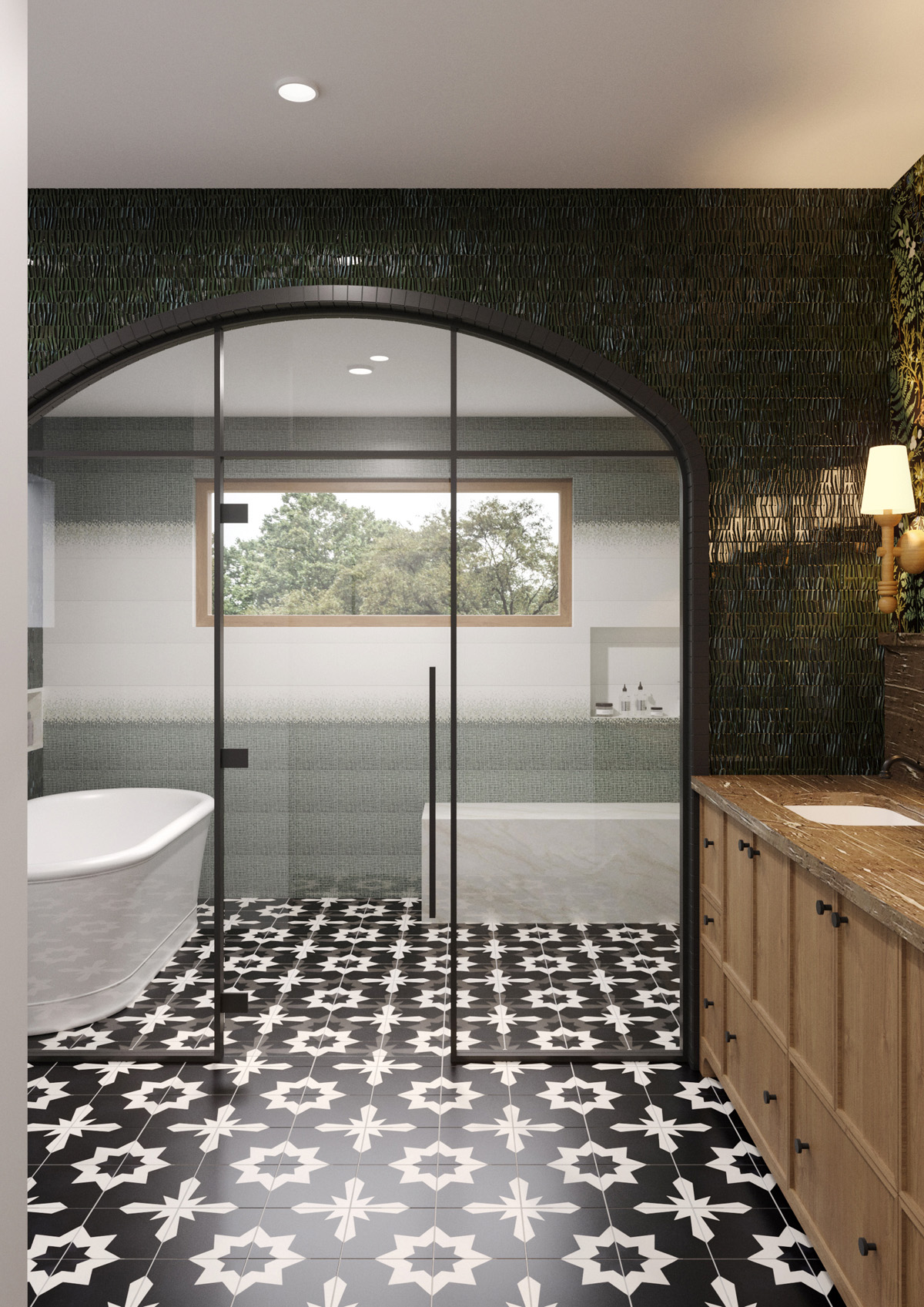
Laura Brandwein’s clients were…
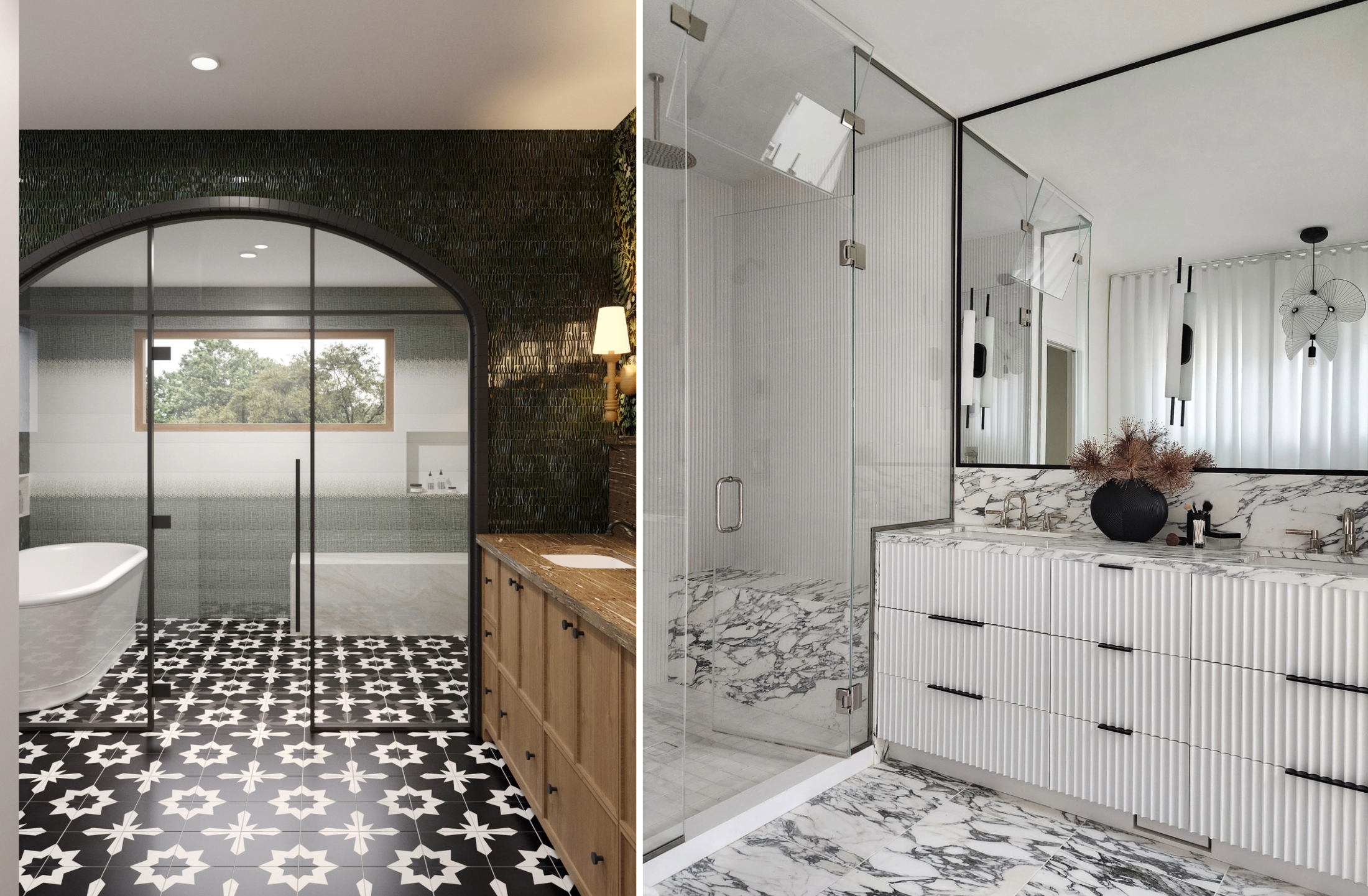
Laura Brandwein’s clients were looking to live big and bold, supported by modern Mediterranean and eclectic tile selections. That translates to using contrasting black and alabaster cement tile on the floor, which forms a classic Moroccan star and cross motif. The arched entrance to the wet room is clad with dimensional clay tile in a deep green.
Photos: Rock House Design
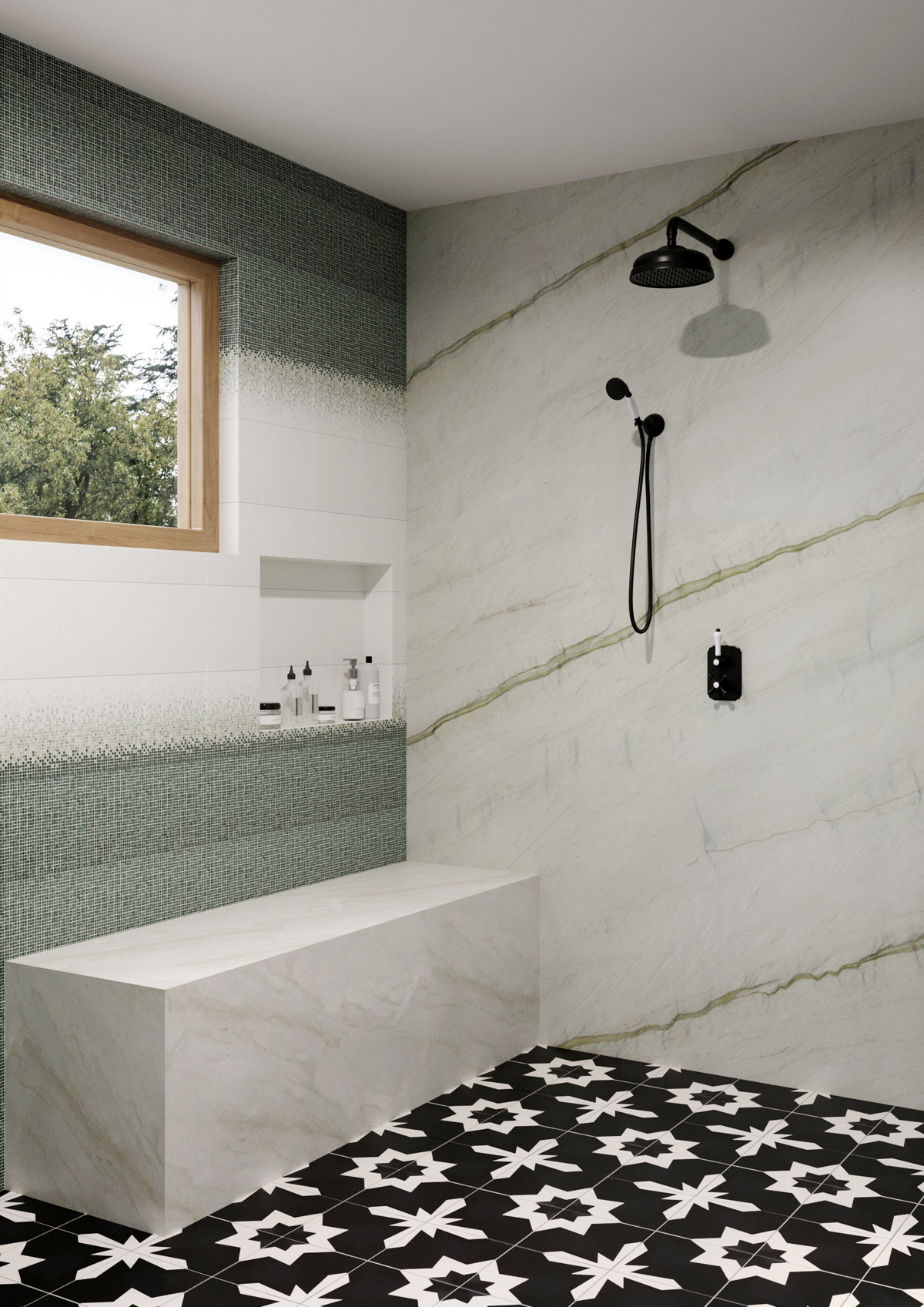
The showstopping star and cross…
The showstopping star and cross cement tile extends into the wet room where it is surrounded by walls of marble and mosaic green and white tile that gradates from dark tiles at the floor and ceiling to light tiles in the center, creating an ombre effect.
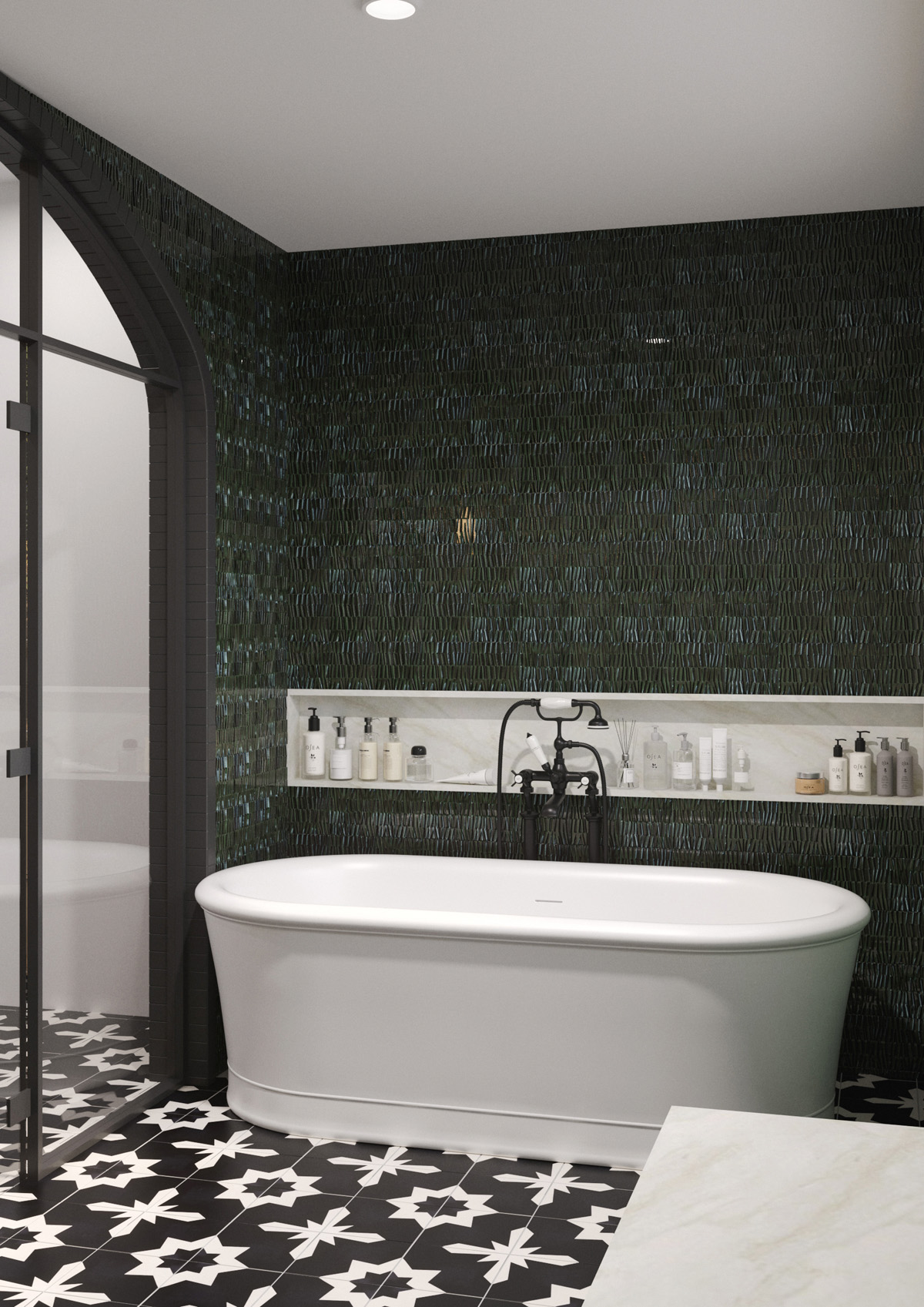
This accent wall behind the tub…
This accent wall behind the tub showcases a dimensional tile in a deep emerald green.
Specifically, Villa Lagoon Tile’s Comino 8″x8″ cement tile in contrasting black and alabaster forms the classic Moroccan star and cross motif on the floor.
“I’ve been seeing strong interest in natural tiles – tile that is of a living material, like cement, clay and Saltillo, and even glass – for several years now,” she relates. “They keep showing up, and they continue to get better and better. I love them because they patina and develop a lived-in look that brings life and adds charm to a space.”
Brandwein extended the showstopping star and cross tile into the wet room where it is surrounded by walls of natural stone and complementary tile. The former is a white marble with green veining that clads one of the plumbing walls and encases the shower bench. Its inclusion adds a touch of luxury to the space. Green is further featured in the window wall where green and white mosaic tile from Artistic Tile gradates from dark tiles at the floor and ceiling to light tiles in the center, creating an ombre effect.
The third wall, which serves as an accent behind the tub, showcases AlysEdwards Tile and Stone’s Rok Candy in Dare to be Emerald. The ceramic tile’s clay base is hand pressed into molds that form hills and valleys, which are hand-sprayed with a deep green glaze to create a sugared crystal effect that gives the tile depth.
Brandwein repeated the dimensional tile on the arched entrance to the wet room, accenting it with a frame of black ceramic tile. On the room’s ‘dry’ side, the dark colors complement the wallpaper on the vanity wall.
“I love all of the different scales of tile used in this bathroom…from the very small mosaics to the mid-size dimensional tile to the largest-scale cement tile,” the designer adds. “They all work well together while creating interest and playing into the desired maximalist style.”
Texture with an edge
Although Alida Coury pays attention to what is happening in the design world, she isn’t necessarily one to follow trends. At the same time, she isn’t opposed to incorporating popular ideas either.
“I love sprinkling in some of the ideas going on in the design world,” says the founder of Alida Coury Interiors, a design studio based in Southern California that serves clients across the country. “But I am not one to make hard rules on what is in or out. It should always be up to the person who is using the space if a particular design is relevant or not.”
Having said that, she has noticed there is a return to color in the way of deeper, saturated tones. As well, she is seeing a greater use of tile on walls and ceilings.
“It creates a higher-end approach, even for penny and subway tile,” she relates. “And, we are mixing shapes and finishes to create more visual interest as well. I think people are craving a look that is more their own.”
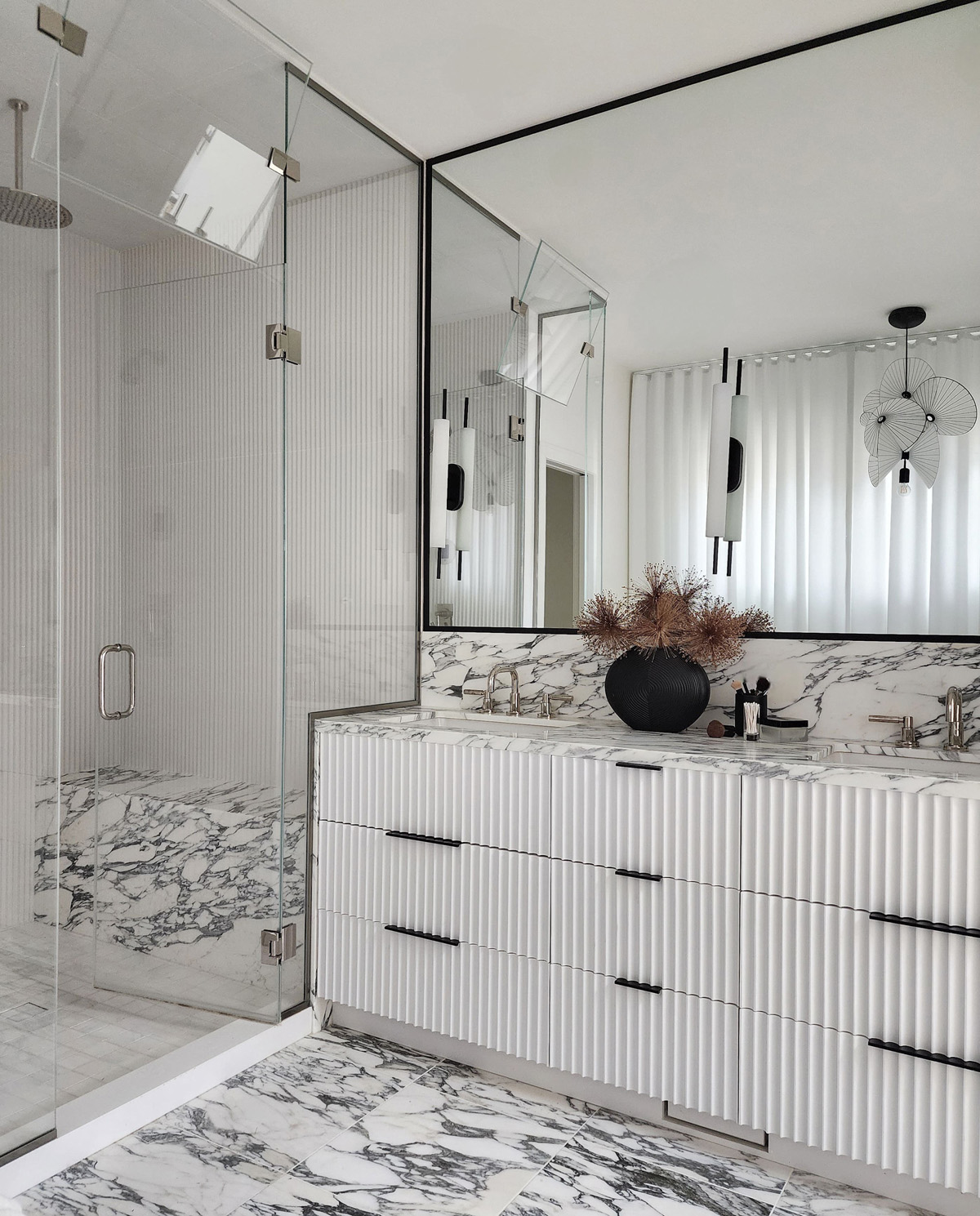
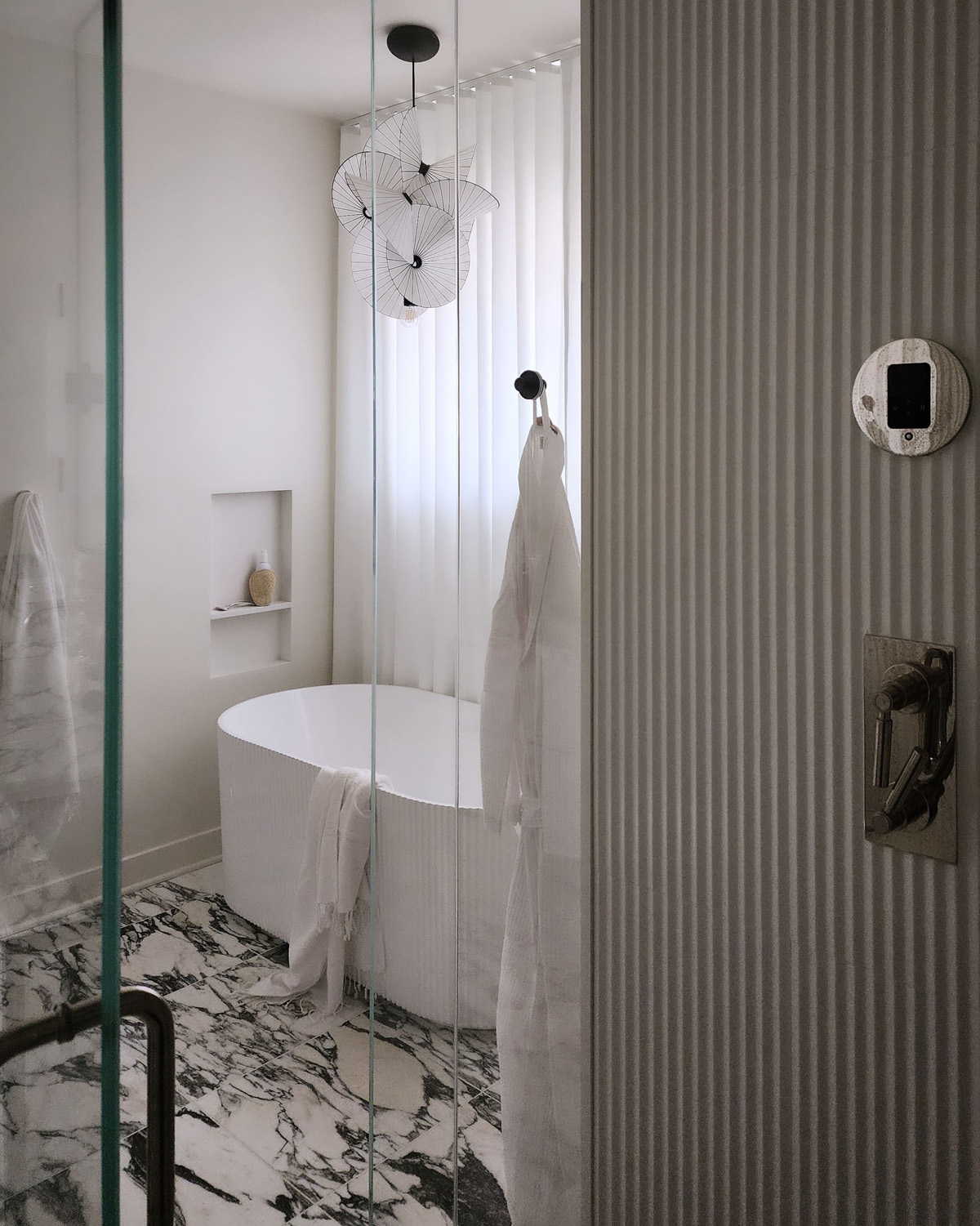
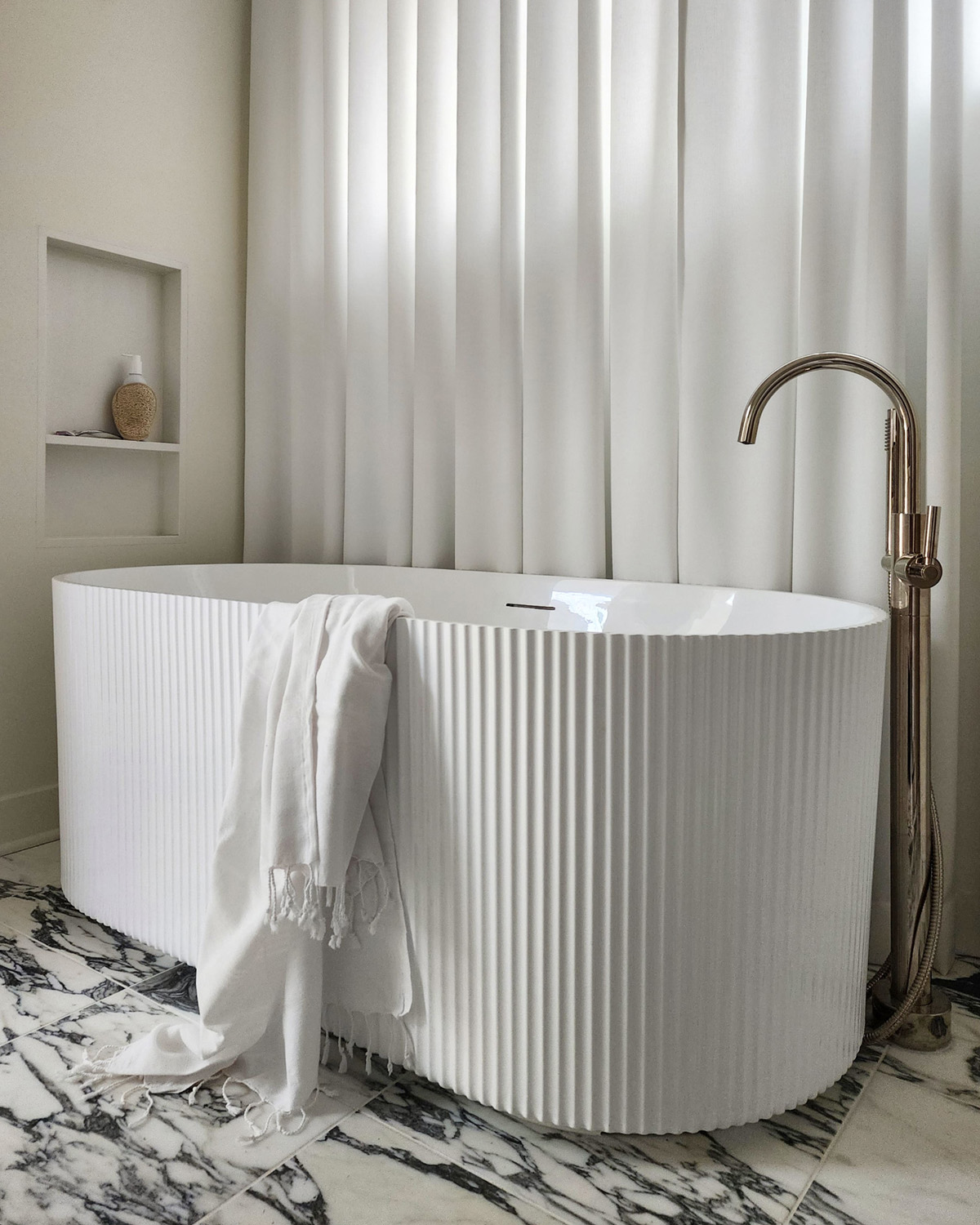
Alida Coury loves to bring texture into her bathroom designs, and in this example, white fluted ceramic tile…
Alida Coury loves to bring texture into her bathroom designs, and in this example, white fluted ceramic tile on the shower walls provide that texture. Its dimensional features echo the fluted vanity and freestanding tub while its agelessness is supported by classic marble for the shower bench, bathroom floor, vanity top and backsplash.
Photos: Alida Coury Interiors
Coury also loves to bring texture into her bathroom designs as a way to create depth and to add a tactile feature. Take for example one recent primary bathroom renovation where she used white fluted ceramic tile from TileBar’s Mod 3D Collection on the walls in her clients’ shower.
“It’s a very unique tile that gives the space texture and a bit more edge,” she says. “Its light color also helps keep the bathroom open and airy in the traditional sense of a spa-
like space.”
This particular selection’s architecturally inspired 3D shape also echoes the custom fluted millwork on the vanity and the fluting on the Randolph Morris freestanding tub.
“The dimensional effect on the tile keeps the space feeling uniquely curated by playing off the vanity and tub,” she explains. “It was a great way to play with dimensional features, without going into a modern look that feels cold or dated. I like creating casually elegant spaces that call you into a room, rather than rope them off as a gallery. And I love that there are so many more tile options now than when I first started my career. These textural and dimensional tiles can add an architectural element to a room. And, they are so much fun to play with!”
While the designer indicates that some textural and dimensional tile can more easily become dated, she appreciates this particular tile’s agelessness, which she further supported with classic marble for the shower bench, bathroom floor, vanity top and backsplash.
“The timeless look of fluting and marble make the space feel very luxe with the mix of polished nickel plumbing fixtures,” Coury relates, “all of which contrast against the modern matte black lighting and hardware.
“The main level of the home has a more contemporary theme of black and white with warm accents,” she continues. “These clients leaned a little more modern in some finishes upstairs, including in the bathroom, but the fluting and marble balance it out in a timeless way.”
Bold and purposeful
Kristen Harper and Michelle Flores love to infuse their design/build projects with color.
“In general, color plays an enormous role in the spaces we design,” says Flores, owner/construction manager at Remodel Boutique in Austin, TX. “It shapes how we perceive a space and it can be an easy way to elevate it and stay within budget. Plus, it just makes people feel happy!”
The duo used color in a variety of ways in one recent bathroom renovation where multiple shades of blue, on the walls and ceiling as well as the vanities, mix with graphic black and white tile. The combination highlights the room’s transformation from an awkward and inefficient space, which was originally converted attic space with limited natural light and relatively short 5′-tall perimeter walls, into a highly functional primary bathroom with double vanities, a spacious shower and a soaking tub. Rethinking the layout even created enough room to include a seat for reading late at night.
Entering the space, the first visual is the showstopping, dramatic accent wall, which is clad floor to ceiling in Cement Tile Shop’s 8″x8″ Tulum cement tile in Pacific Black and Pacific White. An expansive window allows natural light to flow in and prevents the tile from overwhelming the room.
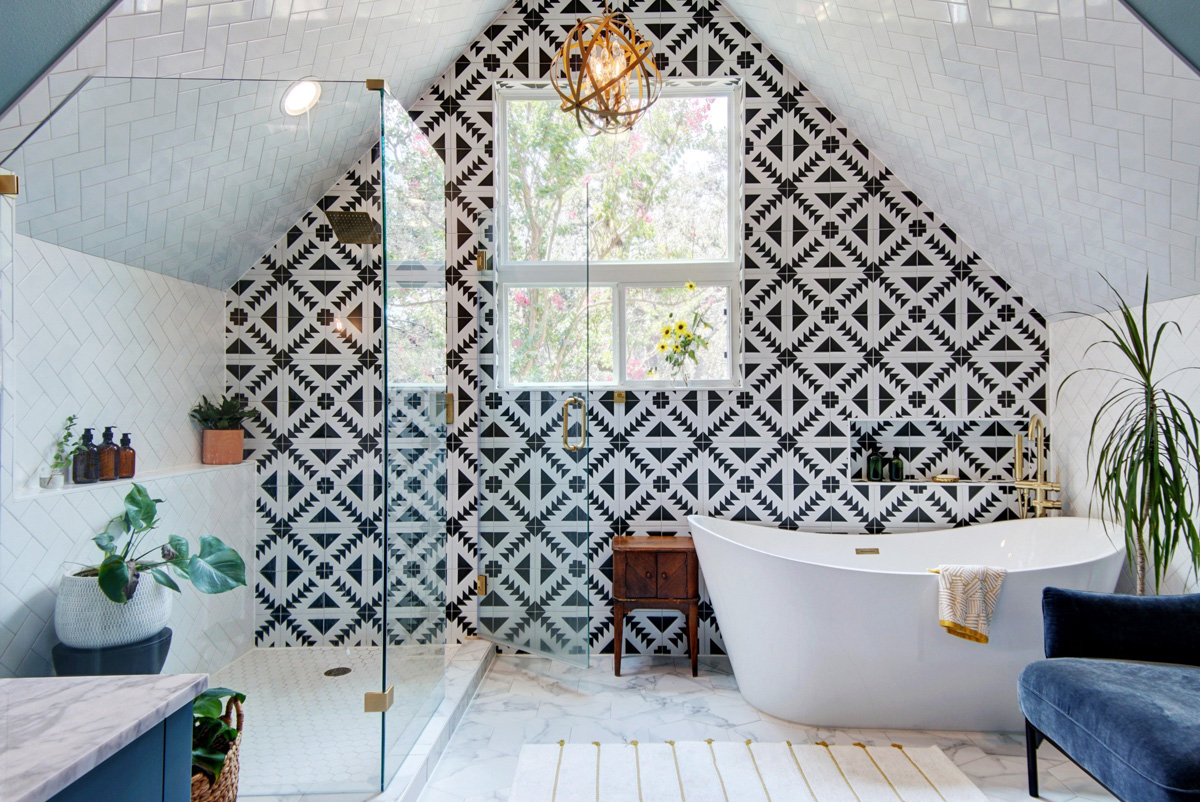
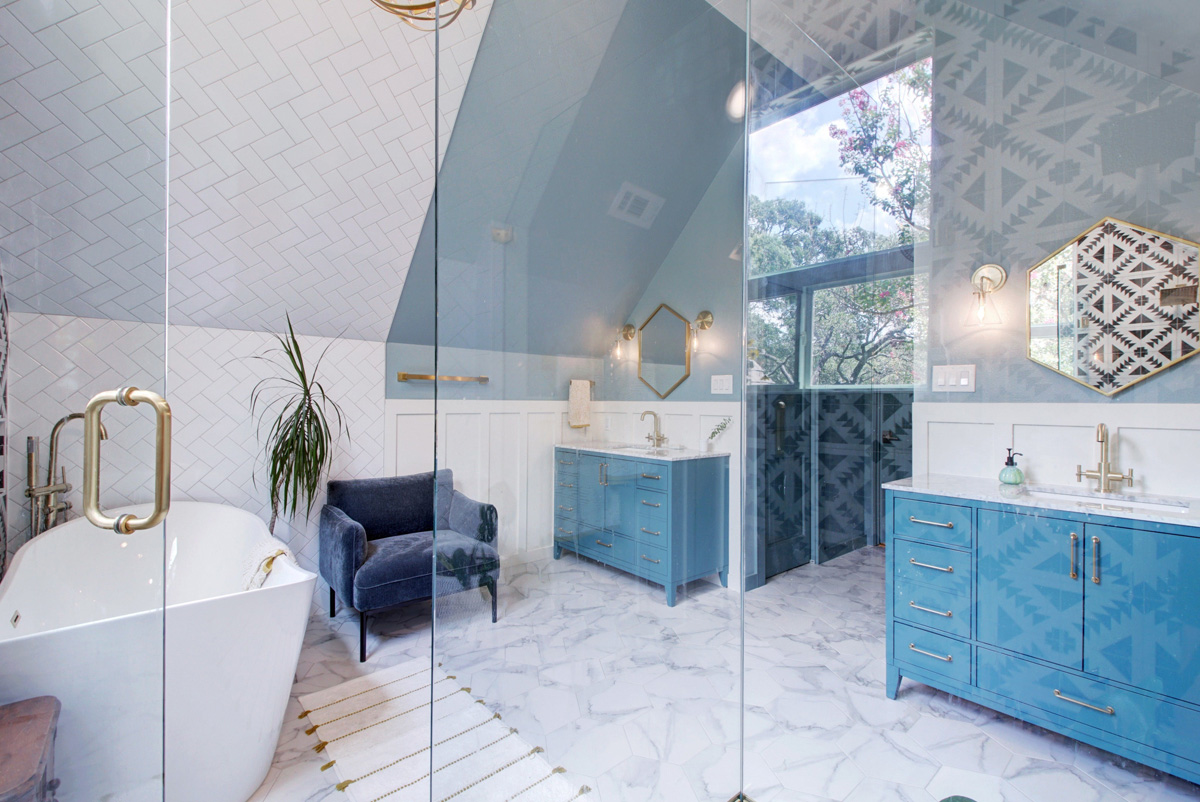
Kristen Harper and Michelle Flores love to infuse their design/build projects with color. In this primary bathroom…
Kristen Harper and Michelle Flores love to infuse their design/build projects with color. In this primary bathroom, they mixed multiple shades of blue with graphic black and white cement tile, the latter of which creates a dramatic accent wall behind the freestanding tub and into the shower.
Photos: Remodel Boutique
“The tile draws the eye to a space that could otherwise feel a bit ‘attic-ey’,” says Harper, owner/design manager. “The wall has a lot of different angles, but the graphic tile plays into its shape…making it feel very purposeful. Instead of trying to hide it, it’s about saying ‘look at me, I’m here!’ If that tile was something like a plain white or gray, it would just be a wall with a few different angles.”
When a client wants to make a statement with tile, the duo often chooses a highly visible wall.
“If we would have done white subway tile on all the walls and used a bold tile on the floor, it wouldn’t have been as impactful, which is fine if that is the look a client wants,” Harper continues. “But if someone is splurging on a highly patterned or brightly colored tile, or something else that is out of the norm, the smartest place to use it is a place where it can be a focal point.”
The pair used neutral subway tile, Festival’s Bright White Ice 3″x6″ ceramic tile, on the side walls, which become part of the shower on one side of the room. Its simplicity creates further focus on the back wall, drawing attention to a specific area of the room and adding visual interest to make the space feel more dynamic and less cramped.
“Functionally, the subway tile in this bathroom provides protection against humidity and water exposure at the shorter angled walls,” Flores explains. “Aesthetically, the light-colored subway tile set in a vertical herringbone pattern further enhances the effect of a taller space. It also helps bounce natural and artificial light around the room. I often recommend placing glossy tiles in the shower area or on a feature wall to catch light and draw the eye upwards, creating the illusion of height. Glossy or high-shine tiles on walls can also create a mirror-like effect, making a bathroom feel light, bright and open.”