

Home technology integration has come a long way from its humble origins of simply installing TVs and sound systems in homes. However, for many designers, builders and architects, the myriad technology systems and options remain daunting – sometimes perceived as a “necessary evil” in their projects that they reluctantly accommodate.
Technology can seem overwhelming, complex and often intrusive to the aesthetics of a space. As I begin regular contributions as a columnist for Kitchen & Bath Design News, I aim to make accommodating your clients’ technology needs as straightforward and seamless as possible, alleviating any apprehension and inspiring confidence, highlighting the exceptional opportunities technology can offer when skillfully integrated into your designs.
Collaborating with Tech Pros
With a career spanning nearly three decades in the custom integration industry, I’ve had the opportunity to work with some of the most discerning architects, builders and interior designers in Southern California. Currently, I am the CEO of the Home Technology Association (HTA), an organization that was formed to establish clear quality guidelines, create greater transparency and bridge the communication gap between the design and build trades and home technology integrators. The HTA is a link connecting architects, designers and builders with qualified technology integrators who respect and enhance their design visions.
By working with the HTA, designers can breathe a sigh of relief. You don’t need to feel the pressure to become technology experts – that is what the technology integrator is for. HTA Certified integrators are rigorously vetted for technical proficiency, exceptional customer service and a positive reputation. This certification serves as a badge of trust, reassuring you and your clients of a superior technology experience. In essence, HTA Certification functions similarly to Michelin stars for restaurants or GIA ratings for diamonds, offering designers a reliable standard for selecting technology partners.
“Early collaboration with a qualified technology integrator transforms technology from a ‘necessary evil’ into a seamless component of luxury living.”
And, for clarity and consistency, going forward I will use the term “technology integrator” or just “integrator” to describe what has often been informally called “the AV Guy.” This shift in terminology is intentional for several reasons. First, today’s technology integrators design, install and service far more than audio and video components. Secondly, our profession includes many woman-owned integration firms, making the term “AV Guy” outdated and inaccurate. Finally, the concept of “integration” is precisely what these professionals do: integrating multiple technology systems into a cohesive whole and carefully blending these technologies into a home’s structure and décor in a visually appealing way.
Early collaboration with a qualified technology integrator transforms technology from that “necessary evil” into a seamless component of luxury living. When brought into the conversation early, skilled technology integrators act as collaborative design team members, addressing both functional and aesthetic considerations upfront, eliminating potential issues before construction begins. Integrators who understand design needs help avoid aesthetic compromises and costly last-minute changes – an unfortunate hallmark of projects that neglect early tech planning.
To ensure seamless technology integration, it’s essential to bring an integrator into the project during the schematic design phase. The best integrators start with a consulting and design plan, creating drawings and documentation that interface directly with your design plans. These documents clearly identify technology placements and facilitate design collaboration. Such proactive planning helps clients and designers envision how technology will blend with the home’s aesthetics while reducing potential conflicts and eliminating costly changes.
Adopting a Key Guideline
An important part of the early technology and design process is the implementation of the Project Technology Assessment form – a new tool that represents a significant advancement in helping you effectively meet and exceed your clients’ technology expectations (download PDF).
The Project Technology Assessment form was born as a result of direct requests by design and building professionals. Prior to the 2022 KBIS/IBS show in Orlando, a group of custom home builders I serve with on an NAHB committee admitted that they often forget the breadth of home technologies that today’s integrators design, install and service. Today’s technology integrators offer significantly more than audio/video products, encompassing sophisticated systems like smart home controls, lighting controls, motorized shading, security systems, home networks and WiFi systems, surveillance cameras, access controls, energy management systems, lighting fixtures, sports simulators and wellness solutions.
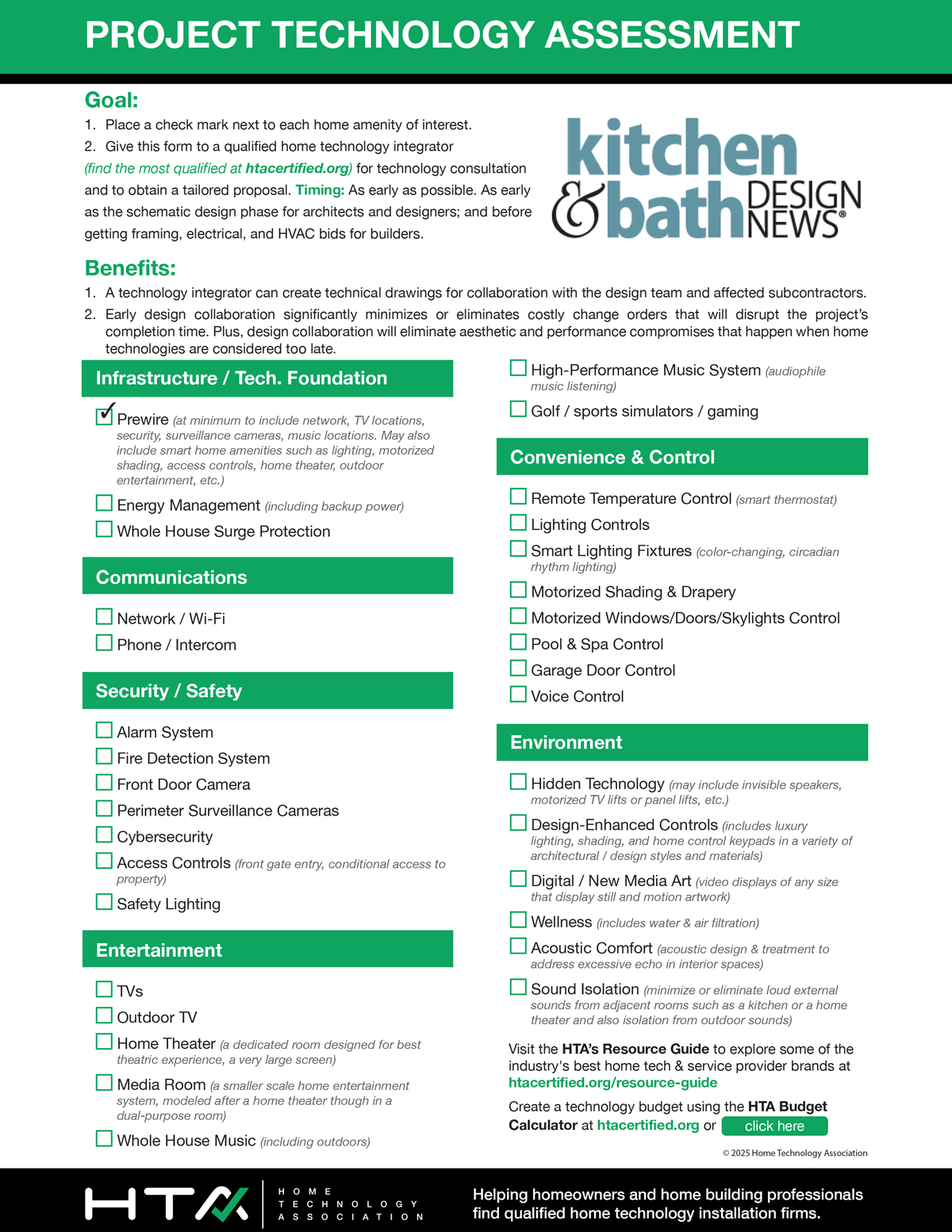
Recognizing this knowledge gap, industry professionals requested a concise tool to communicate available technology solutions clearly to their clients. The HTA responded by developing the Project Technology Assessment form – a one-page “cheat sheet” that allows designers and builders to present clients with a comprehensive yet easy-to-understand overview of potential technology amenities, enabling meaningful discussions about technology early in the design process.
The Project Technology Assessment form details various home technology options – from foundational elements like pre-wiring for networks and security systems to lifestyle-enhancing features like motorized shading, human-centric/circadian lighting systems, and invisible speakers. As a designer, you don’t need to be a technology expert. Instead, your role is to provide informed guidance, leveraging this form to identify client preferences. This allows you to lead the technology conversation. This puts you in the driver’s seat, so you can select a qualified design-centric technology integrator who will respect your design vision.
As an example of things you can do to enhance the design experience for your client, consider the transformational impact that thoughtful lighting controls and motorized shading can have on kitchens and baths. Lighting controls simplify wall clutter by reducing multiple switches to a single intuitive keypad that offers preset “scenes,” adapting ambiance at the touch of a button or a simple voice command. Motorized shades enhance both privacy and aesthetics, seamlessly integrated and programmed to respond to natural light conditions throughout the day. This thoughtful approach doesn’t simply fulfill a function; it elevates the client’s experience.
The demand for wellness technologies is also rising, especially in luxury homes. Solutions like circadian lighting, air and water purification, and acoustic treatments significantly enhance the quality of life for homeowners. Designers who embrace these solutions not only deliver beautiful, functional spaces but elevate their value proposition. These benefits require integrators who appreciate and understand design nuances.
And great design often means seamlessly integrating technology so that it remains hidden when not in use. Invisible speakers, televisions concealed within cabinetry, mirror televisions, and digital artwork displays offer functionality without disrupting aesthetics. Features like hidden kitchen TVs or bathroom mirrors that transform into video displays elevate luxury living. To explore these options, simply select the “Hidden Technology” box on the form, and your technology integrator will suggest suitable solutions.
In short, designers are increasingly being asked to create spaces that are both visually compelling and technologically up to date. At HTA, my mission is to facilitate seamless partnerships between talented designers and highly qualified technology integrators. Through tools such as the Project Technology Assessment form, we aim to make technology integration not merely manageable but rewarding. I encourage you to embrace this tool as a catalyst for smoother, more successful projects. By bridging the gap between technology and design, you will create spaces that are not just aesthetically pleasing but also truly exceptional in function and comfort.
For more information on the HTA, please visit htacertified.org.
Josh Christian has been a technology enthusiast since childhood and entered the home technology industry in 1995 at a locally owned audio/video retailer. He moved to a custom technology integration company in 1998, where he helped the firm grow into one of the largest custom AV integration, home theater and home automation companies in the industry. In 2015, Christian joined a low-voltage technology consulting firm specializing in designing and engineering home technology systems until co-founding the Home Technology Association in 2017. An experienced educator, he has taught at CEDIA Expo and delivered dozens of industry outreach presentations to top architects, general contractors and interior designers.