

I have found that the average kitchen professional who sells cabinets is challenged with vetting prospects properly. In truth, I know of colleagues who were so eager for a sale that they raced out to measure, and then raced back to the office to price and design, only to find out that the person could not afford the cabinets. Situations such as these could easily be avoided if the professional vets the prospect properly.
The most important information to uncover when vetting a prospect is to find out what their planned investment is. When asked, most prospects will say “I am not sure,” but they do know because they have already asked a friend, neighbor or relative who has told them how much it could cost. They just want to know how much it would cost if they work with you and your firm.
Most people feel uncomfortable asking how much something will cost, and the truth is it’s also uncomfortable for the designer to ask how much money a potential client wants to spend. We know we have to talk about money before we design, yet it can be difficult to do so. We often find ourselves dancing around the elephant in the room.
The Vetting Experience
I struggled with this issue and, as a result, established a method that helps vet the prospect properly and talk about money with ease. The vetting process starts by providing an estimate to establish your potential client’s planned investment. This tends to go against the standard process most showrooms have adopted, which is to select product, design and then price.
When vetting, it is important to describe your company’s design process, and to ask, “Will our process work for you?” If they say no, stop the vetting at that point as that prospect is not a good fit for your company. If they say yes, then continue with more questions. The objective is to obtain their project timeline, scope of work and motivation to remodel. Vetting is fact finding that should be done thoroughly during the first conversation.
“The vetting process starts by providing an estimate to establish your potential client’s planned investment.”
Money is a major topic to discuss during the vetting process, and one way to make it more approachable is to refrain from using the word budget. Budget implies thatthere is a limited amount of money assigned. Therefore, the word budget is negative and not productive to use when delicately dancing around that elephant. I suggest elevating your delivery and use the phrase planned investment, because that phrase refers to the level of investment that person wants to commit with expectations of a financial return. After all, financial return is one of the main reasons to remodel – to improve the investment in one’s home.
When asking for their planned investment, most people will respond “I don’t know.” Your reply can be, “Then let me help you understand what it could cost; here is a copy of the Cost vs. Value report,*” which details the average nationwide remodeling costs. When sharing the report with them, make sure to explain the report’s value. I usually note how the report has helped my clients establish a baseline for what they could expect to spend, and then I note that I have found that the majority of my clients spend more than what the report states. By emphasizing that, I have just set up expectations on what the project could cost.
Estimating Price Range
Estimating is easy and best to do during the first meeting. If that first connection is by phone, then reviewing pictures of their space via text can work just as well. I prefer to present an estimate in person in their home.
I start the estimating process by stating, “If you are unclear how much your kitchen could cost, let me help you with a baseline estimate.” I then start by using their existing kitchen to get an estimate; I count cabinets, quickly measure countertops and write down the selling price line by line, calculating the total and handing over the paper. I note that this is a quick estimate for the current kitchen, and the cost would go up if the design changed or the space was expanded.
When presenting an estimate I stress that this is a price range and, once we go through materials and preferences, we can proceed with an accurate price. I note that, if they decide to work with us, I will be sure to work within their planned investment, educating them along the way and telling them what they need to know, not what I think they want to hear. I also assure them that I will find cost savings when I can. I close with, “So what do you think the next step should be?”
I am always perplexed when I hear from colleagues that they refuse to provide an estimate in the beginning because they feel the prospect will hold that number against them. While they might, they won’t if you emphasize that it is an estimate and show them the price range, such as shown above with the total being the estimate.
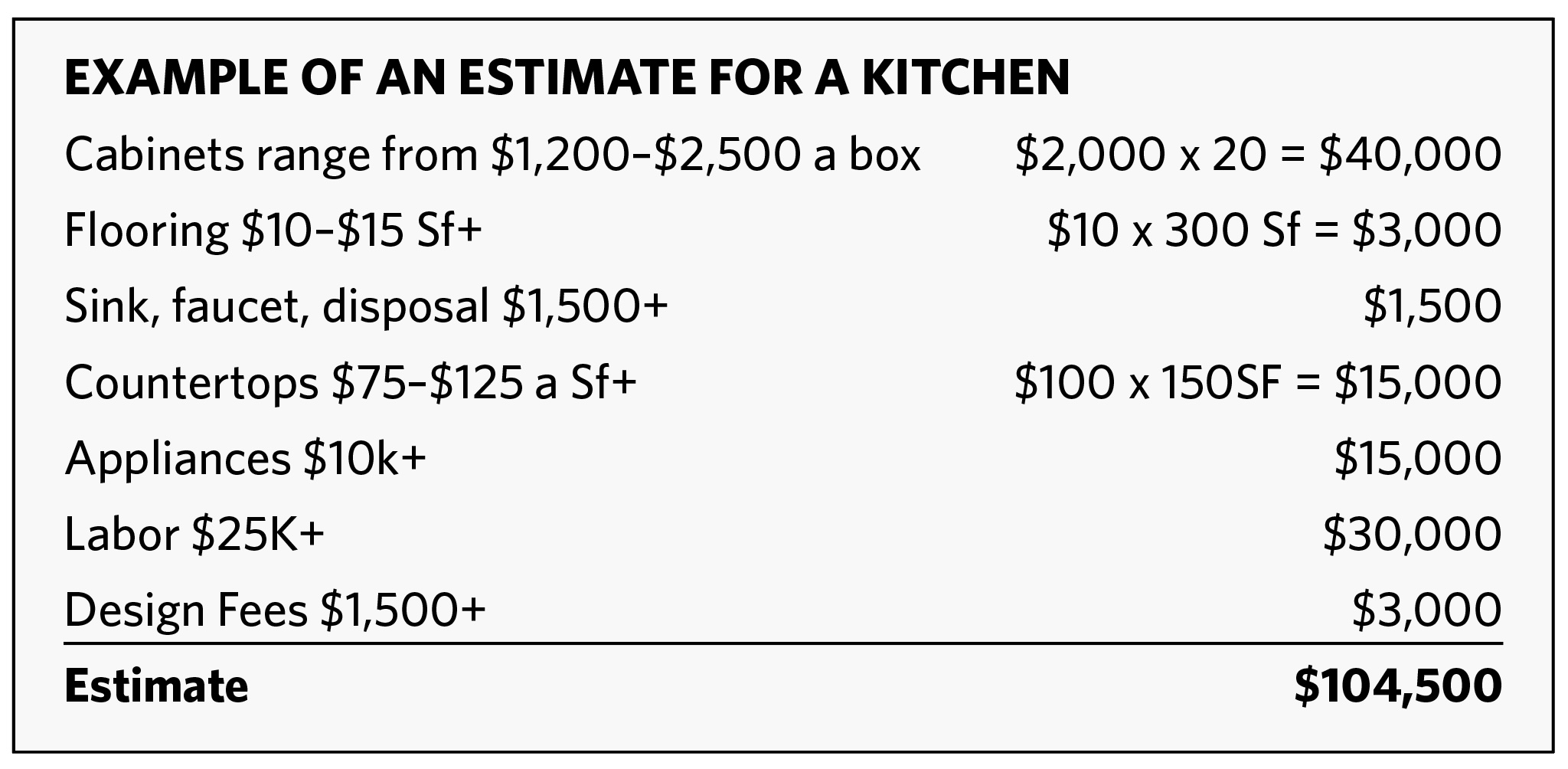
You can easily build your tool chest of product estimates by perusing your past projects to calculate the average selling price per item. For cabinet box price, count the number of cabinets on a recent job (tall cabinets count as two); divide by the total selling price of the cabinets to get the average box price. To get a price range, use different cabinet orders that vary in price.
In summary, improve your vetting process to obtain the correct information to confirm that this prospect can afford your services. Time is all we have, so stop wasting it on potential jobs that will go nowhere. Learn to approach that elephant in the room head on by addressing money right away.
*Cost Vs Value Report published annually by Remodeling Magazine
Jan Neiges, CMKBD, has been part of the kitchen and bath industry for 25 years, starting her own design firm in 2012. She is currently v.p. of sales & design with Avalon Cabinetry in Englewood, CO. An award-winning designer, she is a past Board Member for the National Kitchen & Bath Association (2019-2022) and past president of the NKBA Rocky Mountain Chapter. In addition to designing kitchens and baths, Neiges is a business coach for designers and acts as a mentor for design students. She can be reached at [email protected].