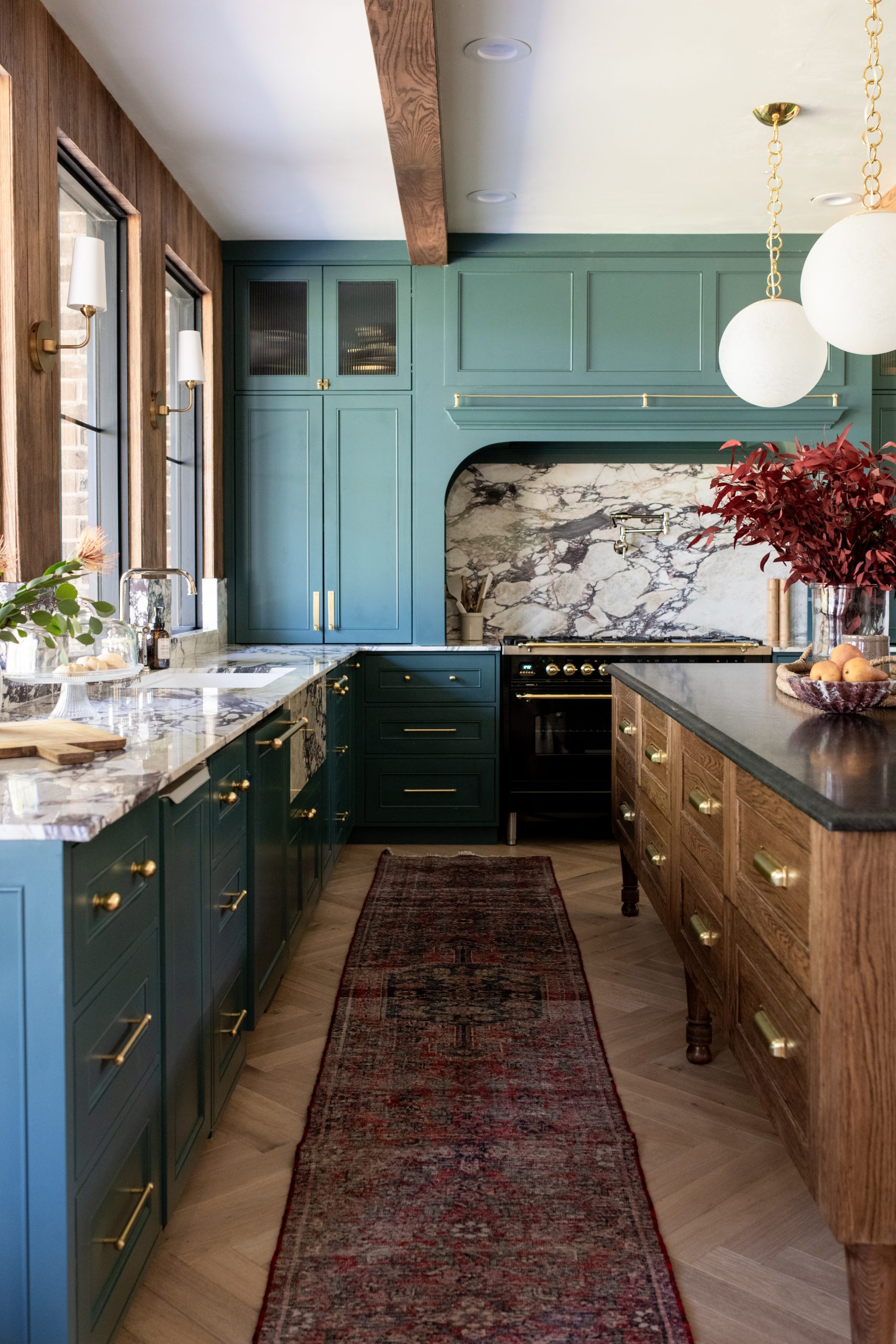
SAN ANTONIO, TX — Cammie Malaga finally has her dream kitchen in her dream home. After moving frequently and living in 11 different residences to accommodate her husband’s career, the empty-nester couple finally settled in more long term by purchasing this circa 1995 gem in May 2023. The principal designer of CM Interiors in San Antonio, TX, admits that her initial draw to the property was one of sentimentality.
“The home is late ’80s inspired,” she says. “It reminded me of all the beautiful homes I saw in the TV sitcoms when I was growing up. My mom was a single mom with six kids. We didn’t have much money and I used to dream about some of the things these homes had…like a laundry chute and a dumbwaiter. And, a couple of them had stairs that led right into the kitchen…just like this home. When I walked in, I loved it right away!”
Photos: Madison Kircher
Other initial recollections, although not necessarily highly esteemed, were the kitchen’s lack of light, storage/counter space and a focal point. There was also an exterior door in the middle of the primary walkway. However, she knew all of those maladies could easily be remedied with an extensive renovation, which she embarked on with her daughter and junior design team member, Madison Kircher, as well as Justin Korb at KJ Works who served as general contractor.
As she considered the transformation to her dream kitchen, it included a foundation of European-inspired elements. Take for instance, the island.
“European islands are typically a piece of furniture, or minimally something that is different than the perimeter,” she relates. “And they aren’t usually solid to the floor.”
Malaga admits she could have purchased an actual antique piece of furniture for her kitchen, which she has done in previous homes, but rather, she opted to design something that mimicked it.
“It’s difficult to find just the right piece…something that is the right size, with drawers that don’t stick and glides that work properly,” she remarks. “Instead, this island has all of the modernity and functionality of a current-day island, with the look of something that is old.”
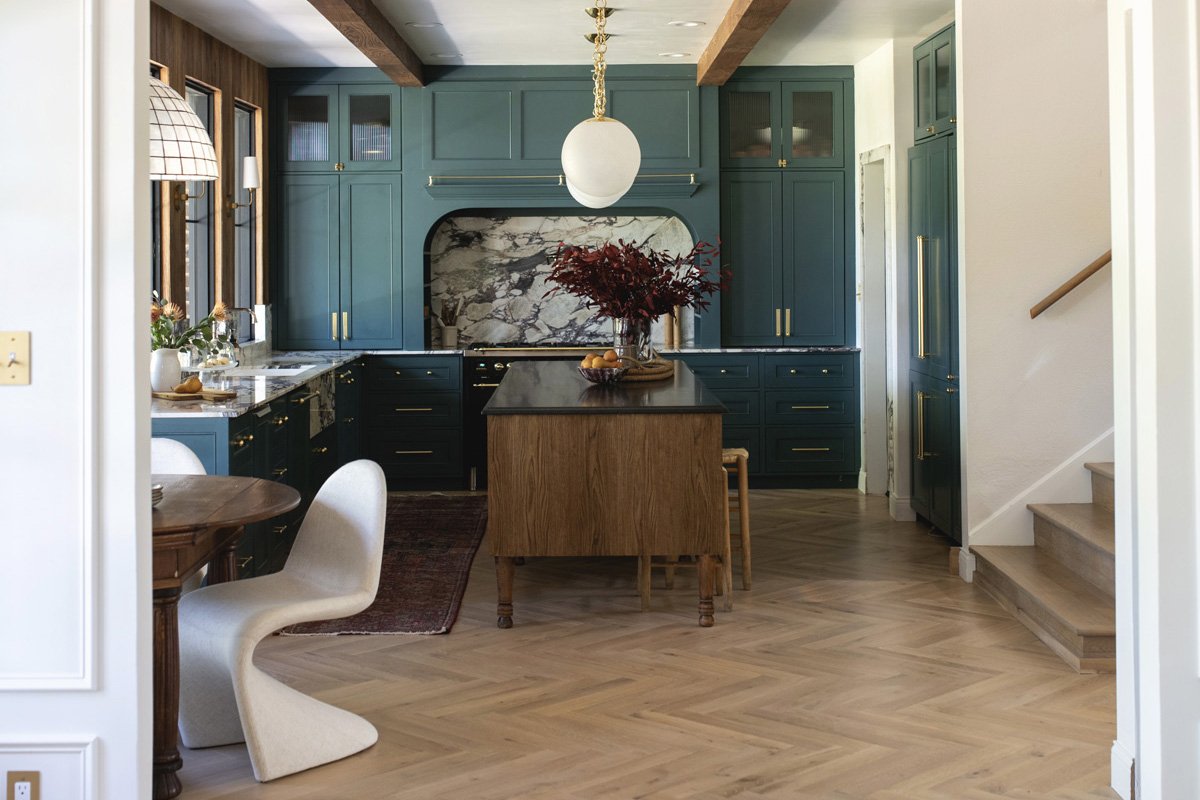
In affirmation, it is crafted from white oak lightly brushed with a wire brush to add texture and to draw attention to the grain pattern. A dark stain, Minwax’s Provincial, gives it a European vibe, and maybe most importantly, it has legs that were custom-made from a woodworker on Etsy. The designer included seating on one side and drawers on the other, the latter of which stores daily-use items such as cups, bowls and plates directly opposite of the dishwasher. The designer topped the island with honed Nero Mist granite with a traditional ogee edge profile to complement the inset shaker cabinetry accented with a small bead.
“Granite is relatively inexpensive, hardwearing and readily available,” she observes. “But, I don’t find many of the colors appealing…with the exception of this one. It looks like soapstone, but it doesn’t have the maintenance or porosity of soapstone.”
While durable and hard-working natural stone serves as the island top, Malaga made a complete 180-degree decision for her perimeter countertops and backsplash.
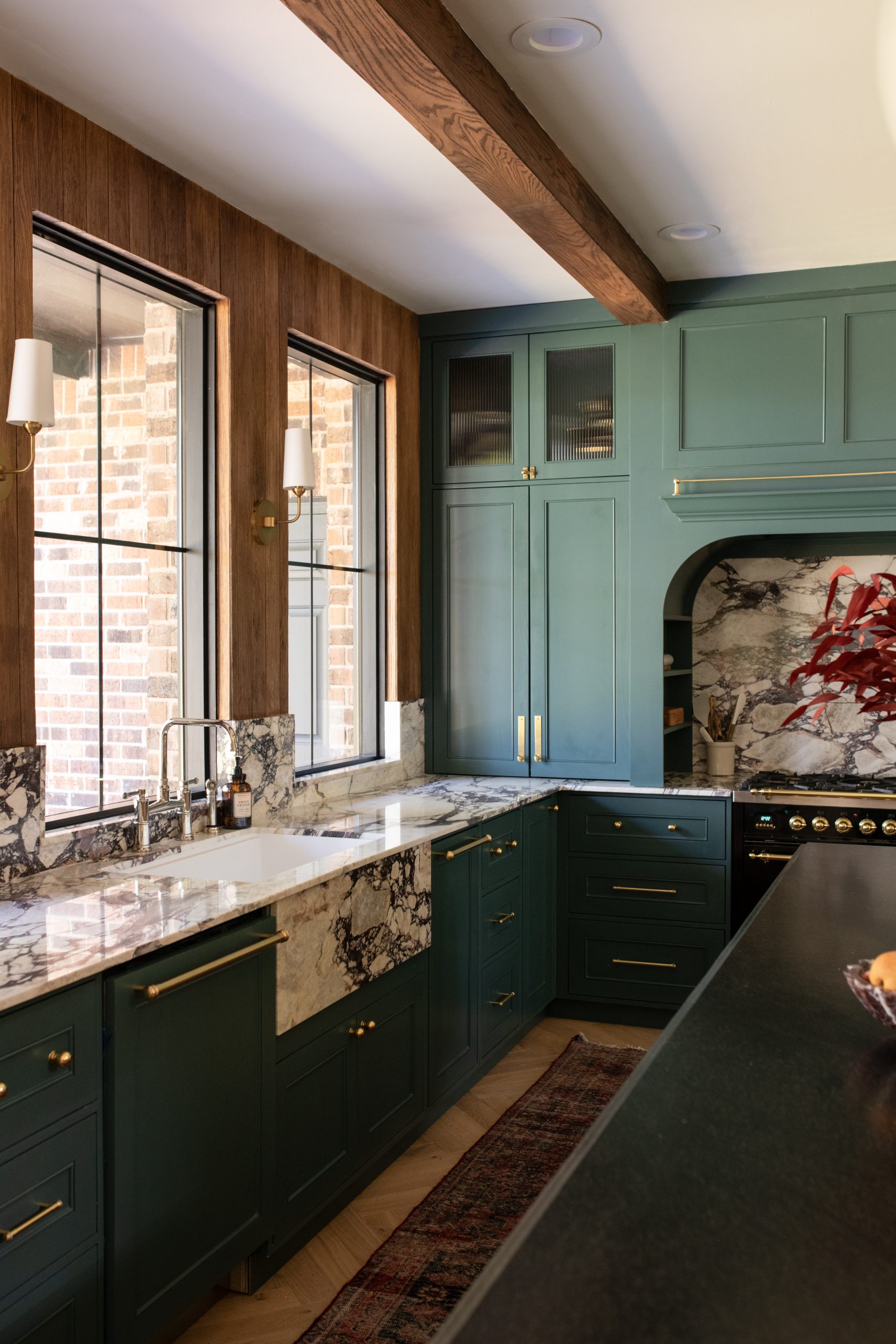
“I love Calacatta Viola marble,” she says, adding that also using it as an apron front for the sink, which is accented with a Brizo Litze faucet in a Polished Nickel finish, helps to protect the cabinetry. “It’s completely opposite of the granite…not readily available, fragile and expensive! But it has the most beautiful purple, green and gold veining.
“And while it does etch and scratch, I don’t mind,” the designer continues. “Marble is used all over Europe and even here in Washington DC for our monuments. They are worn, but that’s okay. Having something that ages and patinas tells a story. It gives soul to the home.”
Balancing Color and Warmth
Drawing upon colors from the marble, Malaga chose to use Farrow and Ball’s Inchyra Blue for the custom perimeter cabinetry, which also includes panels for the Dacor refrigerator and dishwasher.
“I honestly love the color,” she relates. “I knew I wanted something saturated for my kitchen.”
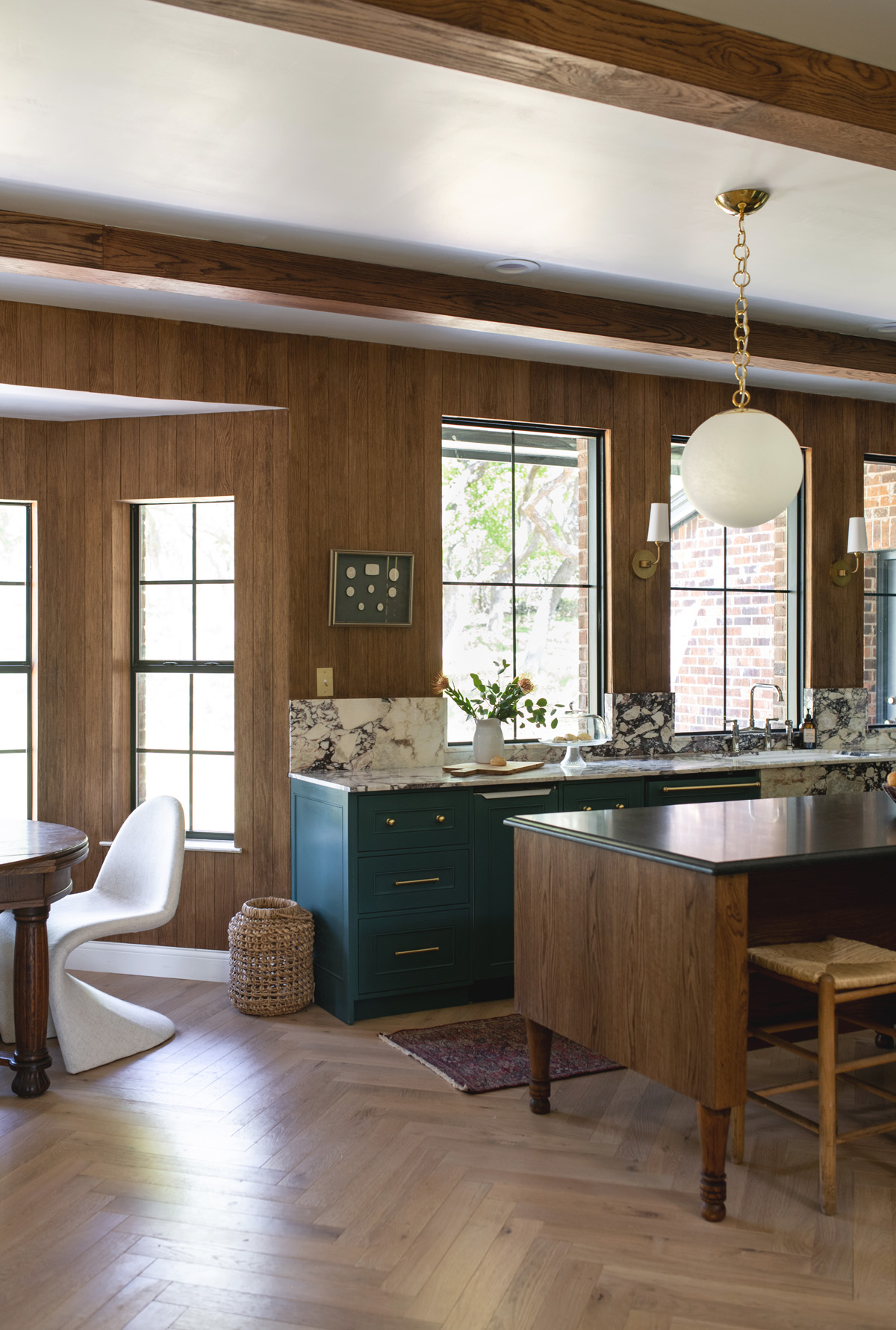
To balance the relatively bold color and to add richness and warmth, the designer included white oak veneer for the window wall, extending it into the adjacent breakfast nook. Stained to match the island as well as the ceiling beams, the strips were custom cut to a dimension that makes the paneling feel more European as opposed to more-trendy shiplap.
The oak veneer also frames the new trio of 5′-tall windows that replaced the previous exterior door and the more traditionally sized single kitchen window.
“There is a lot of light in here now,” she says. “One of the problems with the previous kitchen was that it lacked light, so I knew I needed more windows that were also taller. Also, removing the exterior door allowed me to create a longer island and bigger footprint for more storage and counter space.”
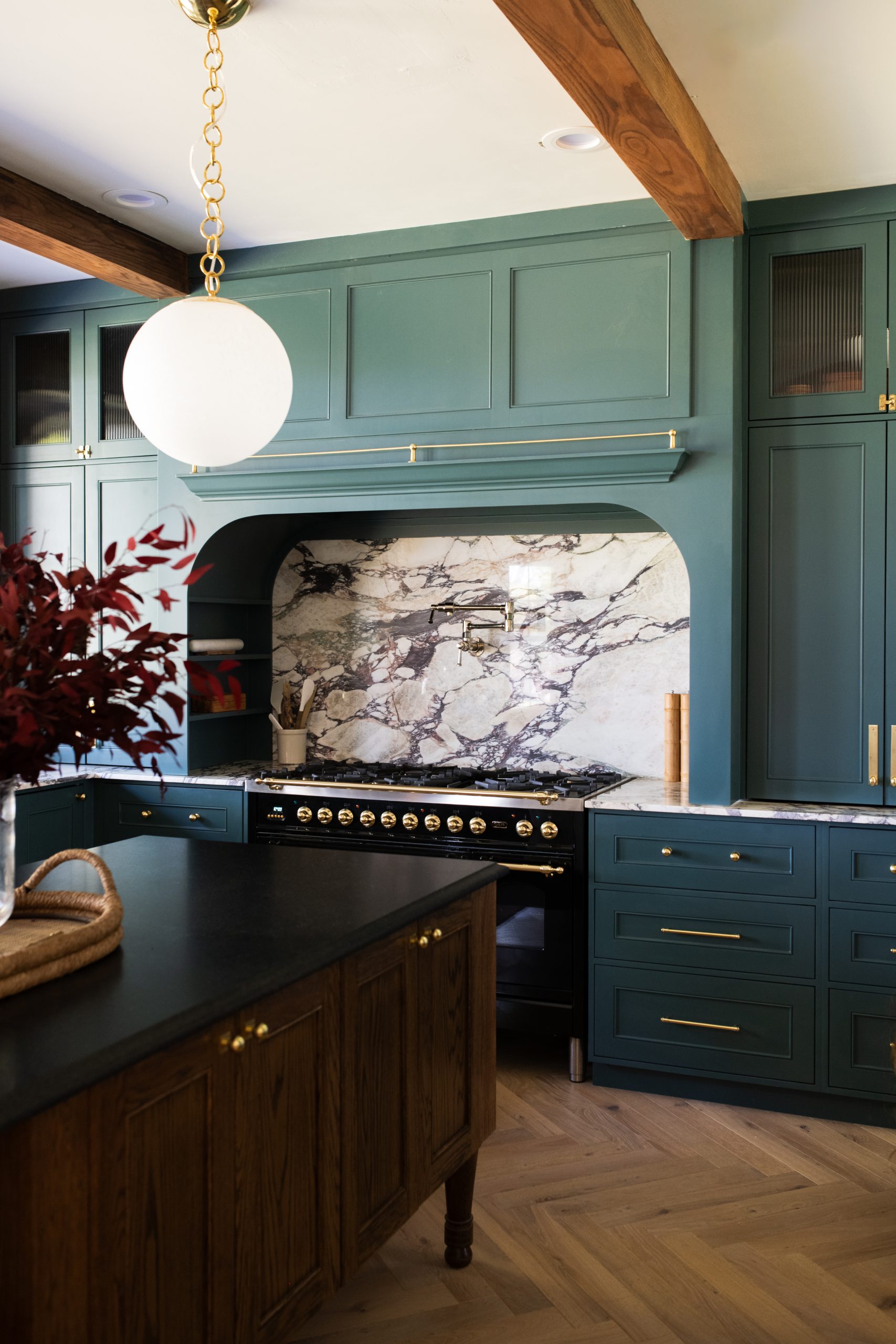
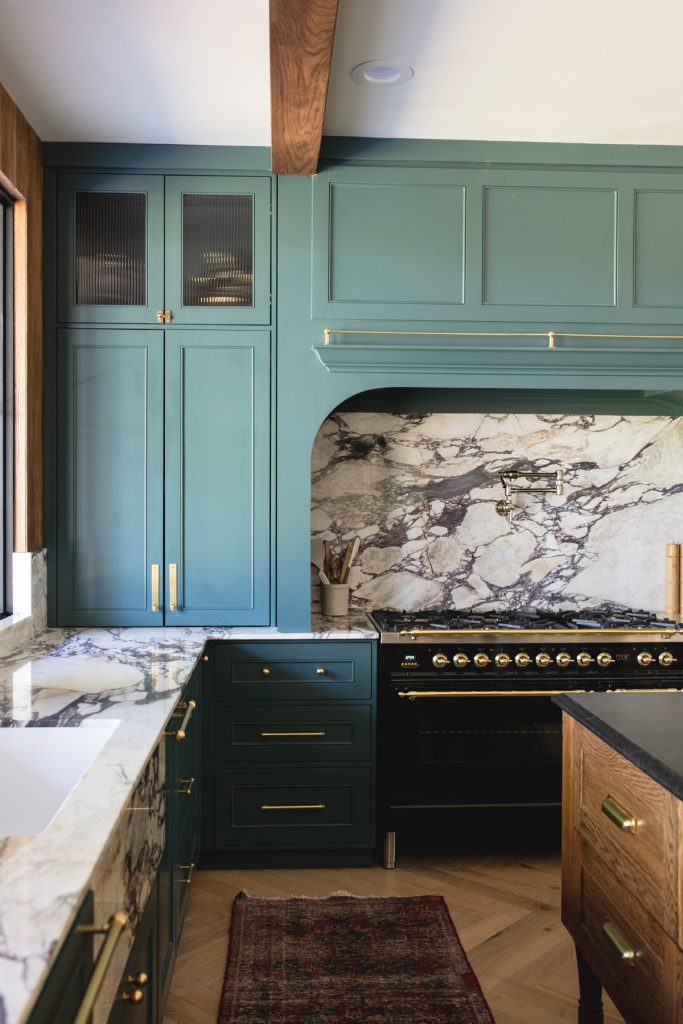
To further enhance storage for the relatively small kitchen, Malaga chose to extend the cabinets that flank the glossy black ILVE range from countertop to ceiling. Reeded glass doors on the uppermost cabinets give her a bit of display space, and serve as a nod to Europe.
“These are my favorite, favorite cabinets,” she expresses, noting she also often uses them in her clients’ designs. “I store my Breville Barista Express coffee maker in one of them. It’s a beautiful machine, but I don’t want to see it. And, when we spill, it’s easy to wipe up the mess since the coffee maker just sits on the countertop. In fact, I store all of our small appliances behind these doors…the toaster oven, the blender, etc. I don’t have to move them, and I don’t have to see them.”
Similarly, as it relates to convenience, the designer included shelves inside the alcove for storing frequently used cooking oils and spices. Giving the alcove a curved arch softens the abundance of square edges.
“There are so many squares in a home, especially in a kitchen,” she mentions. “There are square cabinets everywhere; the sink is square; the refrigerator and freezer are square, etc. So, whenever possible, I like to add something that is rounded or curved, thus the curve on the alcove. It introduces some dimension and another shape, other than a square.”
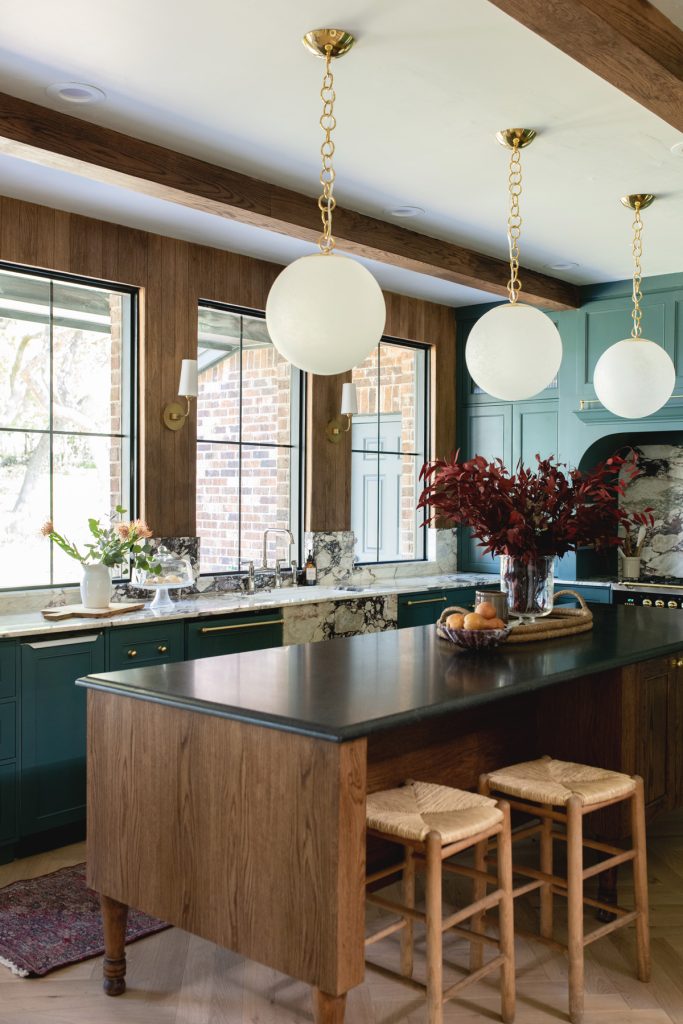
The new trio of 5′-tall windows replaced the previous exterior door and the more traditionally sized single kitchen window to allow more light into the kitchen.
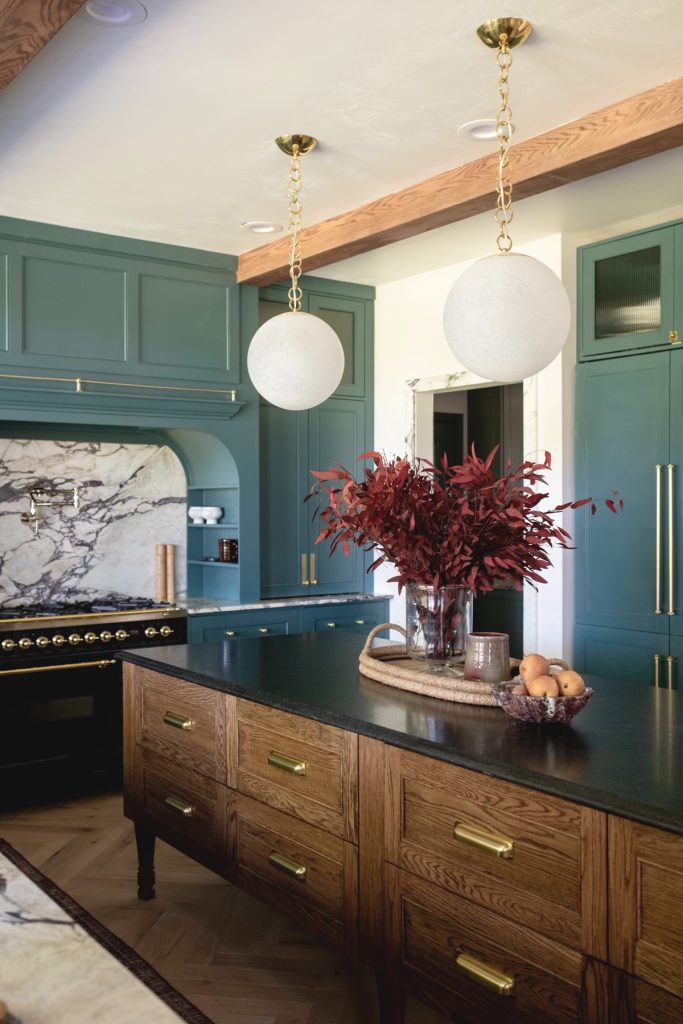
The custom white oak island, with its dark stain and custom-made legs, is designed to look like antique European furniture. It also provides seating on one side and drawers on the other. A honed Nero Mist granite top with a traditional ogee edge profile complements the inset shaker cabinetry.
Including a brass tipping rail, accented with round balls and a shallow shelf, above the arch gives her a place to display ‘future finds.’
“At some point I’ll put something up there,” she quips. “Brass tipping rails are also very European. Oftentimes, people will use them to display plates or to keep glasses in place. At some point, I’ll find some sort of art…or maybe plates!”
The gold-toned rail also coordinates with the unlacquered brass Rejuvenation Hardware cabinetry hardware used throughout the kitchen.
“The unlacquered finish will patina over time, which goes back to my philosophy about history and living finishes,” she relates. “I also love to use a lot of different types of hardware in my designs, albeit in the same finish so they aren’t distracting. In my kitchen, I’ve used six different ones, ranging from small knobs, to different lengths and styles of pulls, to cabinet latches. I think the variety makes the design more interesting. And spatially it’s important to scale. For instance, one little knob on a tall cabinet isn’t appropriate.
“I also love cabinet latches, which, again, are very European,” she continues. “They are pretty and fun, but they can be a little tricky to actually use, so I included them on the top, more infrequently used cabinets. Plus, pulls, which I prefer over knobs for long, heavy drawers, are styled differently for the island and the perimeter cabinets.” ▪