
There are a lot of considerations that go into making countertop selections for a kitchen. Color, pattern and texture as well as durability, stain resistance and ease of maintenance routinely enter into the conversation.
Natural stone and quartz are often top of mind, but the list of choices is long enough that designers can find just the perfect fit. In some cases, that ideal fit may actually be a combination of finishes.
As part of this month’s focus on surfacing, KBDN asked designers to share kitchen projects that showcase a perfect countertop fit for their clients.
Natural Stone: Quartzite
Photos: Niamh Barry
Ariel Apter, Principle Designer
Studio AA Interiors – Toronto, ON, Canada
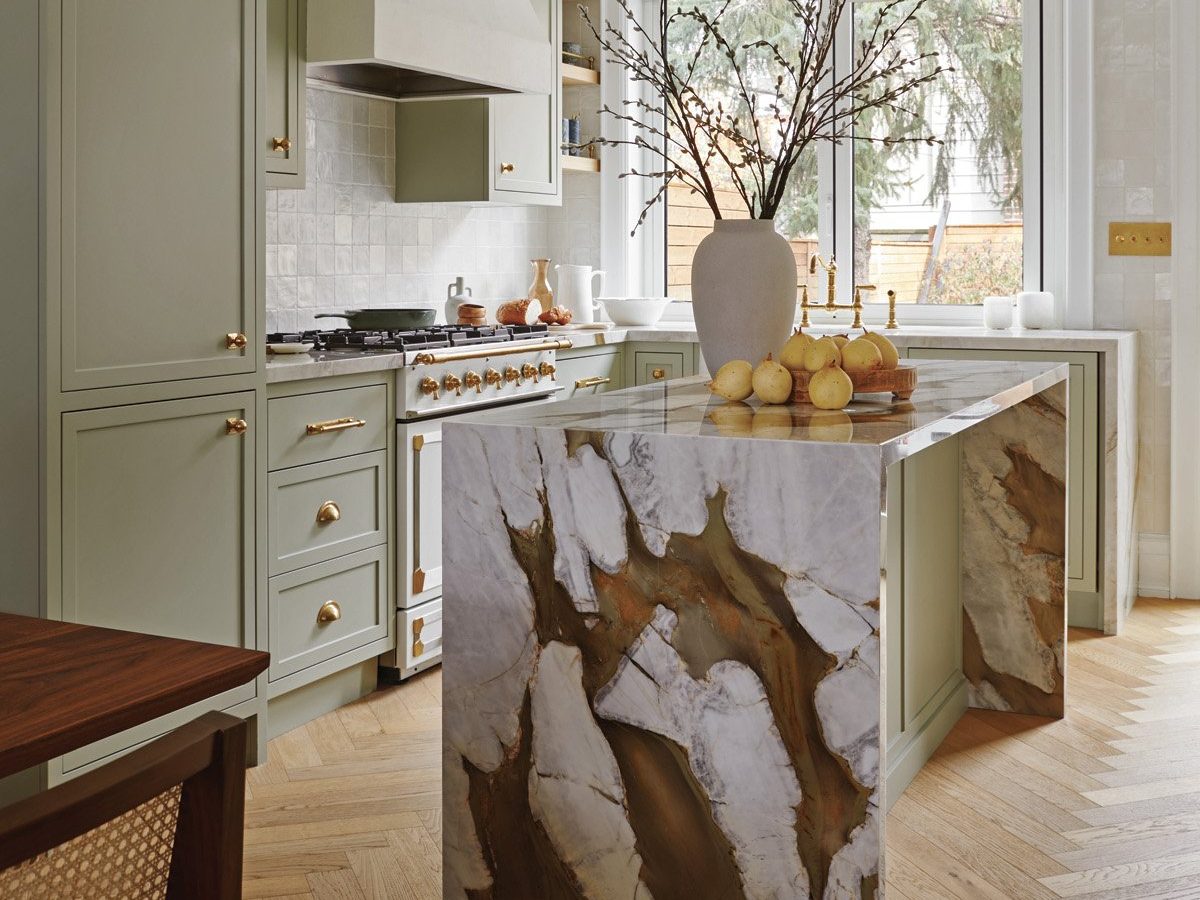
Although located in the heart of Toronto’s bustling The Junction neighborhood, Ariel Apter’s clients wanted their cozy home to feel like they were revisiting the quaint and charming European countryside. Their newly purchased home had good ‘bones,’ but the homeowners wanted to revamp its design to better suit their style, so the designer completely gutted the main and second floors to transform them into her clients’ dream home.
As that related to the kitchen, she completely rethought the layout of the space.
“We were able to increase the flow and give our clients a beautiful feature island, which is perfect for entertaining!” she relates.
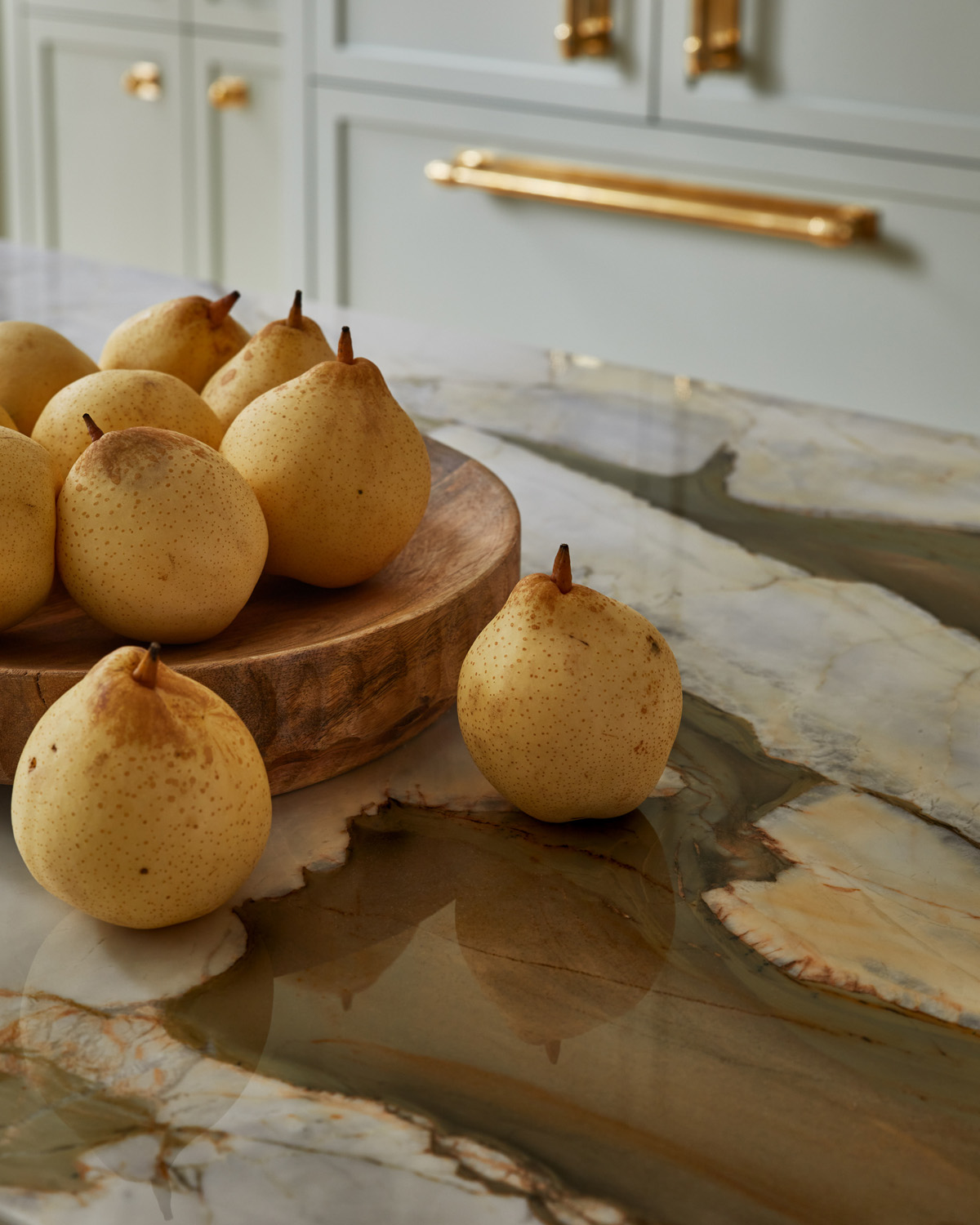
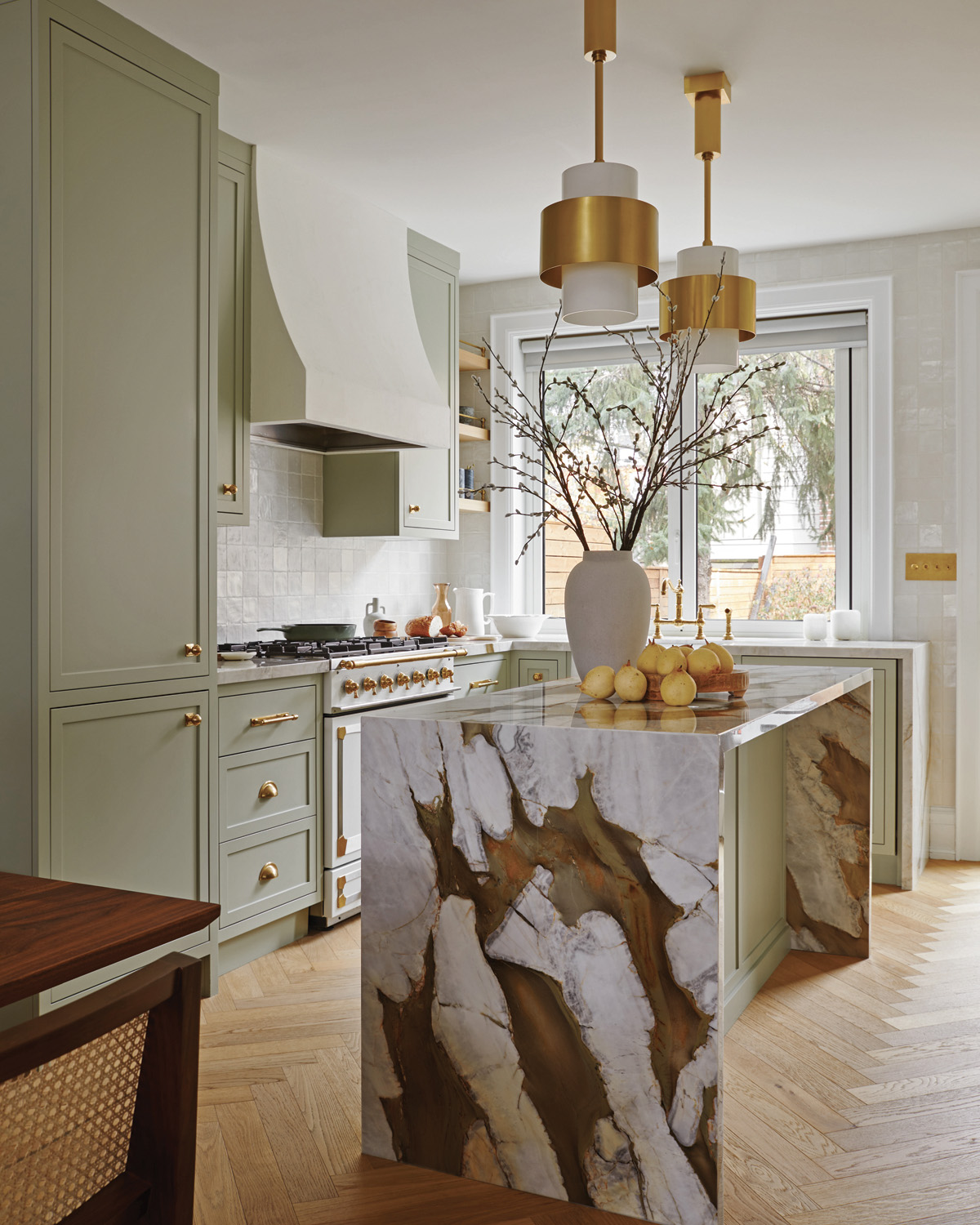
Its subtle sage green base, which matches that of the perimeter’s base and wall cabinetry, is topped with Calacatta D’oro quartzite that features deep browns, taupes, golds and grays against a foundation of warm white. The island’s waterfall edges highlight the stone’s dramatic veining pattern that is on full display from the adjacent dining room. The designer repeated the sophisticated and timeless stone as the perimeter’s worktop surface.
“Its bold gold veining is unique and luxurious,” Apter indicates, noting that its rich, warm hue complements the warmth and color of the unlacquered brass cabinetry hardware and plumbing fixtures, gold-tone gallery shelf rails and island pendant lights, and polished brass La Cornue range trim and knobs. “We also gave the stone a polished finish to help protect the surface and give it some glam that makes it pop!”
Another benefit of the stone is that its natural beauty brings the outdoors in, which is further supported by several other natural elements such as the custom herringbone floor, open shelves and select wood cabinetry interiors.
“The floors, green cabinetry, unlacquered brass fixtures, venetian plaster hood, range and, of course, the quartzite countertops, all come together to make this kitchen special,” she says. “With this renovation, there was almost no surface in this house that wasn’t touched, and we can’t wait to see our clients use this home for years to come!”
Natural Stone: Granite
Photos: Abigail Jackson Photography
Leslie Cohen, ASID, CID, NCIDQ, CKBD
Leslie Cohen Design – Raleigh, NC
This active family of four wanted to lighten up their kitchen, add color and make the space more functional since it is the center of daily living and entertaining in their home.
“The previous layout was cramped and dark with inadequate counter and storage space,” relates Leslie Cohen. “Changing this kitchen from a U-shape to one with an island opened up the space.”
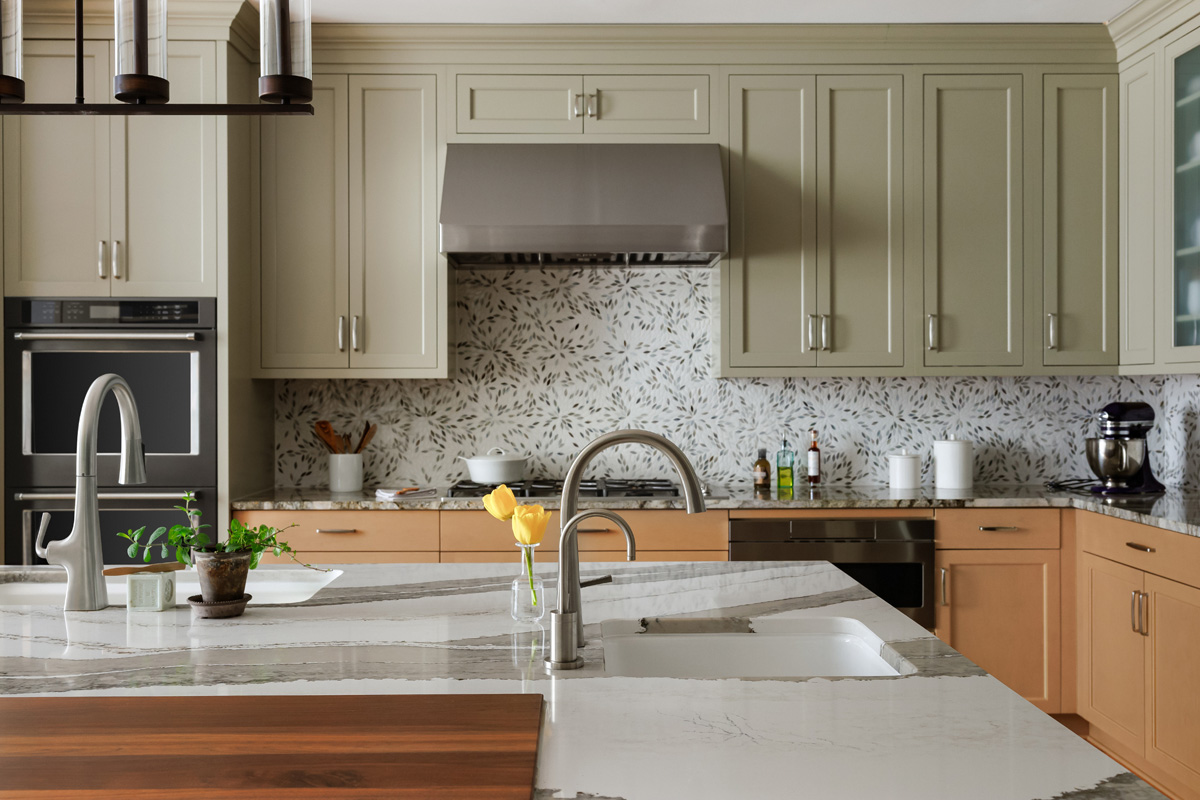
A color scheme that includes a mix of blues, greens, whites and creams with wood creates a relaxing, organic, light and timeless aesthetic. Multiple counter surfaces define different areas of the kitchen and add character. Each selection was made for its ease of maintenance since meals are prepared throughout the day, every day.
“These clients travel a lot and food preparation includes not only traditional American dishes, but Indian, Thai and other Asian foods,” she explains.
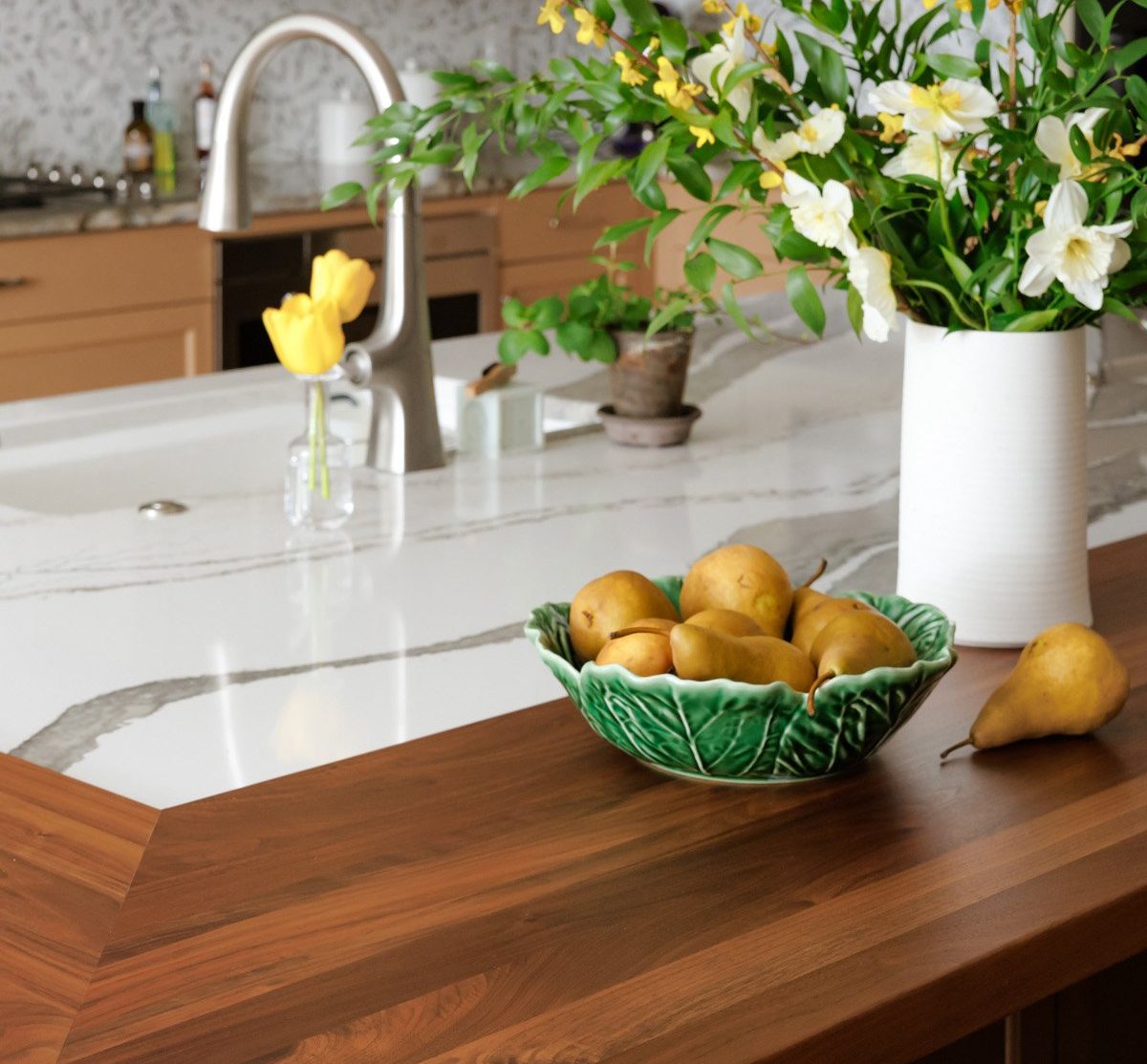
The Blue Dunes granite perimeter counters offer a gorgeous medley of blues, browns and creams. The natural stone was also chosen to serve as the bench top in the ‘drop area’ because the family needed a durable surface for the endless amount of sports equipment that lands here.
“Natural stone has been making a comeback for several years,” Cohen comments. “People love its beauty and depth. Plus, many granites don’t really need sealers, and those that do have many sealing options available, everything from impregnated sealers with a 10-year warranty to daily cleaners that seal and clean at the same time.
“Also, all sorts of beautiful granites have become available, due in part to shipping costs that have totally changed the market,” she continues. “It isn’t really worth it for a distributor to bring over cheap, boring granite anymore because the shipping costs have become a very high percentage of the overall cost of an inexpensive stone, which makes it unattractive to buyers. With more expensive stones, the shipping costs are a lower percentage of the overall cost, so buying more beautiful, higher-quality stones is more cost effective than buying lower quality stones.”
Cohen contrasted the granite with Cambria’s Skara Brae quartz for the island’s work surface.
“We wanted a lighter island with a non-granite pattern to differentiate it from the perimeter,” she explains. “When my client saw this pattern, it was a ‘go bold or go home’ moment!”
The designer used walnut to define the eating/socializing side of the island, giving it an L-shape to promote conversation between seated guests. She finished it with a conversion varnish so it can be wiped clean.
“The walnut also complements the browns in the Blue Dunes granite, while preventing the large island from feeling too massive,” she adds.
Sintered Stone
Photos: Austin LaRue Photography
Emily Marek, Principal Designer
Emmy Couture Designs – Scottsdale, AZ
As a high-profile lifestyle influencer and mother of four kids, Emily Marek’s client wanted the kitchen countertop surfaces in her new-construction home to be durable.
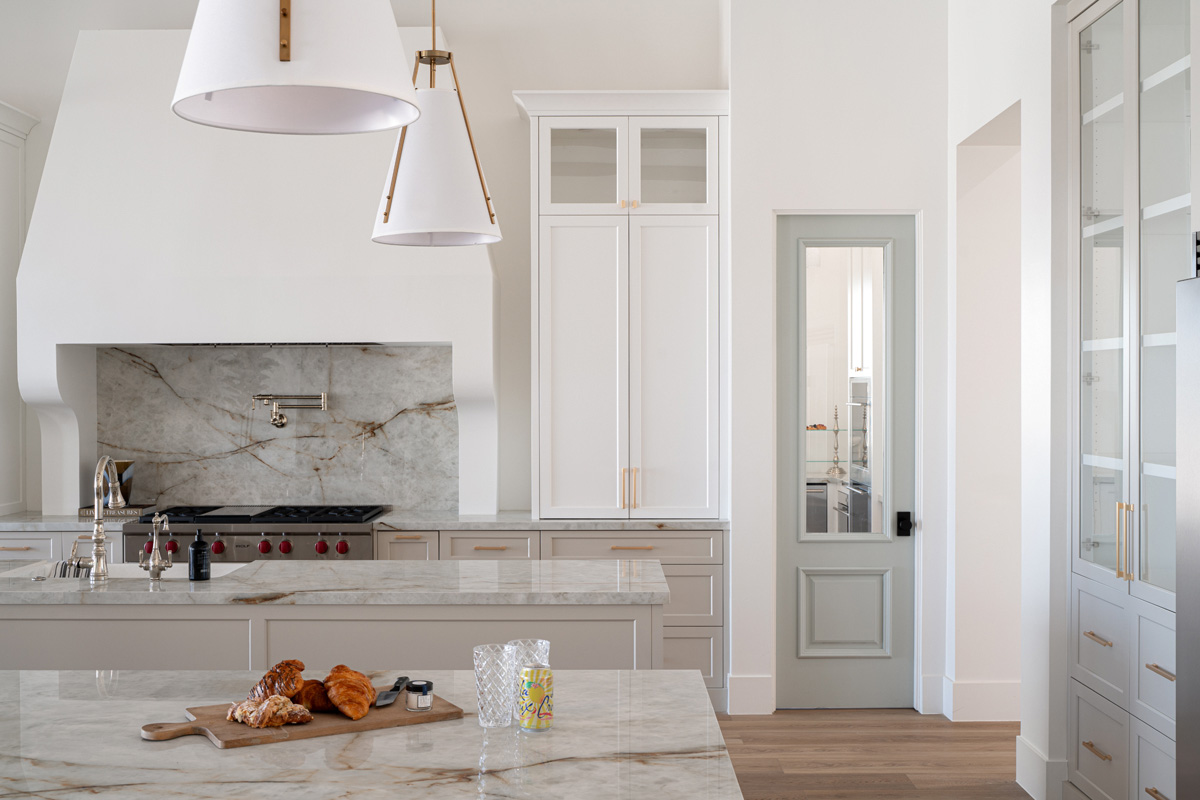
“It’s a very busy kitchen,” she says. “She’s always cooking, so the durability and longevity of this sintered stone is important to her. Because of its composition, she won’t ever have to seal it, and it will never discolor, even if exposed to heat. These countertops can stand the test of time, too, and they will still look stunning years from now.”
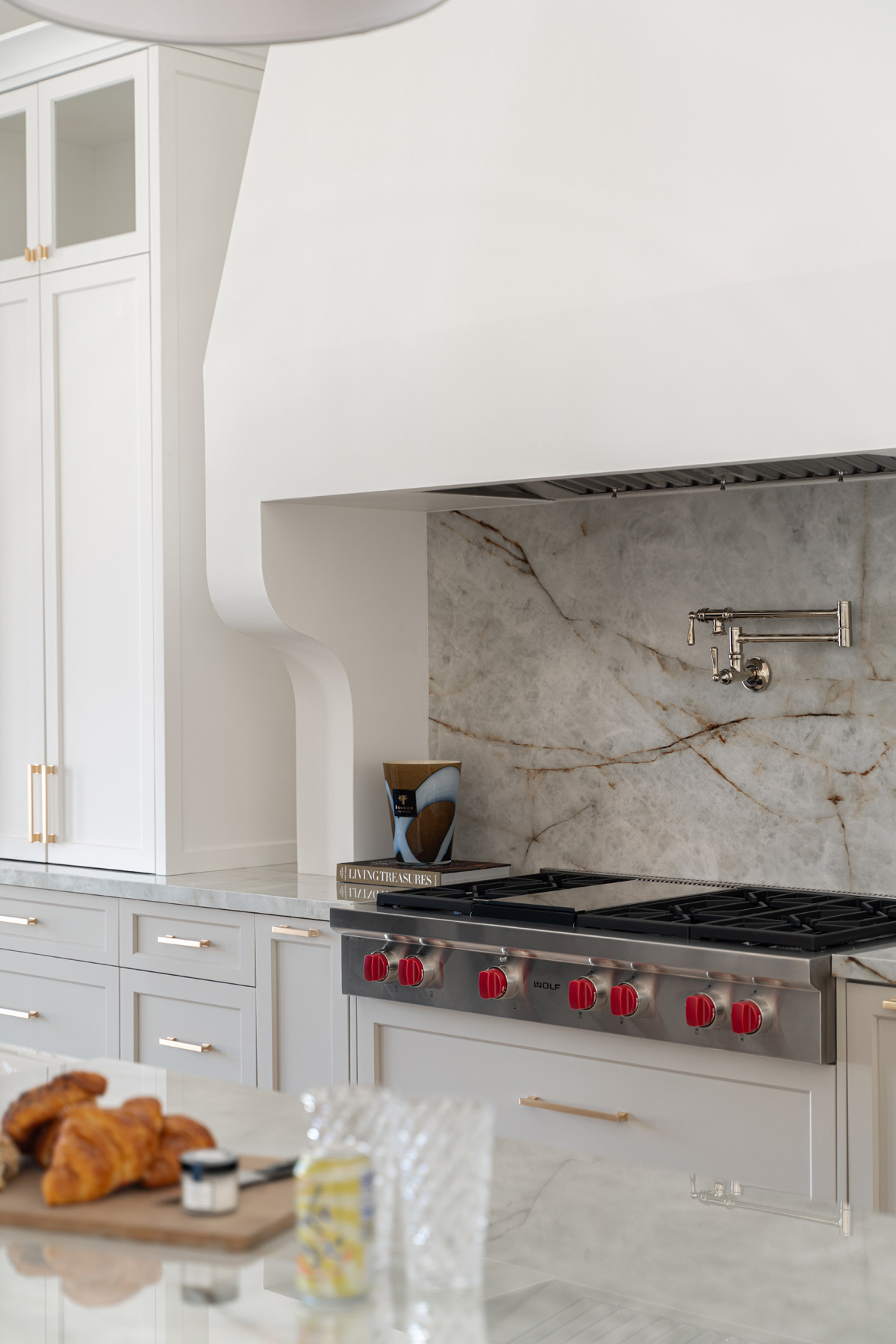
This particular pattern, Himalaya Crystal, which is Neolith’s tribute to the salt crystals of the namesake summit, is also timeless, which is another quality she desired for her kitchen.
“It has a natural stone look to it,” the designer continues. “It has great depth with its veining pattern, which has all of the colors we were trying to pull out, like her cream-colored and gray cabinets and her gold-tone light fixtures.”
Available in ultrasoft, silk and polished finishes, Marek opted for the latter.
“We wanted the surfaces to really sparkle,” she explains. “A lot of natural stone countertops are polished and we wanted this sintered stone to have the same look and feel of natural stone.”
Using the material in multiple areas throughout the kitchen, including as the countertops for the prep and eating/serving islands, the perimeter and the backsplash, maintains a consistent aesthetic.
“Seeing this material applied in a vertical aspect, like the backsplash, gives it a totally different look,” the designer relates. “My client wanted a simple backsplash, as well as something that was easy to clean. Because we didn’t need any grout, this single-slab backsplash accomplishes those goals. It also gives the cooking area, which features a beautiful plastered hood, an elevated look.”
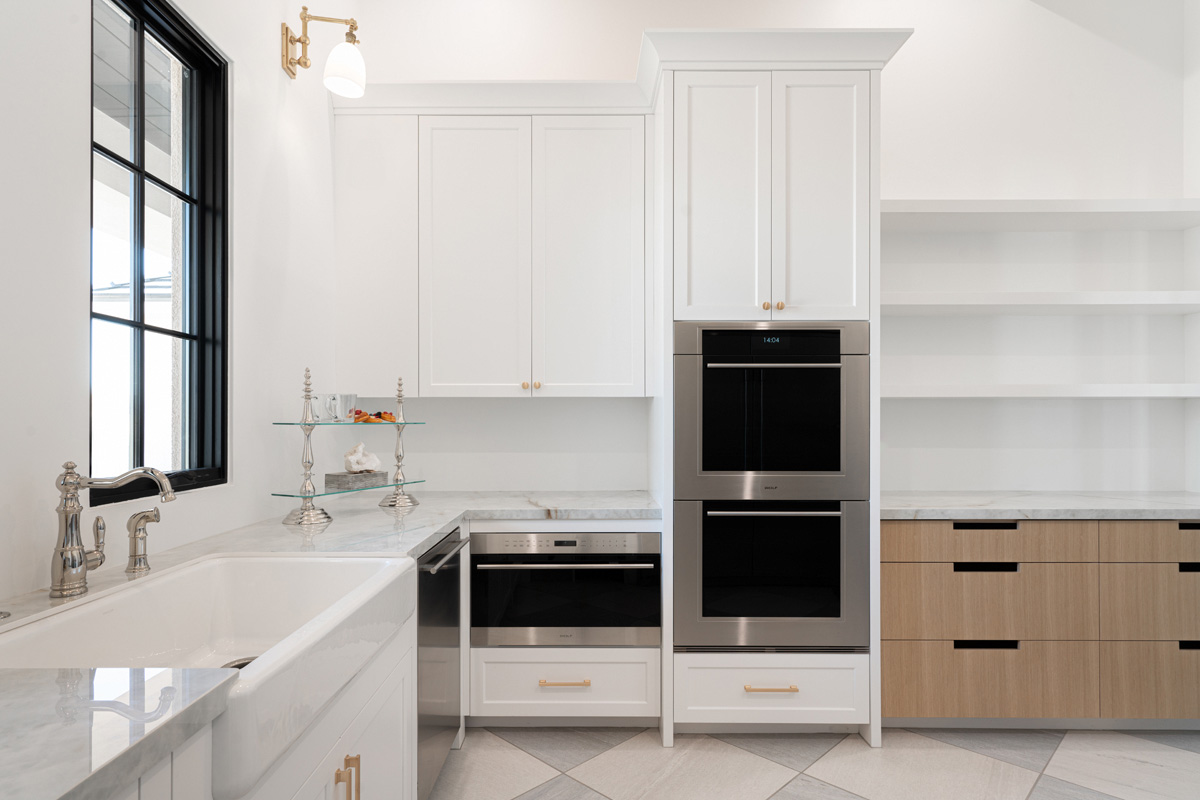
Marek repeated the sintered stone as the buffet top in the adjacent breakfast nook and as the countertop surfaces in the prep kitchen. Tucked behind the cooking wall, this secondary kitchen includes a full-size refrigerator, ice maker, sink, dishwasher, microwave, double ovens and plenty of storage on open shelves and inside drawers.
Quartz
Photos: Ryan Theede Photography
Maureen Jarock, Kitchen Designer
Kitchens of the South – Hendersonville, NC
Jennifer Scott, Interior Designer
Tyner Construction – Asheville, NC
Budgets are an integral parameter for any kitchen project, and designers work diligently within them when considering material selections and design elements for any kitchen renovation or new construction project. However, sometimes clients are willing to adjust those budgets, extending them to include certain aesthetic or functional items that are seen as important to the project.
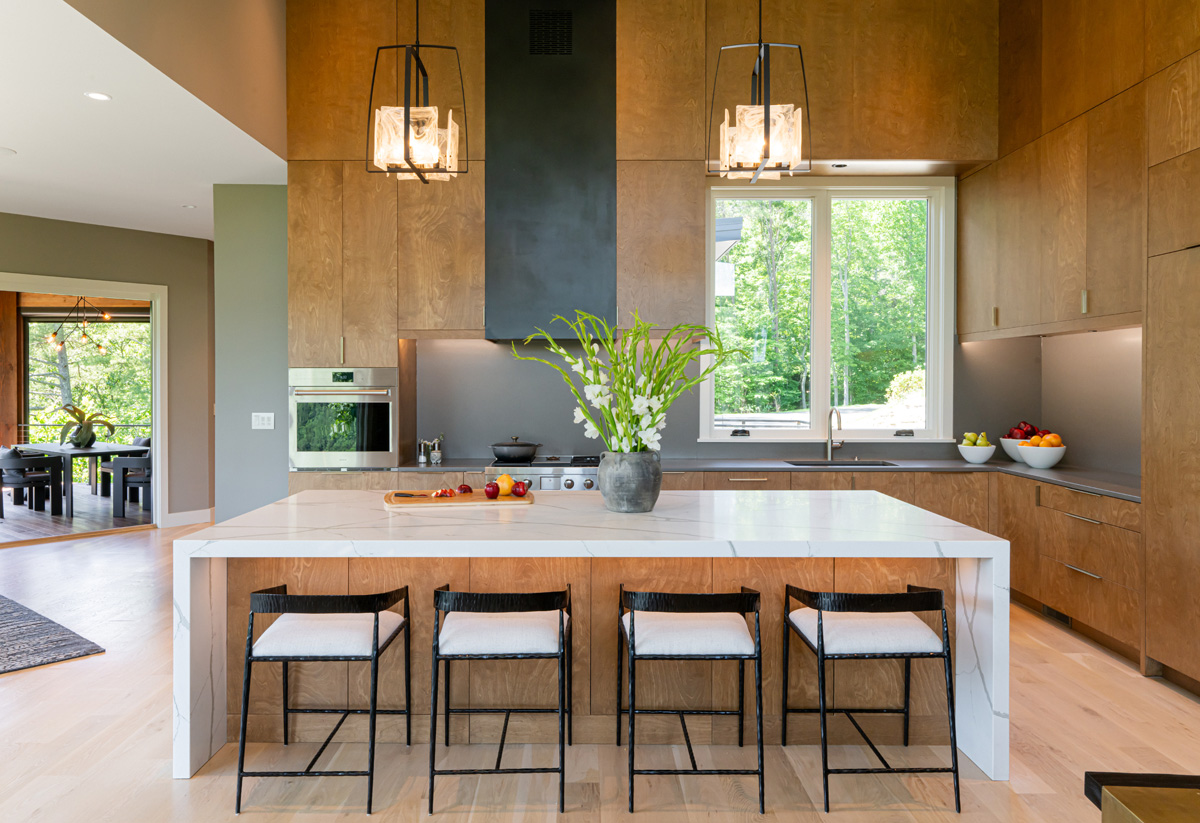
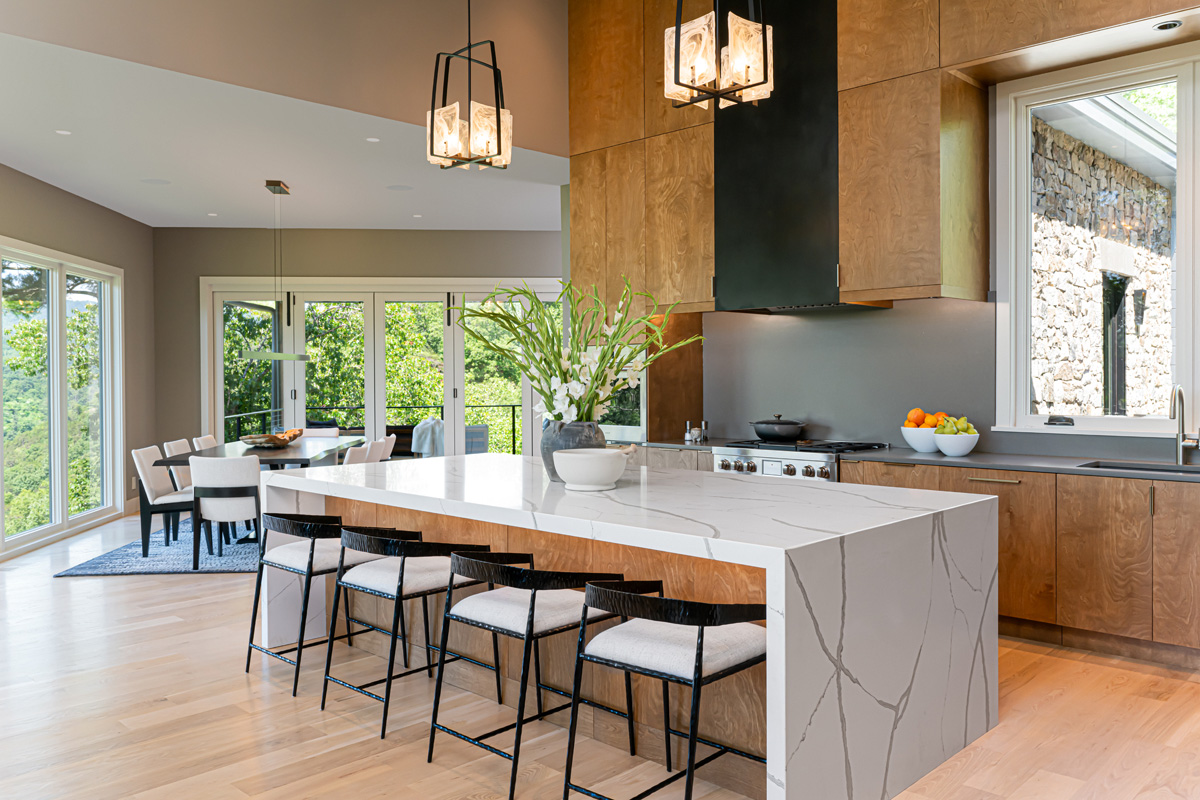
Such was the case for these homeowners, who saw the value of allocating additional funds to include Polarstone’s Calacatta Vagli quartz as the island countertop for their new kitchen. The large island features an uninterrupted work surface for food prep and serving while an overhang allows for in-kitchen seating. Waterfall edges draw attention to the veining pattern and a 2.5″ folded mitered edge adds visual ‘heft.’
“The island material and thickened edge was over budget,” explains Jennifer Scott. “However, the homeowners understood the importance of the statement that it makes.”
For the perimeter, Cambria’s Devon quartz, configured with shades of gray and black, serves as a contrast and complement with its darker hue and more monochromatic design. Its matte finish offers distinction to the polished finish given to the Calacatta Vagli surface.
The design duo extended the quartz as the backsplash behind the range to provide a seamless aesthetic and create an easy-to-clean surface. It continues behind the sink and into an illuminated niche that offers additional workspace. As well, they featured it as the countertop in the adjacent dry bar and walk-in pantry where its non-porous composition offers stain resistance from spills.
“The countertop selections were created to marry the modern architecture articulated by the form of the home with the immortal elegance of a natural stone look,” says Scott. “The sleek, earth-tone perimeter and backsplash coupled with the timeless look of Calacatta marble for the island create a modern-meets-timeless design.”
That design theme is further supported by upper cabinetry that extends to the ceiling and is uniquely the same depth as the lower cabinets.
“It was a challenge to make sure all of the cabinetry was at the same depth, including the panels that extend to the ceiling, which at its highest point is 14′,” emphasizes Jarock. “As well,
we considered many stain colors and finally landed on this warm yet light, earthy tone that complements the countertop selections.”
Photos: Andrew Lewis Architectural Photography
Nate Nicodemus, AIA, Owner/Founder
Nicodemus Design – La Jolla, CA
These homeowners love mid-century modern design and the neighborhood in which they reside. So, when a fire tragically destroyed their home, they wanted to show respect to both when they rebuilt.
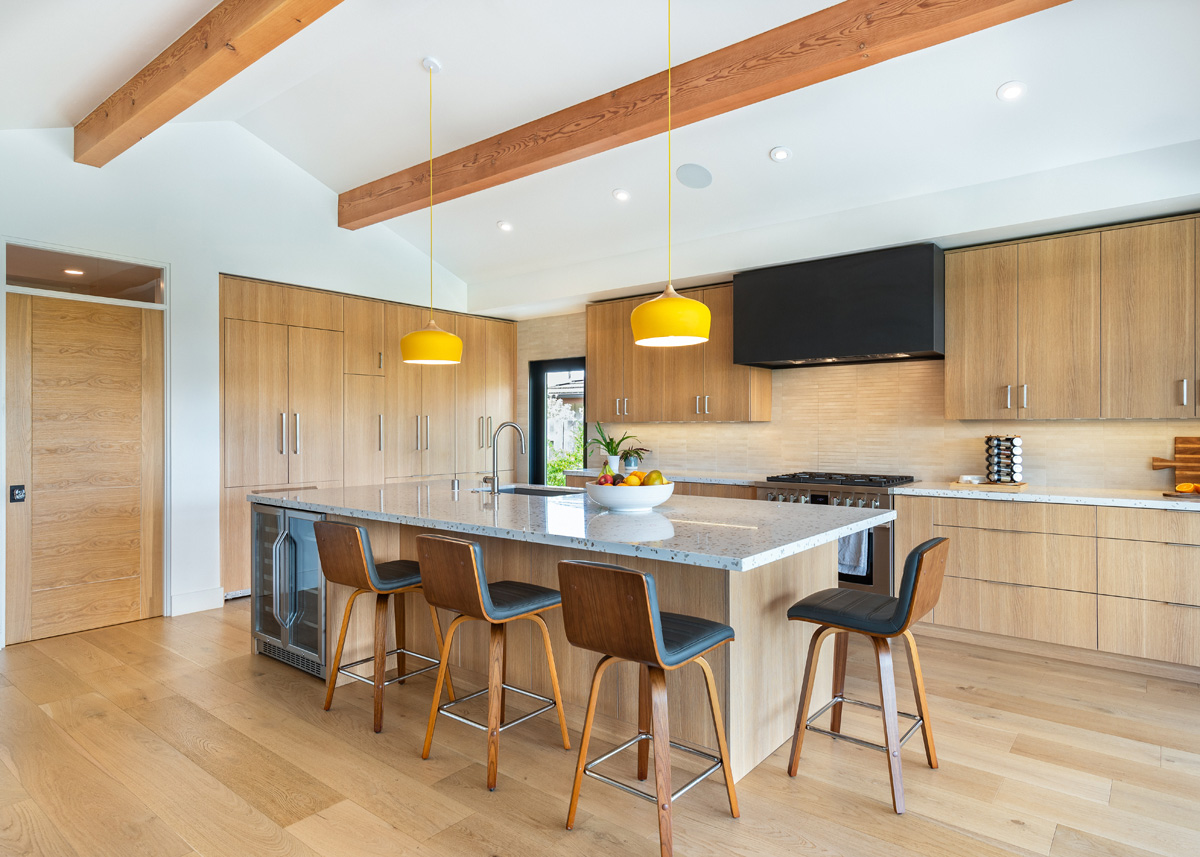
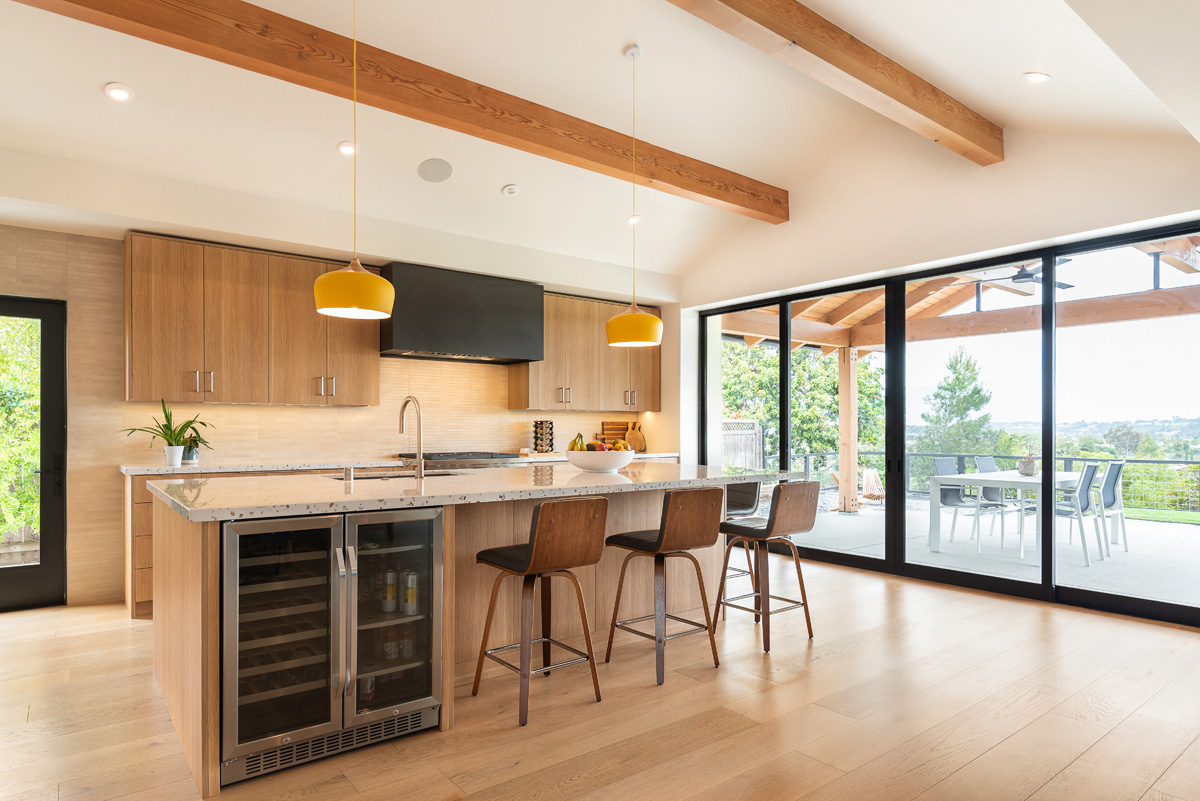
“We wanted the kitchen, and the home at large, to honor the mid-century history of the neighborhood,” says Nate Nicodemus. “We designed a contemporary home, but with a lot of the historic style used as inspiration. This led us to celebrate natural wood grain [white oak cabinetry and floors], exposed structural elements [beams that span the kitchen from the exterior], pops of color [yellow pendant lights] and bold, fun countertops [quartz that resembles terrazzo]. Embracing a minimalist palette and detailing highlights the important design elements that remain.”
While mid-century modernism is heavily influenced by minimalism and is characterized by clean, simple lines, it also is not shy about personality and color, he points out. That’s where the Arizona Tile Della Terra quartz countertops, used on both the island and perimeter, come into play. The Aerial pattern resembles terrazzo and provides a moment of fun/personality while balancing out the restraint.
“A countertop is something people interact with closely and regularly,” he indicates. “It is touched and examined up close every day so it’s nice to have a layer of detail for the spaces where we slow down. The varied quartz pebbles provide that in this case. At a distance, the countertops have a fun field effect, but up close you notice the intricacies of each of the individual pieces.”
This particular pattern also includes many of the colors Nicodemus used throughout the home.
“The warm hues echo the white oak and some of the warmer tones we used in the kitchen and in the rest of the home,” he continues. “While I wanted a minimal color palette, I wanted to have some fun textural choices, too.”
Wood
Photos: Toni Deis Creative
Miriam Silver Verga, Principle Designer
Mimi & Hill – Westfield, NJ
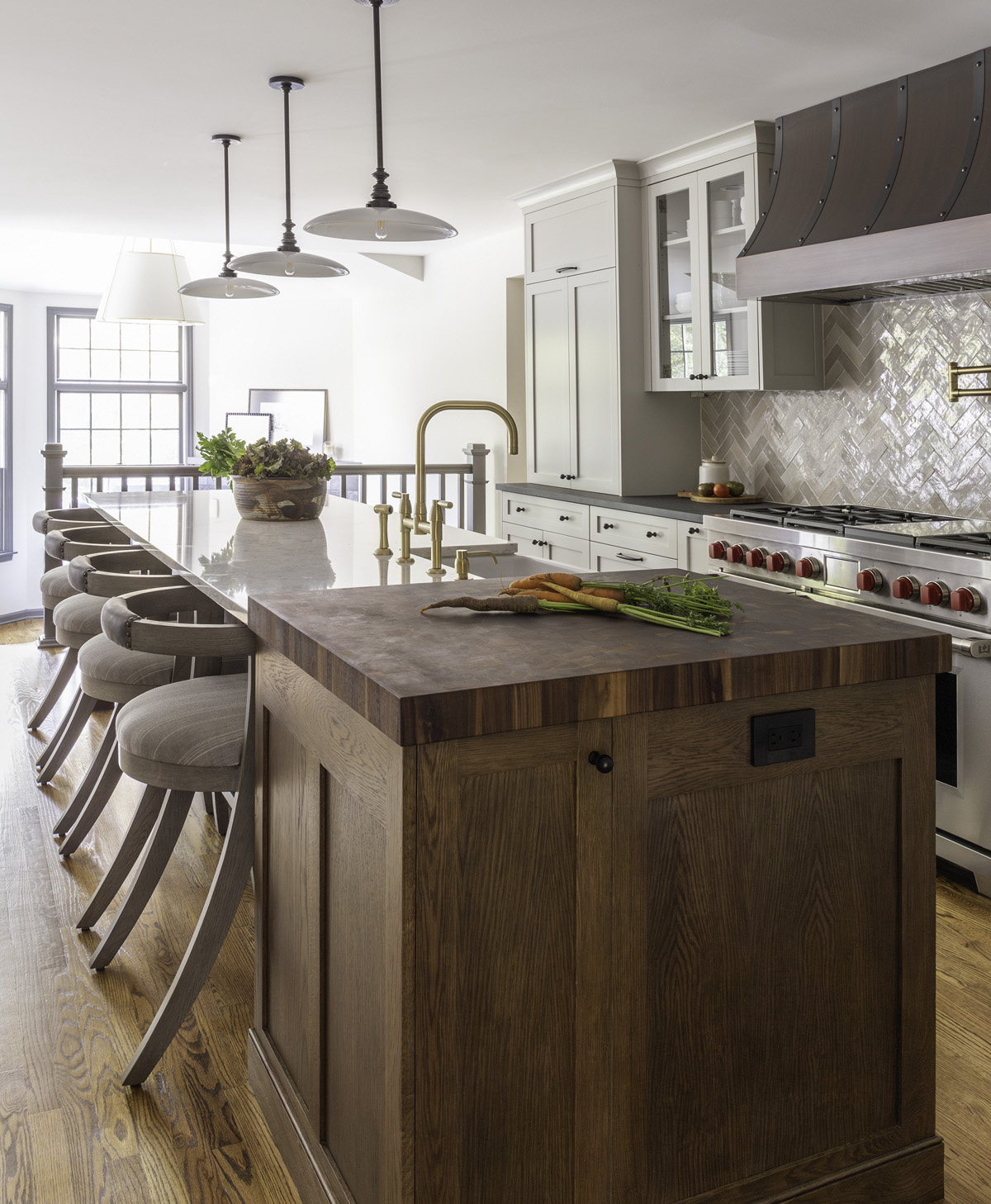
Miriam Silver Verga is well-known for her ability to incorporate islands into her kitchen designs, sometimes even when all hope seems lost. So, when these homeowners came to her with a desire for the foundational and room-defining design element in their historic home, she was happy to oblige.
“When I started my design firm 15 years ago, these homeowners were one of my first clients so it was a joy to finally get to renovate their kitchen, which was long overdue since it hadn’t been done in probably 30 or 40 years,” she relates. “They didn’t think they would be able to have an island because the kitchen was pretty narrow. That meant we would have to forego cabinetry on one side, which then meant we would need to have a very long island to give them the storage space and seating they needed.”
Even with the challenges, Verga persevered. Not only did she include an island, but she included one that is 12′ in length.
Another of Verga’s defining design techniques is creating seamless island countertops, even those with extended dimensions. One way she accomplishes that is to use a variety of materials, which provides for an expected and accepted seam. In this case, she used walnut butcher block on one end. It sits atop an oak cabinet that is slightly taller than the rest of the island, which features a seamless slab of LX Hausys’ Viatera Minuet quartz.
“There is such a richness to walnut that people are really attracted to right now,” she says. “It adds a layer of provenance, which is especially important when someone wants something that feels historic and timeless, which is what these clients wanted.”
The designer often uses natural stone in her designs, especially quartzite. However, these clients wanted something extremely durable, thus the Minuet quartz. As a way to include natural stone, Verga opted for Black Vermont granite for the perimeter worktop surface.
“It’s a great durable stone at a really good price point,” she relates. “This particular one is a solid black, which is what we wanted for this installation, but there are some very interesting black granites with white and brown veins, and there are even some that have a marble feel. We’ve seen some really beautiful granites, and we’ve been using them more and more.”
Porcelain
Photos: Erika Bierman
Mitra Shahi, Construction Manager/Interior Designer
Shahi Design Group – Los Angeles, CA
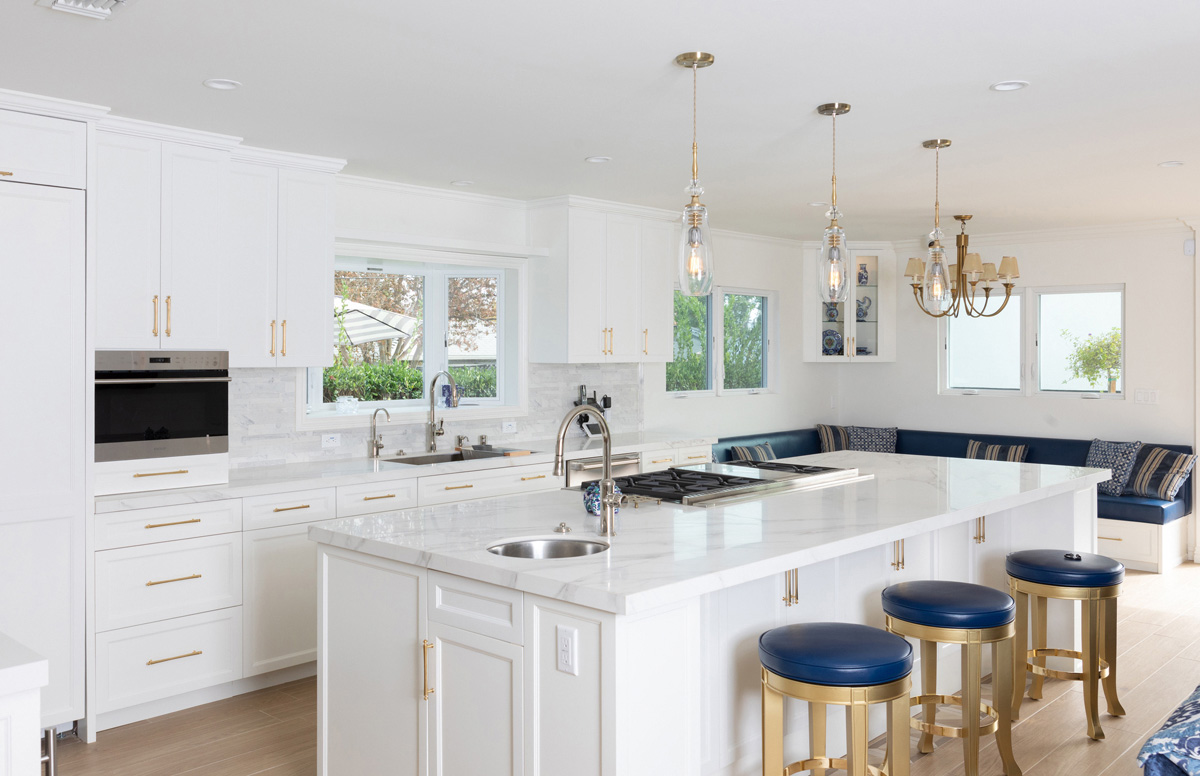
Mitra Shahi’s client enjoys getting together on the weekends for family meals with her parents at their home in Los Angeles. Those events are made even more pleasant with the recent renovation of the entire first floor, which included tearing down a wall to create an open-concept living area and thoughtful kitchen with high-end appliances and custom cabinetry. At its heart is a spacious, 12′-long island topped with a seamless slab of Statuario Michelangelo porcelain.
“She wanted a large island to maximize countertop and work space,” says the designer. “She also wanted low-maintenance finishes that would be easy for her aging parents, who are in their 80s and 90s, to take care of. I frequently use porcelain slabs because they are more durable than natural stone.”
Shahi chose a honed finish for the porcelain, which gives it a more natural appearance and minimizes glare from natural light that flows into the room from the patio doors and abundant windows. Choosing a porcelain slab pattern with a bit of veining keeps the space from looking too sterile given its foundation of bright white and white/gray three-dimensional ledger stone backsplash. Gold-toned cabinetry hardware and lighting fixtures as well as wood-look porcelain flooring, which features a custom decorative pattern, also add warmth to the space.
“She wanted something with a bit of movement so it would look natural, but not be too busy,” she explains. “This particular pattern gives a luxurious, sophisticated look to the space.”
Although manmade, porcelain slabs, like natural stone, are each unique, so Shahi took her client to the local stone yard to select those that suited her taste. Since she used porcelain for the island, perimeter and adjacent walk-in pantry, which also features the same custom cabinetry and backsplash tile as the kitchen, she needed multiple slabs.
“It’s a lot of fun to pick out the perfect slab,” she says. “Each one is a little bit different.
“This kitchen was such a joy to design,” Shahi adds. “My client grew up in this home, and she loved being able to give her mother a beautiful space to cook. They all look forward to enjoying the home for many more generations.”
Stainless Steel
Photos: Mike Schwartz
Jennie Bishop, Co-Founder
Studio Gild – Chicago, IL
Working with repeat clients can oftentimes streamline the design process since both parties are already familiar with each other. So, when this client requested stainless steel countertops for the renovated kitchen in his former live/work loft space located in Manhattan’s Tribeca neighborhood, Jennie Bishop wasn’t necessarily surprised.
“I have done six projects with this client, both in New York and Colorado, and this is his second or third kitchen with stainless steel countertops,” she indicates. “He’s very exacting and knowledgeable, and he knows what he wants. He’s an attorney and an art collector, but he’s also a self-taught chef who loves
to cook.”
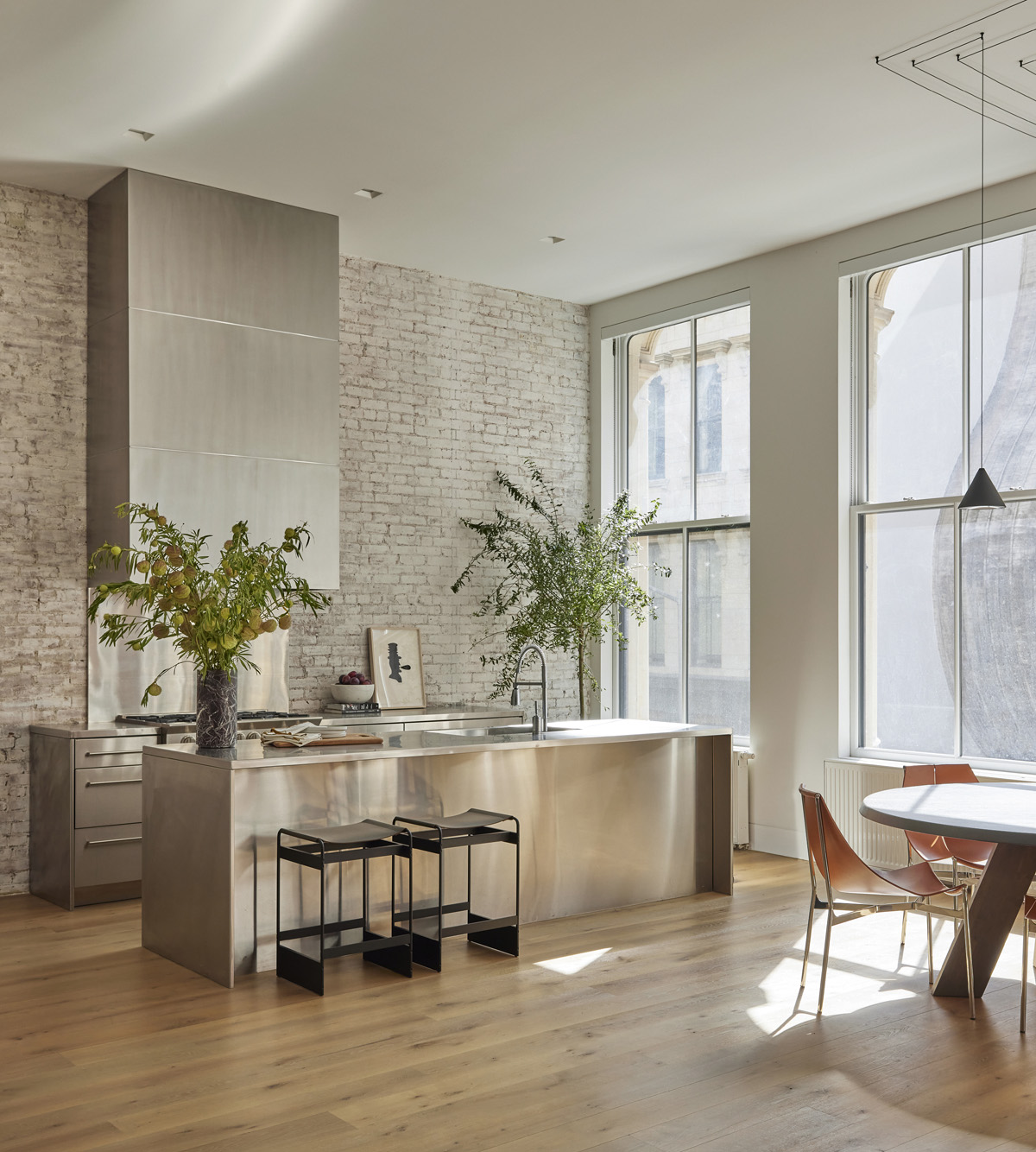
While her client appreciates the material’s stain resistance and anti-microbial properties, he is also familiar with its susceptibility to scratching.
“Stainless steel falls into a category of ‘authentic’ materials,” says Bishop. “Over time, he will be able to see his favorite place to cut veggies. That can be a beautiful thing…for people like this client who crave authenticity and are accepting of materials that develop a patina.”
In addition to topping the perimeter and island, the latter of which features waterfall edges and an integrated sink, stainless steel makes an appearance in several places throughout the kitchen, including as the backsplash behind the range, as the cabinetry faces and as the island façade. As well, stainless steel with a brushed finish serves as the ventilation hood surround that soars to the ceiling.
Because stainless steel can be considered a ‘cold’ design element, both physically and aesthetically, Bishop warmed up the space with a floor-to-ceiling wall of cabinetry sheathed in an off-white paint. The adjacent brick wall, a holdout from the building’s 1865 construction, is also painted a warm white, which is a bit transparent and distressed just enough to allow part of the brown brick to shine through. The wood floor and an abundance of natural light add further warmth to the space.