
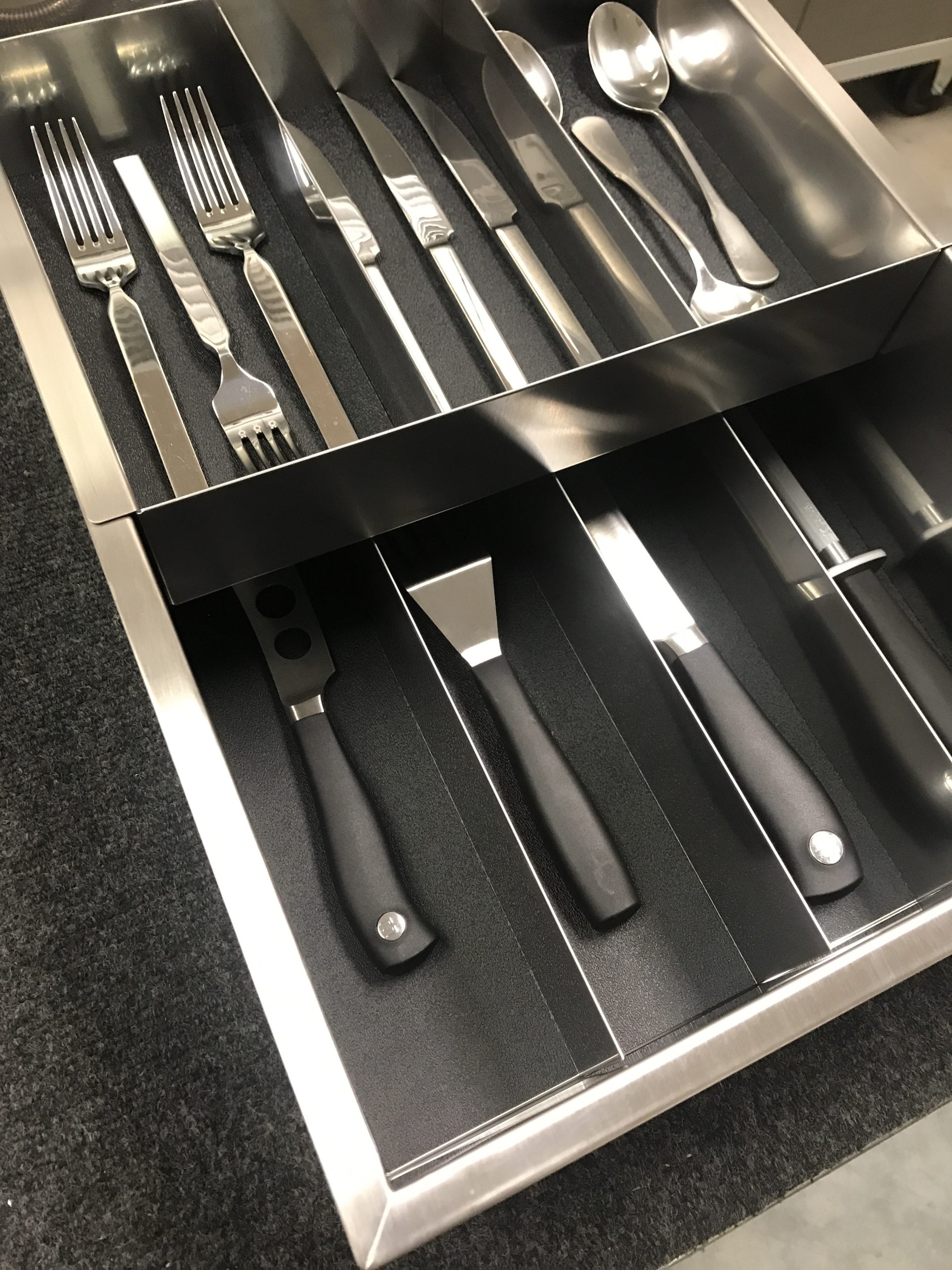
Accessories and interior fittings are increasingly important tools for containing clutter to create the sense of calm and relaxation homeowners crave. These days, there’s almost as much focus on the inside of cabinets as on the exterior. Cavernous spaces with doors are no longer enough – the space must be intentionally arranged for the best possible use.
“Today, the interiors of cars receive a lot of attention – this is the same for cabinetry as well,” says Daryl Nauman at Häfele America Co., based in Archdale, NC. “Everyone wants to lead a less cluttered life, and the kitchen is the heart of the home,” he says. “Keeping items out of sight when they aren’t needed and having good, efficient organization systems makes for happy customers.”
Shari McPeek, marketing manager at Rev-A-Shelf, LLC in Jeffersontown, KY says that design isn’t just about the space, but also about creating a feeling. “[Homeowners] want to come home and enjoy a space that is open and relaxing, not cluttered and chaotic,” she notes, explaining that well designed interior storage “is a must.”
Storage solutions that support the overall flow of the kitchen are essential, and they must integrate seamlessly into their surroundings. Fittings that add convenience, flexibility and true value to the space are key, while kitchen accessories that allow consumers to show some personality while making the space more comfortable are also in high demand. That’s according to manufacturers recently surveyed by Kitchen & Bath Design News.
A Place for Everything
Accessories and tools that used to live on the countertops are more often being contained within cabinets and drawers. And there’s often a space designed just for each item, to keep the insides neat and tidy as well.
“To keep kitchens neat, and give them that clean, open feel, homeowners are searching for ways to get clutter off countertops,” says Karen Smith, brand communication coordinator for Blum, Inc. in Stanley, NC. “Full-extension drawers in base cabinets give you a quick overview of the entire drawer’s contents, and utilizing interior organization keeps everything neat and within quick reach.”
J. Ulrich Hauser, CEO at Schwinn Hardware, Inc. in Scottsdale, AZ, also acknowledges the trend toward less clutter on the countertops and more internal organization within the cabinets. Specific needs require specific solutions – for instance, the added demand for power in more places requires power boxes, grommets and wire management, he says. Functionality and versatility are key, he adds.
Angelika Weidling, head of marketing at Vauth-Sagel Systemtechnik GmbH & Co. based in Germany, has noticed a stylistic mix of tradition and new technological design in accessories.
And, in addition to having a proper spot for everything, it’s expected that every bit of space will be usable – which means solutions for hard-to-reach places are essential.
“It’s important that every millimeter of space within a drawer be able to be utilized in some fashion,” believes Jan Fitzpatrick, customer & market relations manager at Kernersville, NC-based Grass America Inc. This means that full-extension or full-access drawers are high on the list of “must haves,” she says.
“Space optimization continues to be an important factor in considering remodel options, especially when you’re dealing with tight quarters,” states Billy Peele, marketing/PR representative for Doug Mockett & Co., Inc. in Manhattan Beach, CA. While opening up wall space that usually holds cabinetry can make a small space feel larger, storage needs must then be considered, he notes. “Your walls can be outfitted with shelf supports that still serve as a great way to store kitchen accessories and foodstuffs without overpowering your overhead space. Shelf supports are much more versatile than cabinetry since they can be installed anywhere.”
Integrated Flow
When it comes to how fittings and accessories look, it’s important that they’re integrated with the look and feel of the cabinetry, manufacturers agree.
“Seamless integration is the most basic requirement from an aesthetic standpoint, though it can often be one of the most difficult properties to achieve,” Peele states. “A truly seamless design that blends with the design almost does its job a little too well – it’s really a shame that its brilliance is not on full display. But that’s the idea, that adding accessory options will not overpower the existing design and will add function to the furniture without calling attention to itself.”
With the increasing popularity of simple, modern kitchen styles, Smith sees plain styles and doors without handles on the rise. “Touch-to-open mechanisms, with either electronic or mechanical components, are the key element to achieve this look without compromising storage space,” she notes.
Functional Value
Finding interior fittings and accessories that add real value is important to consumers, manufacturers say.
Cost is a factor, but consumers are willing to pay more for what they really want – especially if those things will add convenience and efficiency to their kitchen. “Consumers don’t want to spend money on things that are too trendy or flashy,” believes Nauman. “They’re willing to pay more for the functional aspects of their space, whether that be the proper hinge for their opening or an efficient pull-out to store their cooking needs. Something as simple as a spice rack can add enormous functionality to a kitchen.”
“The best investment is in quality goods that have a timeless, classic style,” adds Peele. “Quality retrofit accessories like drawer pulls and cabinet handles will go a long way in adding value to your furniture as well, which is also an easier way to update furniture and give it new life without having to replace it.”
Weidling agrees that quality and longevity are important factors. She also believes people are willing to spend money on something that is unique, as globalization and social media make it harder and harder to stand out. “People are willing to invest more when they know it’s worth it. They spend more on designer statement pieces and are looking to save on basics. Handicraft products are also very popular, since people are seeking individuality and quality,” she says.
Value becomes a little more complex when talking about luxury accessories like radiant heating and cooling. Tim Botten, single family segment specialist for Uponor based in Apple Valley, MN says, “Most people who have lived with radiant will simply not do without it. The comfort experience is that meaningful to the homeowner. Those who are new to the technology tend to have sticker shock.”
While homeowners are drawn to the new smart thermostat and app, Botten believes “the value that has the most importance is comfort. A system that is designed and installed properly will be able to operate without the occupants knowing it,” he adds.
Standard Options
Much like how some of the options on vehicles that used to be upgrades now come standard – like power locks and windows – some interior fittings features that used to be optional are now considered standard, manufacturers say. Options like pull outs and soft-closing mechanisms are so popular they are now available at any price point, and often incorporated automatically.
“While we used to talk about soft-closing doors and drawers being an upgrade for your cabinetry, they are now the standard, or quickly becoming that way,” says Fitzpatrick. “Of course, there are still the self-closing items, but if a consumer is educated in any way, they will ask for the soft-closing feature in their functional hardware. In our manufacturing operations, we consistently see the soft-close items outsell the self-closing items,” she adds.
“Just like consumers have come to expect a quieter dishwasher, soft-close drawers and doors are a must,” agrees Smith. “Soft close has become the standard in mostly all cabinet lines. In fact, it is now expected in mid- to-high-end kitchens. Having the soft-close technology built into the runner or hinge cup makes installation quick and simple,” she adds.
Pull-out systems are also becoming common, particularly for waste bins and hard-to-reach spaces. “Pull-out waste bins such as the Häfele MX Waste Bin have now become a standard in today’s kitchen,” says Nauman. “Consumers can have one or two bins that pull out, keeping their trash concealed. We’re seeing a similar trend with blind corner pull-outs.”
Modern Conveniences
One of the key tasks of accessories and fittings is to simplify kitchen tasks. Hauser says consumers are looking for convenience, and products that make their lives easier by saving time and requiring less effort.
“Efficiency and convenience are really the name of the game,” says McPeek. “No one wants to get on their knees and dig through a cabinet or riffle through a drawer. They want what they want, and they want it right then, and that’s why more people are adding cabinet accessories to their kitchens, bathrooms and closets. “
Peele agrees: “We are constantly looking to improve efficiency and convenience in design. Those are the driving factors in the way we work and the way we live. Ergonomic solutions that promote comfort and function without losing sight of basic aesthetic values are the crux of contemporary design solutions.”
Drawers that incorporate a wide range of accessories are on the rise in order to meet the demand for increased convenience, and for better ergonomics, manufacturers say.
“Full-extension drawers in base cabinets are an ideal solution because they bring the contents out into full view, eliminating the need to get on your hands and knees to search for an item that’s been pushed to the back corner of the cabinet,” says Smith. “Deep drawers can hold more than their traditional counterparts. Having storage items that are easy to access means less time spent preparing meals.”
Fitzpatrick also sees this shift toward drawers due to added convenience. In the future, she believes it’s likely that cabinet doors will be replaced by lifter units. “Lifters offer quick and easy access to cabinet interiors. In one smooth motion, doors lift up, providing full exposure to the cabinet contents. And most lifters will hold firm in any position. Depending on the type of lifter used, one can accommodate a variety of door sizes and weights,” she says.
One additional option to fulfill the desire for efficiency and convenience is digitalization, notes Weidling. “The market is working on solutions that serve the trend for smart homes. Motion sensors (e.g. to open doors) and other electrical supports of interior fittings are used to increase convenience. Time efficiency and energy efficiency are important,” she says.
Efficiency and convenience are relevant to the radiant heating and cooling market as companies try to find ways to differentiate themselves by providing products that can bring value to the installer – such as labor savings or ease of installation, says Botten. “Of course there needs to be value to the end user in the form of energy savings, less maintenance and reliability,” he adds.
Individualized Accessories
Beyond storage considerations, kitchen accessories are as varied as the individuals and families who use them. Accessories are an easy way for designers to personalize the space for their clients, and the range of available options means the possibilities are endless. From the need for extra power sources to specialized lighting, manufacturers see a wide variety of accessories on the rise.
As people grow used to being constantly connected, digital products – and places to keep these charged – top the list of kitchen accessories. “I think you are seeing more and more items with technology being built in,” says McPeek. As an example, she cites cabinets that have speakers and even tablets incorporated into their design.
“At Rev-A-Shelf, we listen to the industry and design accessories that fill this need,” she states. That means not only offering darker finishes, but also developing products that are easy to use, beautiful to look at, and that answer a need, she notes. “Years ago, a charging drawer would have been overlooked as a ‘need,’ but with all the electronic gadgets, they are being included in designs without a second glance,” she points out.
Peele says, “Accessible power options are in demand on every inch of usable space to create a more accommodating and more efficient work and living space.” That means power hubs are turning up in unexpected places: in countertops, inside drawers and cabinets, or on the sides of islands. “These simple power additions can make all the difference when it comes to hosting and food preparation,” Peele maintains. Units that pop up from the countertop when needed, but hide away for a clean, uncluttered look when not in use, are becoming a popular alternative, he adds.
In radiant heating and cooling, technology has allowed hydronic systems to become more energy-efficient, Botten says. Technological advances in equipment that includes heat pumps, condensing boilers, variable speed pumps and a smart thermostat with remote access capabilities have made radiant heating and cooling appealing to the tech-savvy user, says Botten. “However, they have also made radiant complicated and expensive. There are some radiant system companies and installers that are looking beyond the technology curtain and implementing other means to increase market share by using radiant panels. This does not mean floor and ceiling panels exclusively; the innovators are also taking advantage of radiant walls. These panel products tend to be more feasible to install in retrofit applications,” he states.
Interior lighting is another accessory showing up everywhere. “When consumers see lighted cabinetry, it’s something that they don’t want to live without,” says Nauman. “Opening a drawer, pantry or cabinet and having it immediately light up adds ‘wow’ to the space. It’s also convenient and functional.” ▪