
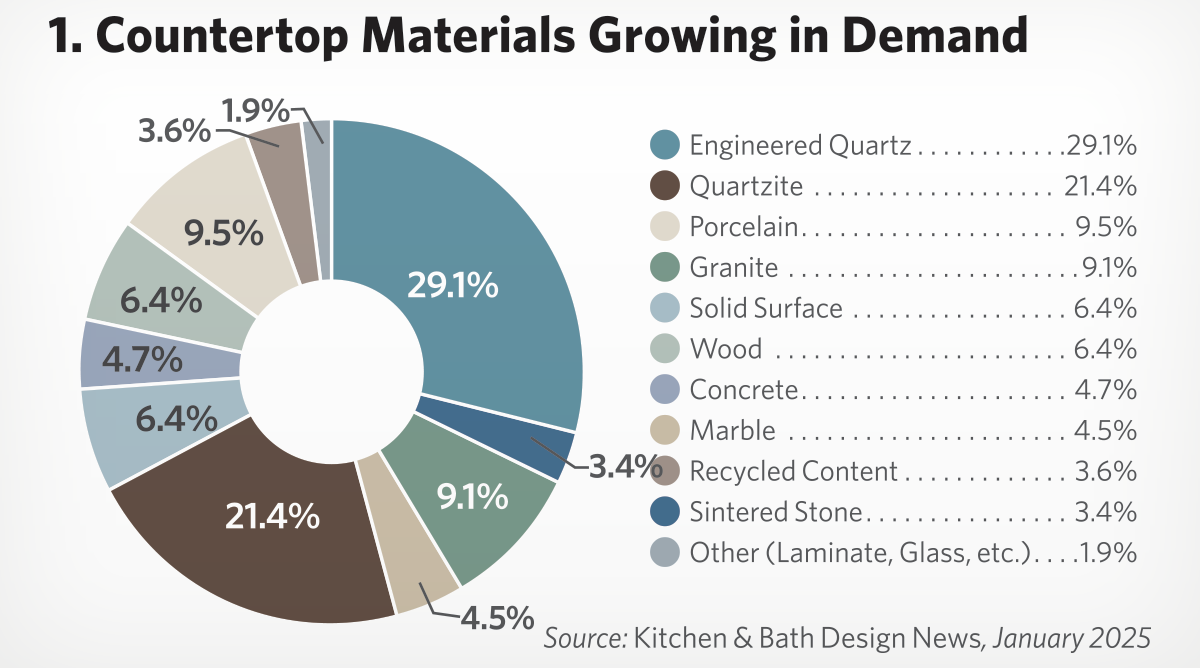
Engineered stone and quartzite top a lengthy list of countertop materials that are currently growing in demand, while an ever-widening palette of colors, patterns, finishes and other options are offering kitchen consumers exciting new ways to address their functional requirements, budget and sense of style.
That is among the most significant findings of a nationwide survey conducted by Kitchen & Bath Design News among more than 200 kitchen design and remodeling professionals, who report that one or more countertops continue to serve as a key focal point of today’s kitchens, serving not only in their traditional roles of food prep, dining, cleanup and entertaining, but increasingly as spaces for myriad household activities (see related story, Page 33 of the KBDN March 2025 issue).
KBDN’s annual countertop survey, conducted online early in 2025, also reinforced previous findings that countertop space is increasing as both an aesthetic and functional component in today’s kitchens.
On the flip side, inflationary pressures are impacting the countertop-purchase decisions of price-conscious consumers, particularly in the low- to mid-end sectors of the housing and remodeling markets, KBDN’s survey found.
Key Findings
According to those surveyed, engineered quartz is, far and away, the countertop surfacing material that is growing most in demand among kitchen consumers, followed by quartzite, granite and an array of other options, including marble and wood. Also popular among today’s countertop clients, design professionals report, are porcelain and a variety of solid surface materials (see Figure 1).
“Countertops tend to be the ‘jewels’ of the kitchen,” one design pro told KBDN. “I’m seeing clients wanting tops that exhibit interesting, yet subtle, patterns for perimeter areas, and often dramatic, colorful and more exotic-looking island countertops. Backsplashes to the ceiling enhance the height of a kitchen space. Choices tend to be tile – subway, stacked, patterned – or sometimes metallic tiles, depending on the overall aesthetic.”
“Quartz countertops took a turn for the better about five years ago, when manufacturers were able to better mimic the patterns of natural stone such as marble,” a veteran design pro observed. “Until then, quartz counters looked totally man-made, with very generic and predictable patterns. Now, we can get honed surfaces with patterns that really look like natural stone.”
“I’ve always gravitated toward using marble or natural stone,” another designer observed. “Now that the initial quartz craze has subsided and concerns about silica exposure are growing, natural stone countertops are back in demand. Clients are becoming less fixated on durability and more appreciative of patina and the concept of a ‘living kitchen.’”
“Quartzite has also become more popular, although it can be quite a bit more expensive than quartz,” according to another kitchen remodeler. “If a client loves the look of quartzite, but is still looking at the budget, I might suggest just using quartzite on the island only.”
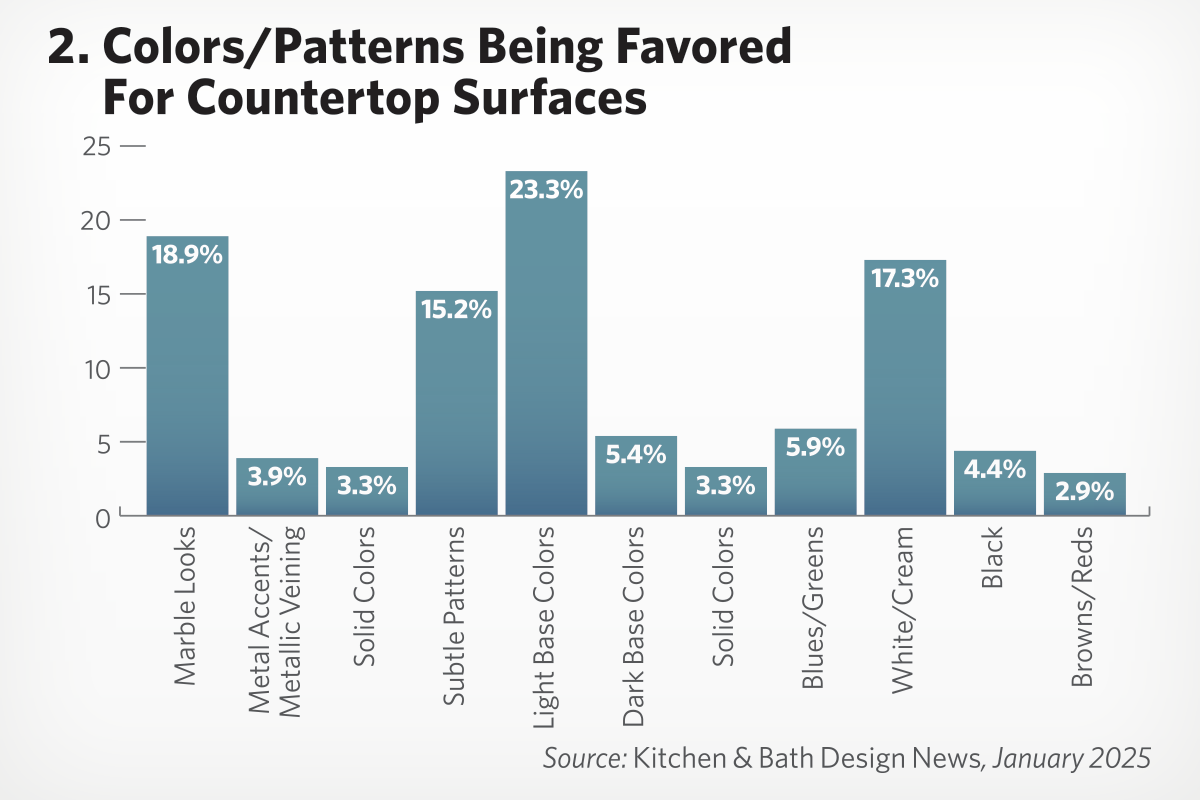
An even wider range of colors and patterns – led by light base colors, marble looks and subtle patterns – are currently popular among kitchen clients, survey respondents told KBDN (see Figure 2).
“My clients usually follow my lead when it comes to their countertop selections, and that selection is based on the look and design of the space,” another designer said. “Often I work with suppliers that offer a wide range of colors, finishes, sizes and designs that allow clients to have the best of both worlds.”
“The ability to have a natural-stone look while flexing a maintenance-free product with a limited lifetime warranty…that’s what clients are gravitating to,” stated another designer.
“The tried-and-true brand names from the past are being challenged by new competitors both in price and selection,” yet another design pro said. “It has become tougher to discern the differences between products and quality, so selecting countertops has become much more difficult.”
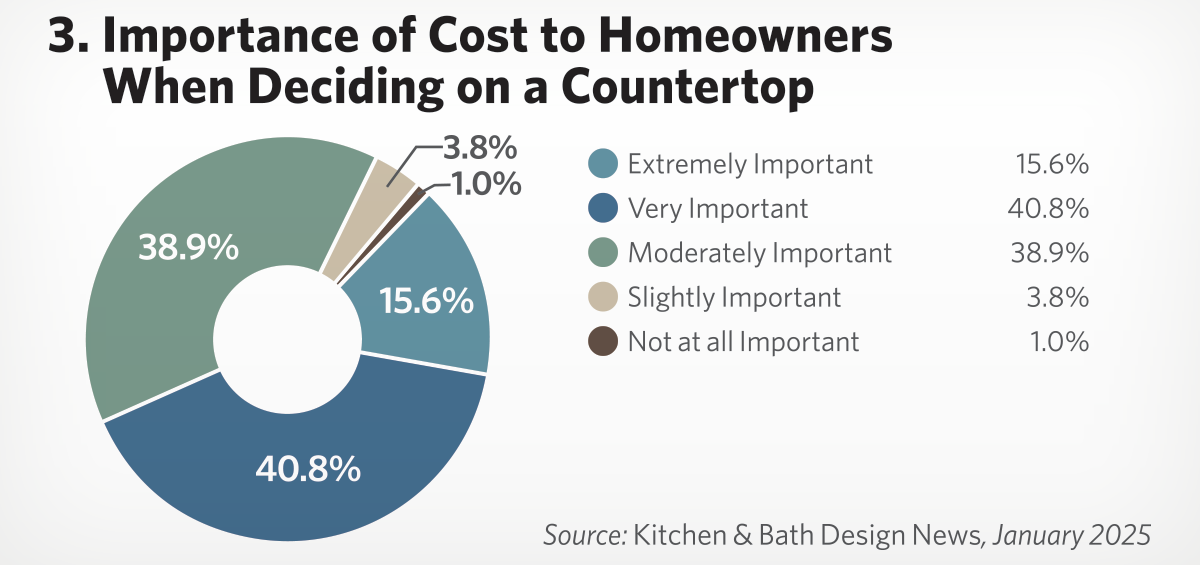
In a similar fashion, in a market in which inflationary pressures and elevated product/labor costs have led to cautious spending, an overwhelming number of homeowners are finding countertop costs either “extremely,” “very” or “moderately” important in their purchase decisions compared to prior years, dealers and designers reported. In contrast, cost is not a factor in only a relative handful of countertop selections, survey respondents noted (see Figure 3).
“All our costs have increased substantially,” one designer told KBDN. “This results in two types of buyers. One is looking solely based on price, and can’t afford what they really want. The other is stuck in their home, unable to sell at high mortgage rates, and they want the best option that’s available without a serious concern about price.”
Among the survey’s additional findings:
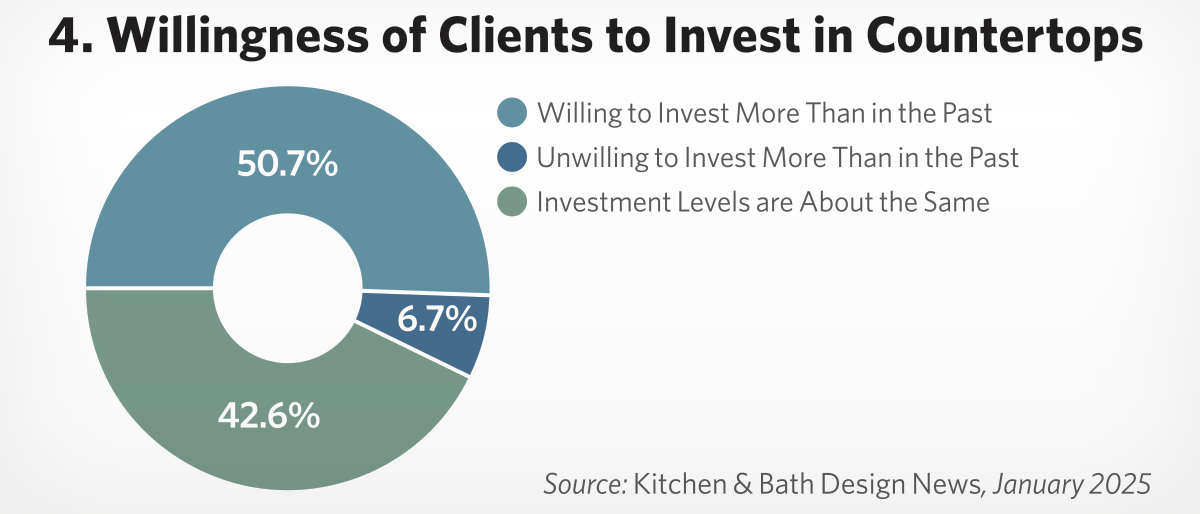
- Despite the prevailing cost-sensitivity, however, some 50.7% of the design professionals polled told KBDN that their kitchen clients are more willing now than in the past to invest in countertops. While 42.6% of those design pros reported that investment levels are about the same as in the past, only 6.7% said that client investment levels have declined (see Figure 4).
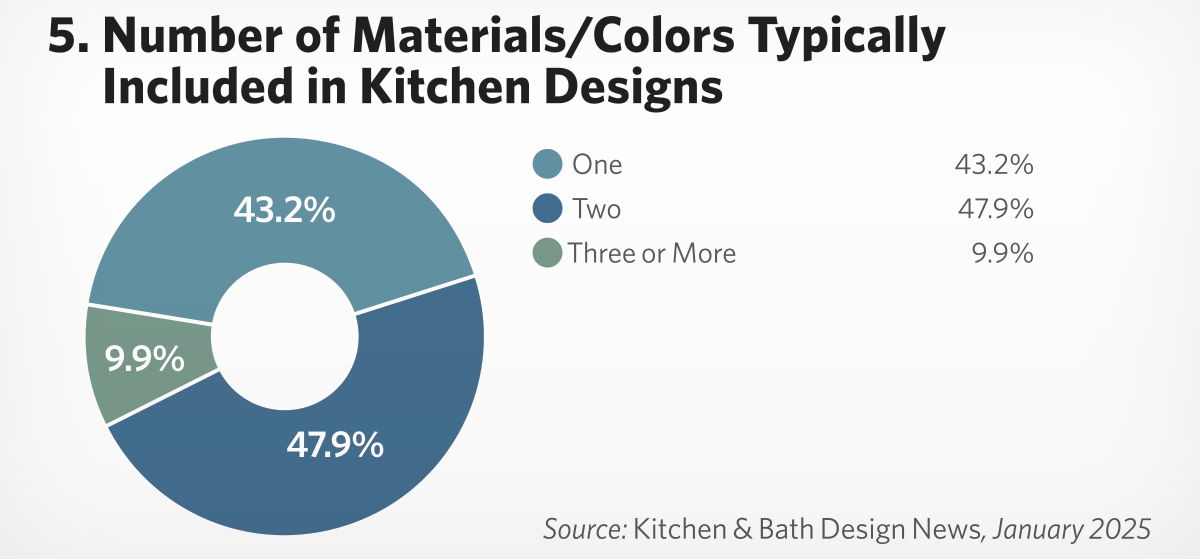
- More than one type of material, as well as multiple colors, are typically included in roughly 58% of the countertops they include in their kitchens, design professionals report (see Figure 5).
“Countertop colors are moving more into warm, earthly tones,” one designer told KBDN. “However, we’re also incorporating bold accent areas to really showcase a particular space.”
“We often do accent colors: one main solid color for the bulk of the countertop, and a busier ‘showstopper’ piece for the island,” another survey respondent noted.
Wide Range of Perspectives Reflect Myriad Options
CHICAGO — Design professionals have widely differing perspectives about the materials, colors, price points and other features they tend to specify for the countertops in the kitchens they design and sell – a reflection of the plethora of choices available, as well as costs and the preferences of clients.
“Most of my clients are going with quartz, especially because solid surface is so pricy it often comes out close to the cost of quartz, and quartz is seen as superior,” a surveyed design pro told Kitchen & Bath Design News.
“Laminate is mostly used for budget-friendly projects,” the designer added. “We steer people away from butcher block and toward veneer wood tops, or suggest they (shop) elsewhere for them, because butcher block has too many issues with humidity and wetness over time.”
“We’re still seeing marble-look quartz being popular,” another designer commented. “Sometimes quartzite is a great option to create the look of a natural stone that’s not granite, doesn’t require the maintenance of marble, but has a luxury look and crystal effect. I know that porcelain continues to be up-and-coming, but I’m still afraid to spec it.”
Among the other countertop-related observations offered by surveyed design pros were the following:
“Granite is on its way back in. My fabricator applies a 15-year sealer that mitigates some of the maintenance. Granite is still less expensive than quartz. Clients are more educated now. They know quartz can melt or scar. Many are incorporating butcher block as an alternative or additional material. Quartzite is ‘da bomb!’”
“A few of my clients are asking for countertops that look a little more ‘vintage’ and organic, less like the consistency of quartz although still a popular choice. We’ve been looking at quartzite slabs, honed soapstone and even honed marble as possible options.”
“Quartz seems to be the favored material, since simple-to-no maintenance is preferred by most clients, especially those seeking white or lighter colors. Quartzite is making a bit of a comeback, but mainly as a showpiece such as the island or serving bar.”
“I’m seeing a split between clients who want engineered quartz for the durability and ease of cleaning and clients who are willing to spend more time cleaning to get the beauty and uniqueness of real stone. Quartzite is definitely on the rise.”
“Natural teak and dark walnut seem to be a favorite with the dark robin egg blue, forest green and black cabinets. It’s half the price of granite, and warmer to the touch.”
“I like manmade patterns better than the natural patterns, in general. They’re more consistent and don’t often have ‘big blotches.’”
“Our clients tend to go more for natural stone with depth and character that’s enhanced with non-white cabinet colors and wood tones.”
“The pendulum has definitely swung back to warm, dark and subtle. Our clients (prefer) warm, dark, rich tops that often have a texture or are honed, providing for a cozy feel and avoiding glare.”
“Most of our clients are looking for a light and bright kitchen. They do not want dark tops or busy patterns. We sell mostly that look. Engineered stone is the lead seller.”